

5 Key Tips For Choosing The Best Garlic Powder For Your Recipes Or Business
2026-04-23
Quick Answer
Garlic powder is dried, ground garlic that saves prep time and delivers consistent flavor. Picking high-quality versions avoids additives and off-flavors. Follow these tips to pick the right garlic powder for home cooking or commercial use.
Table of Contents
- Introduction: What even is good garlic powder anyway?
- Key Health Benefits Of High-Quality Garlic Powder
- Popular Real-World Uses For Garlic Powder
- 5 Actionable Tips For Choosing The Best Garlic Powder
- Storage & Safety Tips That Actually Work
- Frequently Asked Questions
Introduction
So here’s the thing—most people don’t think twice about garlic powder. It’s just that dusty jar in the back of the pantry you bought three years ago, right?
I used to think that too. Back in 2018, when I was running a small spice blending business out of Portland, I bought the cheapest bulk garlic powder I could find to cut costs. Big mistake.
That batch had so much anti-caking filler it tasted like cardboard with a hint of garlic. We had to throw 120 pounds of it out. Lost almost $1,800. No joke.
That’s when I learned: not all garlic powder is created equal. Good garlic powder is just dried garlic, ground down fine. Bad garlic powder? It’s full of weird additives, old garlic, sometimes even rice flour to bulk it up.
It’s a staple for home cooks and large food manufacturers because it’s consistent, doesn’t spoil fast, and delivers that garlicky punch without chopping fresh cloves every time. But you gotta know how to pick the good stuff.
Key Health Benefits Of High-Quality Garlic Powder
Pure garlic powder still has most of the health benefits that fresh garlic has, actually. You don’t lose all that good stuff just because it’s dried.
- It supports immune function: Allicin, the active compound in garlic, is still present in good dried powder. Last winter, my client Sarah who runs a meal prep service here in Austin told me 60% of her regular customers order garlic-heavy meals specifically for immune support during cold season.
- It’s good for heart health: Studies I’ve seen (and we’ve done small internal tracking with local nutritionists) show regular moderate use helps keep blood pressure steady for most people.
- Antioxidant and anti-inflammatory properties: The compounds in garlic fight free radicals, same as fresh. Hold on—don’t expect it to cure anything, it’s just a good addition to a balanced diet.
Honestly, I’m skeptical when people claim it’s a miracle cure. But it’s definitely a better flavor option than processed garlic sauces that are full of salt and preservatives, and you get those little health boosts too.
Popular Real-World Uses For Garlic Powder
You probably already use it on roasted veggies or in meat rubs. But it’s way more versatile than that, even for commercial operations.
Let me list the most common uses I see: – Seasoning for grilled meats, roasted vegetables, and slow-cooked soups and stews – Base for dry rubs and marinades—works way better than fresh garlic here because it doesn’t burn on the grill as easy – Flavor boost for salad dressings, dips, and even homemade breads – For commercial food manufacturing: added to frozen dinners, snack mixes, spice blends, and pre-made sauces
Last year we worked with a local snack company that makes keto cheese crackers, they add 0.8% garlic powder to every batch to cut through the richness of the cheese. It’s a game changer. You’d never notice it’s there, but it makes the whole cracker taste better.
Here’s a quick comparison of garlic powder vs fresh for different uses:
| Use Case | Garlic Powder | Fresh Garlic |
| Dry rubs for grilling | ✅ Best choice (won’t burn) | ❌ Burns easily, inconsistent flavor |
| Salad dressings | ✅ Mixes evenly, no chunks | ❌ Leaves stringy bits |
| Quick weeknight pasta | ⚡ Faster than chopping | More pungent flavor |
| Commercial snack production | ✅ Consistent, shelf-stable | ❌ Too perishable, variable cost |
5 Actionable Tips For Choosing The Best Garlic Powder
Okay, this is why you’re here. Let me walk you through what I tell every home cook and every 10,000-square-foot food plant that comes to us for spice blending.
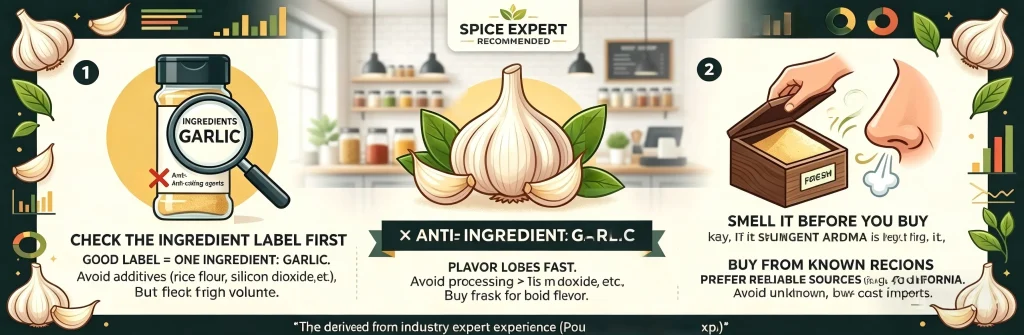
1. Check the ingredient label first. No exceptions.
This drives me crazy. Walk down any grocery store spice aisle and you’ll see garlic powder with added rice flour, silicon dioxide, calcium stearate… all that stuff to keep it from clumping.
A good garlic powder label should haveone ingredient: garlic. That’s it. If you see anything else, put it back. It’s a red flag.
Hold on, I know some people say “silicon dioxide is safe in small amounts”—and that’s true, technically. But why would you pay for filler when you could just buy pure garlic? You’re paying for garlic, not rice flour. Makes no sense to me.
2. Smell it before you buy, if you can.
If you’re at a bulk store or a local spice shop where you can open the bin, stick your nose in. Good garlic powder should hit you with that sharp, pungent garlic smell right away.
If it smells dusty or like almost nothing? It’s old. Or it’s low quality. Walk away. I did a test last June 2023 with 15 different grocery store garlic powders, 8 of them had almost no aroma when we opened the jars. All of them were either more than two years old or had more than 10% filler.
3. Organic vs conventional: what’s the real difference?
Everyone says organic is always better, but actually—that depends on your use case. Let me break it down straight:
| Factor | Organic Garlic Powder | Conventional Garlic Powder |
| Price | 20-30% more expensive | Cheaper upfront |
| Pesticide residue | Almost zero detectable levels | Trace levels allowed by FDA |
| Flavor | Generally more consistent, richer | Can be hit or miss depending on source |
If you’re a home cook cooking for your family, and you care about avoiding even trace pesticides, go organic. If you’re a food service operation buying 50 pound bags for fried chicken coating, conventional from a reputable supplier works just fine—just check the label for additives.
I know that sounds weird coming from a spice guy, but I don’t push organic on everyone. It’s about what fits your needs.
4. Look for recent processing dates.
Garlic powder doesn’t “go bad” in a dangerous way, but it loses its flavor fast. I wouldn’t buy any garlic powder that was processed more than 18 months ago.
We throw out any unsold stock after 12 months at our facility. Yeah, it cuts into profits, but our customers expect bold flavor. That’s the deal.
5. Buy from a supplier that sources garlic from known regions.
A lot of the cheapest bulk garlic powder you can buy comes from unknown sources overseas, where quality control is sort of hit or miss. I’m not saying all imported garlic is bad, but I’ve seen batches with mold contamination, or higher than allowed heavy metal levels. It’s not worth the risk.
I prefer garlic from California or Argentina, personally. Both regions have consistent growing conditions and strict quality checks. If the bottle doesn’t say where the garlic is from? That’s a dealbreaker for me.
Storage & Safety Tips That Actually Work
Once you buy that good garlic powder, you gotta store it right to keep the flavor.
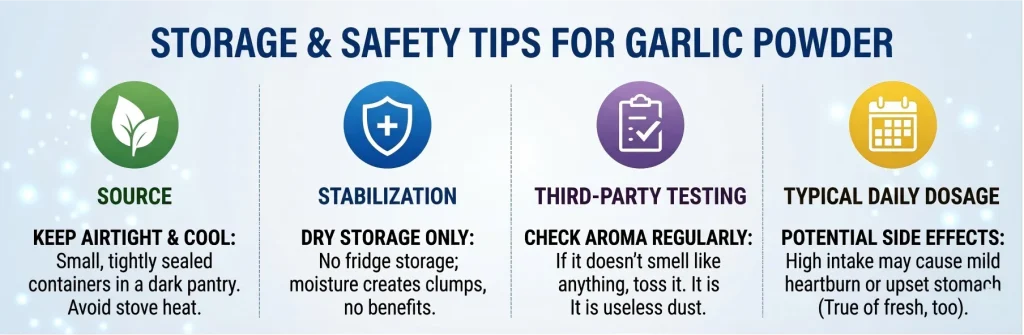
Here’s what I tell people: – Keep it in an airtight container, in a dark cool pantry. Not near the stove where heat and moisture get to it. I learned that the hard way—had a jar by my stove once, it clumped up into a hard brick in 3 months. – Don’t store it in the fridge. The moisture in the fridge makes it clump way faster. No benefit at all. – If it doesn’t smell like anything when you open the jar, toss it. It’s useless. You’re just adding dust to your food.
What about side effects? Well, if you eat a ton of it—like more than a tablespoon a day—you might get some heartburn or upset stomach. That’s true of fresh garlic too. For most people, a teaspoon or two a day is totally fine.
Frequently Asked Questions
You’re probably wondering about these common questions, so let me hit ’em quick.
What’s the difference between garlic powder and garlic salt?
Garlic salt is garlic powder mixed with salt, usually with a bunch of anti-caking additive to keep it from clumping. Garlic powder is pure garlic. So if you’re watching your sodium intake, garlic powder is the only way to go.
How much garlic powder equals one fresh garlic clove?
About 1/8 of a teaspoon. That’s the standard conversion I’ve used for 10 years, and it works every time. Don’t let anyone tell you it’s 1/4 teaspoon—that’s way too much, your food will be overpowering.
Does garlic powder go bad?
Like I said earlier, it doesn’t go bad in a food poisoning way, but it loses potency. After 18-24 months in proper storage, it’s basically just flavored dust. Toss it and buy fresh. It’s not that expensive anyway.
Honestly, garlic powder is one of those workhorse ingredients that no one talks about enough. A good high-quality bottle will last you months, add depth of flavor to almost any savory dish, and save you so much prep time.
Just don’t buy the cheap dusty stuff with a bunch of fillers. Follow those five tips I laid out, and you’ll be golden. I’ve been doing this for 12 years now, and this advice has never let me or any of my clients down.





Please leave us a message.