

Nano Hydroxyapatite vs Micro Hydroxyapatite: Which Works Better?
2026-05-07
Nano vs Micro H
ydroxyapatite: Particle Size, Morphology and Formulation Guide
Hydroxyapatite is widely used in oral ca
re, cosmet
ics, biomaterials and functional material applications. As demand grows for enamel care toothpaste, fluoride-free oral care products and advanced calcium phosphate materials, one technical question is becoming more important for formulators and buyers: should you choose nano hydroxyapatite or micro hydroxyapatite?
The answer depends on particle size, morphology, dispersibility, formula type, claim direction and cost target. Nano hydroxyapatite and micro hydroxyapatite are both calcium phosphate materials, but their behavior in formulations can be very different.
For oral care brands, especially toothpaste and mouthwash manufacturers, particle size is not just a technical specification. It directly affects product positioning, texture, dispersion, enamel surface interaction and marketing claims.
What Is Hydroxyapatite?
Hydroxyapatite, often abbreviated as HAp or HA, is a calcium phosphate mineral with a structure similar to the mineral phase found in teeth and bones. Because of this similarity, hydroxyapatite is widely studied and used in dental care, enamel remineralization, bone repair materials and biomimetic formulations.
In oral care, hydroxyapatite particles can interact with tooth surfaces, support enamel remineralization and help reduce sensitivity. Reviews of hydroxyapatite in oral care describe nano hydroxyapatite as a material that can bind to enamel surfaces and support remineralization due to its small particle size and high surface area.
What Is Nano Hydroxyapatite?
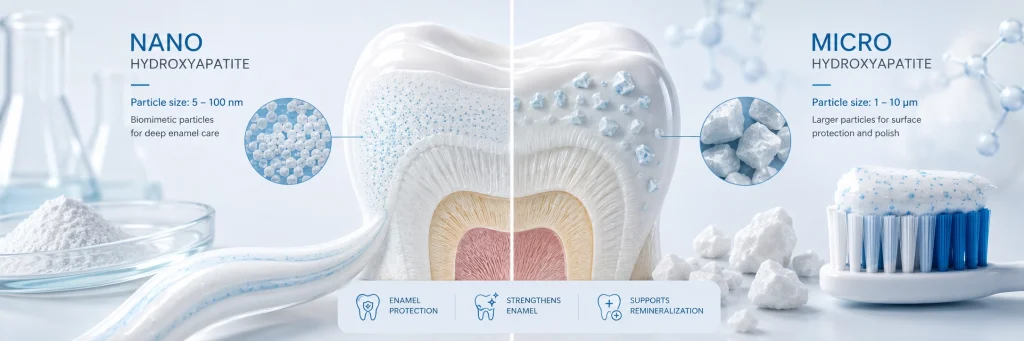
Nano hydroxyapatite refers to hydroxyapatite particles in the nanometer size range. In oral care literature, nano hydroxyapatite is often described as having particle sizes around 20–100 nm, with rod-like or needle-like morphology similar to natural enamel crystals.
Because of its small size and high surface area, nano hydr
oxyapatite is often selected for premium oral care products, especially:
- Enamel repair toothpaste
- Sensitive teeth toothpaste
- Fluoride-free toothpaste
- Children’s toothpaste
- Mouthwash suspension
- Tooth powder
- Dental gel
- High-end functional oral care products
Nano hydroxyapatite is especially suitable when the product needs to emphasize enamel surface repair, remineralization support, dentin tubule occlusion or a biomimetic oral care concept.
What Is Micro Hydroxyapatite?
Micro hydroxyapatite refers to hydroxyapatite particles with a larger particle size, usually in the micrometer range. Compared with nano hydroxyapatite, micro hydroxyapatite has a smaller specific surface area and usually behaves differently in dispersion, texture and surface interaction.
Micro hydroxyapatite is more suitable for:
- General oral care toothpaste
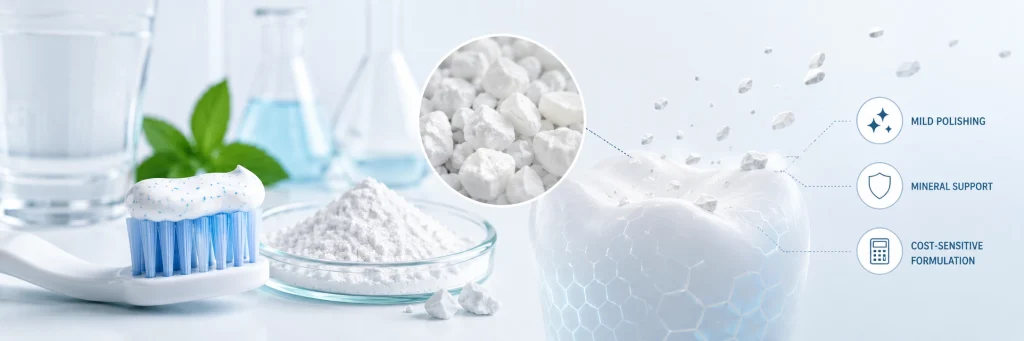
- Mild polishing formulas
- Cost-sensitive formulations
- Calcium phosphate supplement concepts
- Cosmetic powder applications
- Biomaterial and ceramic-related applications
Micro hydroxyapatite may not interact with enamel micro-defects as closely as nano hydroxyapatite, but it can still be useful in formulas where mild mineral support, texture control or cost balance is more important.
Nano vs Micro Hydroxyapatite: Key Differences
| Comparison Item | Nano Hydroxyapatite | Micro Hydroxyapatite |
| Particle size | Nanometer scale | Micrometer scale |
| Surface area | Higher | Lower |
| Enamel surface interaction | Stronger potential | More limited |
| Dispersion difficulty | Higher | Easier in some systems |
| Texture | May feel smoother if well dispersed | May feel more powdery or gritty if not optimized |
| Cost | Usually higher | Usually lower |
| Best for | Premium oral care, enamel repair, sensitivity formulas | General oral care, cost-sensitive formulas, mild polishing |
| Marketing value | Stronger for biomimetic and enamel care claims | More suitable for basic mineral support claims |
For oral care brands, nano hydroxyapatite is usually a better choice when the product positioning focuses on enamel repair, sensitivity relief, fluoride-free toothpaste or premium biomimetic oral care.
Micro hydroxyapatite can be considered when the product focuses on basic mineral support, texture adjustment, cost control or mild polishing.
20nm vs 60nm Hydroxyapatite: Which Particle Size Is Better?
Many buyers ask whether 20nm hydroxyapatite is better than 60nm hydroxyapatite. The answer is not simply yes or no.
Both 20nm and 60nm hydroxyapatite belong to the nano hydroxyapatite category, but they may behave differently in actual formulations.
20nm Hydroxyapatite
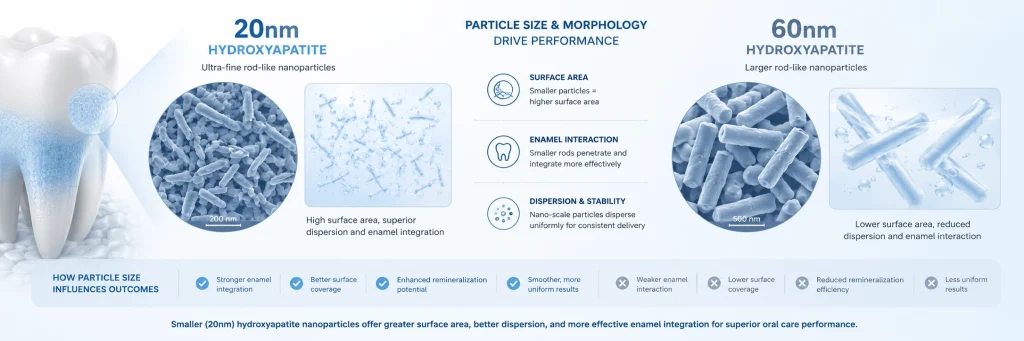
20nm hydroxyapatite has a smaller particle size and higher surface area. It may be more suitable for formulas that focus on close enamel surface interaction and high-end enamel repair positioning.
Potential advantages:
- Higher specific surface area
- Better potential to interact with small enamel surface defects
- Stronger premium positioning
- Suitable for advanced toothpaste and dental gel formulas
Potential challenges:
- More difficult to disperse evenly
- Higher risk of aggregation
- May require better suspension or dispersion system
- Usually higher cost
60nm Hydroxyapatite
60nm hydroxyapatite is still within the nano range but may offer better formulation balance in some systems.
Potential advantages:
- Easier to disperse than very small nanoparticles
- Better balance between performance and stability
- Suitable for toothpaste, mouthwash and daily oral care formulas
- May reduce aggregation risk compared with smaller particles
Potential limitations:
- Lower surface area than 20nm hydroxyapatite
- May be less suitable for formulas that emphasize ultra-fine enamel defect filling
A review on hydroxyapatite oral care notes that hydroxyapatite in the 20–50 nm size range may match nano-sized defects caused by acidic erosion on enamel surfaces. This supports why many premium oral care brands prefer fine nano hydroxyapatite. However, in real product development, particle size should always be evaluated together with dispersion quality, pH, abrasive system and formula stability.
Why Particle Morphology Matters
Particle size is important, but it is not the only factor. Particle morphology also affects how hydroxyapatite behaves in a formula.
Common hydroxyapatite morphologies include:
- Rod-like particles
- Needle-like particles
- Spherical particles
- Irregular particles
- Plate-like particles
- Aggregated clusters
Rod-like or needle-like nano hydroxyapatite is often discussed in oral care because natural enamel crystals also have a nanoscale crystalline structure. This gives nano hydroxyapatite a strong biomimetic story for toothpaste and enamel care products.
However, morphology must be controlled carefully. Very fine or irregular particles may aggregate if the dispersion system is not optimized. Aggregation can reduce the effective surface area and affect formula texture.
For formulators, the best hydroxyapatite raw material should not only have a target particle size. It should also show:
- Consistent morphology
- Narrow particle size distribution
- Good dispersibility
- Low aggregation tendency
- Stable batch-to-batch quality
- Suitable purity and safety documentation
Nano Hydroxyapatite in Toothpaste Formulation
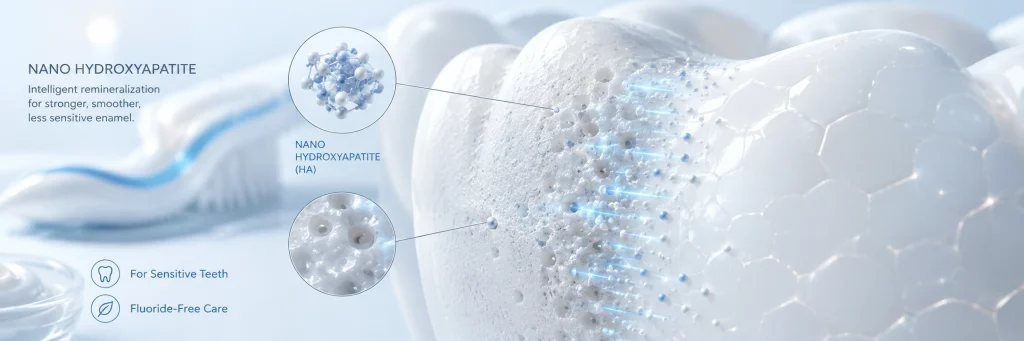
Nano hydroxyapatite is widely used in toothpaste because it supports several product directions at the same time:
- Enamel remineralization
- Sensitive teeth care
- Fluoride-free oral care
- Children’s gentle toothpaste
- Premium daily toothpaste
- Biomimetic enamel protection
A narrative review on hydroxyapatite toothpaste found that hydroxyapatite-containing toothpaste has been studied for enamel remineralization in vitro, in situ and in vivo. Clinical evidence and reviews have also discussed hydroxyapatite-containing oral care products for dentin hypersensitivity management.
For toothpaste formulation, nano hydroxyapatite should be evaluated together with:
- Abrasive system
- Thickener system
- Humectants
- pH value
- Surfactants
- Flavor system
- Preservative system
- Dispersion method
- Final product stability
A good nano hydroxyapatite toothpaste should not feel gritty. The formula should be smooth, stable and easy to rinse, while keeping hydroxyapatite evenly distributed.
Nano Hydroxyapatite in Mouthwash and Liquid Oral Care
Nano hydroxyapatite can also be used in mouthwash or liquid oral care products. However, this is more technically challenging than toothpaste because hydroxyapatite particles are insoluble mineral particles.
The main formulation challenges include:
- Sedimentation
- Particle aggregation
- Poor suspension stability
- Uneven distribution
- pH compatibility
- Visual instability
- Mouthfeel issues
For liquid oral care, a hydroxyapatite aqueous suspension may be more convenient than dry powder. It can help formulators reduce dusting, improve processing and support more stable dispersion.
For mouthwash products, safety and regulatory compliance should also be considered. The SCCS Scientific Opinion published in 2025 considered hydroxyapatite nano safe up to 29.5% in toothpaste and up to 10% in mouthwash, under the specified conditions and data reviewed.
When Should You Choose Nano Hydroxyapatite?
Nano hydroxyapatite is recommended when your product focuses on:
- Enamel repair claims
- Sensitivity care
- Fluoride-free toothpaste
- Premium oral care
- Children’s oral care
- Biomimetic ingredient positioning
- Smooth enamel surface support
- Advanced mouthwash suspension
For B2B buyers, nano hydroxyapatite is especially suitable when the brand needs a strong functional story and clear differentiation from ordinary toothpaste ingredients.
When Should You Choose Micro Hydroxyapatite?
Micro hydroxyapatite may be suitable when your product focuses on:
- Basic mineral toothpaste
- Mild polishing
- Cost control
- General oral care
- Powder-based products
- Non-premium positioning
- Cosmetic or material applications outside oral care
Micro hydroxyapatite is not necessarily “worse.” It simply serves a different formulation purpose. For some formulas, especially cost-sensitive products, micro hydroxyapatite may be more practical.
How to Choose the Right Hydroxyapatite Particle Size
When choosing between nano and micro hydroxyapatite, brands should not only ask for the smallest particle size. Instead, they should evaluate the full technical profile.
Important selection factors include:
1. Application
Toothpaste, mouthwash, dental gel, cosmetic powder and biomaterial products may require different particle size ranges.
2. Claim Direction
For enamel repair and sensitivity care, nano hydroxyapatite is usually more suitable. For general mineral support, micro hydroxyapatite may be enough.
3. Dispersion Performance
A smaller particle size is not useful if the particles aggregate heavily in the final formula.
4. Formula Stability
The ingredient must remain stable in the full formulation, including pH, viscosity, surfactants and storage conditions.
5. Sensory Experience
A toothpaste should feel smooth, not gritty. Particle size and dispersion strongly affect user experience.
6. Regulatory Requirements
Different markets may have different requirements for nano materials, oral care claims and safety documentation.
7. Supplier Documentation
A reliable hydroxyapatite supplier should provide COA, specification sheet, particle size data, purity data and application support.
Quality Indicators for Hydroxyapatite Raw Material
For oral care and cosmetic brands, hydroxyapatite quality should be evaluated from multiple angles.
Key quality indicators include:
- Particle size range
- Particle size distribution
- Morphology
- Purity
- Ca/P ratio
- Heavy metal limits
- Microbiological control
- Solubility or dispersion behavior
- Batch consistency
- Documentation support
The Ca/P ratio is especially important for hydroxyapatite identity and material quality. For B2B buyers, it can be used together with particle size and purity data to evaluate whether the raw material is suitable for high-quality formulations.
Formulation Tips for Nano Hydroxyapatite
Use Proper Dispersion Process
Nano hydroxyapatite should be added with proper mixing and dispersion to reduce aggregation.
Avoid Overly Harsh Abrasive Systems
If the product is positioned for enamel care, the abrasive system should be mild and compatible with hydroxyapatite.
Control pH
A stable, near-neutral pH is usually preferred for daily oral care products.
Test Long-Term Stability
Toothpaste and mouthwash should be tested under different temperature and storage conditions.
Match Particle Size with Product Positioning
20nm hydroxyapatite may be more suitable for premium enamel repair claims, while 60nm hydroxyapatite may offer a better balance between performance, cost and stability.
Avoid Overclaiming
For international markets, avoid exaggerated medical claims. More suitable claim directions include:
- Supports enamel remineralization
- Helps reduce tooth sensitivity
- Helps smooth the enamel surface
- Provides fluoride-free enamel care
- Inspired by the mineral structure of teeth
Recommended Product Selection Guide
| Product Type | Recommended Hydroxyapatite Type |
| Premium enamel repair toothpaste | 20–60nm nano hydroxyapatite |
| Sensitive teeth toothpaste | Nano hydroxyapatite |
| Children’s fluoride-free toothpaste | Nano hydroxyapatite with mild formula |
| Daily mineral toothpaste | Micro or nano hydroxyapatite |
| Mouthwash | Nano hydroxyapatite suspension |
| Tooth powder | Micro or nano hydroxyapatite |
| Cosmetic powder | Micro hydroxyapatite |
| Biomaterial application | Depends on purity, morphology and target use |
FAQ
Is nano hydroxyapatite better than micro hydroxyapatite?
Nano hydroxyapatite is usually better for enamel repair, sensitivity care and premium oral care products because of its smaller particle size and higher surface area. Micro hydroxyapatite may be more suitable for general oral care, mild polishing or cost-sensitive formulas.
Is 20nm hydroxyapatite better than 60nm hydroxyapatite?
20nm hydroxyapatite has a higher surface area and may be more suitable for premium enamel repair positioning. However, 60nm hydroxyapatite may offer better dispersion balance and stability in some formulas. The best choice depends on the final product type.
What particle size is suitable for toothpaste?
Nano hydroxyapatite in the 20–100nm range is commonly discussed in oral care applications. For toothpaste focused on enamel repair or sensitivity care, 20–60nm nano hydroxyapatite is often a strong option.
Does hydroxyapatite dissolve in toothpaste?
Hydroxyapatite is not used like a fully dissolved active ingredient. It works as a mineral particle that disperses in the formula and interacts with the tooth surface.
What morphology is best for hydroxyapatite?
Rod-like or needle-like nano hydroxyapatite is often preferred for biomimetic oral care concepts because it is closer to the mineral structure found in enamel. However, consistency, purity and dispersibility are just as important as morphology.
Conclusion
Nano and micro hydroxyapatite are not interchangeable in every formula. Nano hydroxyapatite is more suitable for premium oral care, enamel repair, sensitivity care and fluoride-free toothpaste. Micro hydroxyapatite is more suitable for general mineral support, cost-sensitive products and some powder-based applications.
For brands developing hydroxyapatite toothpaste or mouthwash, particle size, morphology and dispersion performance should be evaluated together. A smaller particle size may support better enamel surface interaction, but only when the material is well dispersed, stable and supported by reliable quality documentation.
For B2B buyers, the best choice is not simply “nano or micro.” The better question is:
Which hydroxyapatite particle size best matches your formula, claim direction, cost target and market positioning?
If you are developing toothpaste, mouthwash or other oral care products, choosing a reliable hydroxyapatite powder or hydroxyapatite suspension supplier can help improve formulation efficiency and product consistency.






Please leave us a message.