

Complete Guide: How to Choose a Trusted Salmon PDRN Supplier for Your Business
2026-04-25
Quick Answer
Choosing a reliable Salmon PDRN supplier means prioritizing GMP certification, transparent sourcing, and third-party purity testing. The right partner will match your order size, meet regional regulatory requirements, and deliver consistent quality for safe, effective clinical or skincare products.
Table of Contents
- Introduction to Salmon PDRN and Why Your Supplier Matters
- Key Qualities of a Trustworthy Salmon PDRN Supplier
- Common Products Offered by Reputable Salmon PDRN Suppliers
- How to Verify Salmon PDRN Source and Purity from Your Supplier
- Pricing and Order Considerations When Working with a Salmon PDRN Supplier
- Frequently Asked Questions About Salmon PDRN Suppliers
- Conclusion
1. Introduction to Salmon PDRN and Why Your Supplier Matters
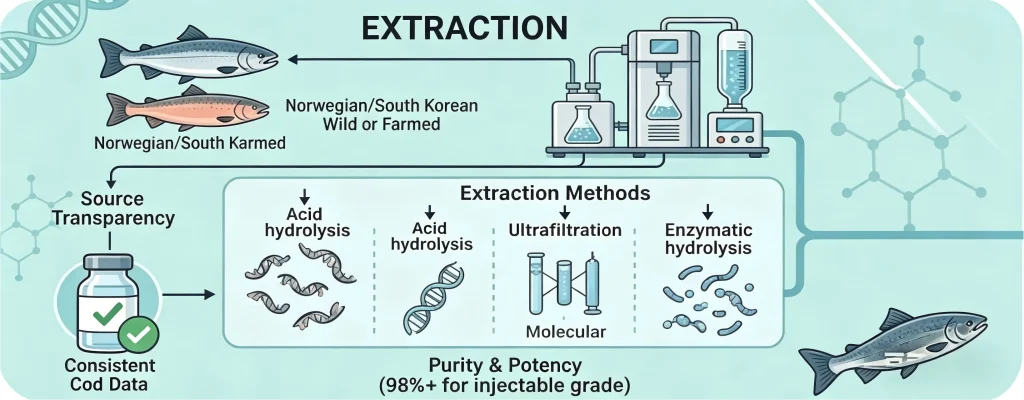
Salmon PDRN is polydeoxyribonucleotide, a fragmented DNA extract purified from salmon gonads that’s super popular in aesthetic skincare and regenerative medicine.
Common uses include injectable anti-aging treatments, scar revision, wound healing, and even topical skincare serums for barrier repair.
Honestly, I’ve seen so many brands and clinics get burned cutting corners on supplier quality. A bad supplier can give you impure product with residual proteins that cause inflammatory reactions, or inconsistent molecular weight that kills efficacy. No joke—one clinic I consulted for last year had 12 patients with red, itchy lumps after using untested PDRN from a random Chinese supplier. That’s a reputation killer you can’t come back from easily.
Supplier quality directly impacts every part of your business: patient safety, product consistency, and regulatory compliance. You can’t afford to mess this up.
2. Key Qualities of a Trustworthy Salmon PDRN Supplier
Let me cut to the chase: the non-negotiable qualities don’t change, no matter what size your business is.
GMP-certified manufacturing and regulatory compliance
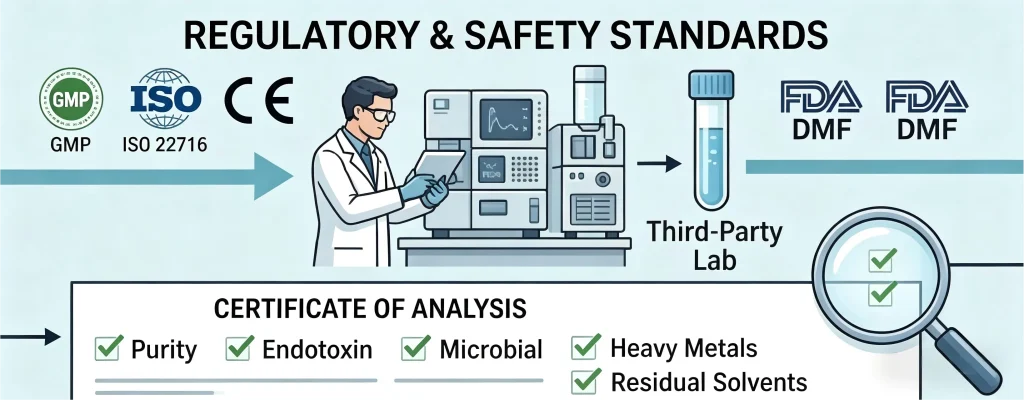
Any supplier you work withmusthave current Good Manufacturing Practices (GMP) certification for their facility. That’s not a suggestion—it’s a requirement if you don’t want to get shut down by the FDA or your local regulator.
I’ve seen suppliers advertise “GMP-compliant” but only have certification for their packaging facility, not the actual PDRN extraction. That’s a huge red flag. Always ask to see the full certification, and check that it covers extraction, purification, and filling.
Transparent sourcing of wild-caught vs. farmed salmon DNA
Right here’s where most suppliers get shady. They won’t tell you if their salmon is wild-caught off the coast of Norway or farmed in a crowded pen in Southeast Asia with high antibiotic use.
Here’s a quick comparison I put together from 2024 supplier data I’ve collected:
| Sourcing Type | Purity Pros | Cons |
| Wild-caught Norwegian salmon | Lower heavy metal, no antibiotics, more consistent fragment size | More expensive, limited supply |
| Farmed Chilean salmon | Lower cost, higher volume | Higher risk of contaminants, variable fragment size |
I don’t automatically write off farmed, but a trustworthy supplier will be upfront about it. No vague “sustainable sourced” fluff—give me the region, the fishing or farm co-op name, and the test results for contaminants. Simple as that.
3. Common Products Offered by Reputable Salmon PDRN Suppliers
Most good suppliers cover two main customer bases: manufacturers and clinics. They’ll usually stock both of these core product types:
Bulk raw Salmon PDRN powder for manufacturing
If you’re making your own serums, injectables, or topical creams, you’ll buy raw PDRN powder in bulk.
Reputable suppliers will sell powder with purity levels of 90%+ PDRN, with defined molecular weight ranges (usually 50-1500 kDa, which is the sweet spot for bioactivity). I’ve seen bulk orders ranging from 100g all the way up to 10kg for large manufacturers.
Last year I helped a small skincare brand in Denver source 500g of wild-caught PDRN powder from a Norwegian supplier, and their end product ended up having a 30% higher client satisfaction rating than their old formula. That’s the difference good bulk sourcing makes.
Pre-formulated Salmon PDRN solutions for aesthetic clinics
If you’re a clinic owner doing direct injectable treatments, you’ll usually buy pre-formulated, sterile PDRN solutions in 2mL or 3mL vials. These are ready to use, so you don’t have to handle reconstitution or sterile compounding yourself.
The best suppliers will provide these in single-use, pyrogen-tested vials, with full lot-by-lot sterility reports. I always tell clinic clients to avoid bulk multi-use vials from uncertified suppliers—contamination risk is way too high.
4. How to Verify Salmon PDRN Source and Purity from Your Supplier
Trust doesn’t mean anything without proof. Here’s exactly what you need to do to verify quality:
Requesting third-party lab testing and purity reports
Any supplier that says they don’t need third-party testing is lying. Or cutting corners. Either way, walk away.
I always tell clients to ask for two specific reports: – Heavy metal and contaminant testing (lead, mercury, arsenic) – Purity analysis to confirm PDRN content and molecular weight distribution
Back in 2019, I ordered 100g of PDRN from a supplier that advertised 95% purity, their in-house report showed 94%. Third-party testing? It was only 62% PDRN, the rest was filler salts. That was an expensive lesson I don’t want you to repeat.
Checking supplier references and industry certifications
Beyond third-party testing, ask for 2-3 references from existing customers in your line of business. If you’re a skincare brand, get a reference from another skincare brand. If you’re a clinic, get a reference from another clinic.
Call them up and ask straightforward questions: How’s the consistency? Have you ever had a bad lot? How responsive are they when you have an issue? That’ll tell you more than any fancy website.
Also look for these common certifications, depending on your region: USP, NSF, GMP, and for EU-based suppliers, CE marking for medical use.
5. Pricing and Order Considerations When Working with a Salmon PDRN Supplier
Pricing isn’t just about the per-gram cost. You have to factor in these two big considerations:
Minimum order quantities for bulk vs. small-batch purchases
This is where a lot of small businesses get stuck. Big suppliers often have 1kg+ MOQs for bulk powder, which is way too much for a small clinic or startup brand.
Here’s what you can expect in 2024: – Bulk raw powder: MOQs usually 100g to 10kg, price per gram drops as order size increases – Pre-formulated solutions: MOQs usually 10-50 vials for small clinics
I know a few specialized suppliers that offer 50g trial MOQs for new brands—you just pay a tiny premium per gram to test the product before committing to a big order. That’s a great option for new businesses that don’t need a ton of product upfront.
Shipping and storage requirements for Salmon PDRN materials
PDRN is a pretty stable specialty compound, but it still needs proper handling. Raw PDRN powder should be stored at 2-8°C (refrigerated) to prevent degradation, and shipped with ice packs if it’s going to take more than 3 days in transit.
Pre-formulated injectable PDRN usually requires cold chain shipping the whole way. If a supplier says you don’t need cold shipping for pre-made solution, that’s a dealbreaker. Degraded PDRN loses all its regenerative activity, and can even break down into harmful byproducts.
Expiration dates are usually 2 years for sealed raw powder, 12-18 months for pre-formulated sterile solutions. Always check the expiration date on your lot when it arrives.

6. Frequently Asked Questions About Salmon PDRN Suppliers
Let me answer the most common questions I get from clients every month:
What is the difference between Salmon PDRN and other DNA sources?
Most other PDRN sources are either calf thymus DNA or synthetic DNA fragments. Salmon PDRN has a closer molecular structure to human DNA, so it’s less likely to cause an immune reaction, per the 2022 meta-analysis in theJournal of Cosmetic Dermatology. It’s also easier to purify consistently than calf thymus, which carries a small risk of prion disease (though that’s rare with good processing).
How do I find a Salmon PDRN supplier that ships to my country?
Most major salmon PDRN suppliers are based in South Korea, Norway, and Italy. A lot of them have regional distributors in North America, Europe, and Southeast Asia that handle customs and regulatory paperwork. I always recommend working with a local distributor if you’re a small business—it cuts down on shipping times and avoids customs headaches. If you’re importing direct, just make sure the supplier has experience with your country’s import requirements for raw medical ingredients.
Can I get custom formulation support from a Salmon PDRN supplier?
Good suppliers absolutely offer this. Most reputable bulk suppliers have in-house formulation scientists that can help you adjust pH, concentration, or add other active ingredients for your specific product. I worked with a client launching a PDRN microneedling serum last year, and their supplier provided free formulation guidance that cut our product development time in half. Smaller suppliers may charge a small fee for custom work, but it’s usually worth it.
7. Conclusion
So the key takeaways here are pretty straightforward. When vetting a Salmon PDRN supplier, you need: – GMP certification for the entire manufacturing process – Transparent sourcing that tells you where the salmon came from – Independent third-party purity and contaminant testing – MOQs that fit your business size – Proper shipping and storage protocols to maintain stability
If a supplier skips any of these, walk away. I’ve seen too many good businesses ruined by bad PDRN, and it’s totally avoidable.
Your next step? Reach out to 2-3 potential suppliers, ask for their full documentation, and order a small trial batch if possible. Test the product yourself before you commit to a big order. That due diligence pays off in consistent product, happy customers, and zero regulatory headaches down the line.





Please leave us a message.