

Hydroxyapatite Stability in Water-Based Formulas: Sedimentation, pH and Dispersion Tips
2026-06-17

Introduction
Hydroxyapatite is becoming an important functional ingredient in oral care, toothpaste, mouthwash, dental gel, pet oral care and biomaterial-related formulations. As a calcium phosphate mineral, it is valued for its tooth-like mineral structure, enamel-support concept and strong compatibility with oral care product development.
However, when hydroxyapatite is used in water-based formulas, formulators often face one practical challenge: stability.
Unlike fully water-soluble cosmetic actives, hydroxyapatite is an inorganic mineral particle. It does not truly dissolve in water under normal formulation conditions. Instead, it exists as a dispersed solid phase. This means the final product performance depends not only on the ingredient itself, but also on how well it is suspended, dispersed and protected from sedimentation.
For toothpaste, mouthwash, oral gels, pet toothpaste or water suspension products, poor hydroxyapatite stability may lead to visible settling, uneven active distribution, rough texture, inconsistent appearance or poor consumer experience.
This article explains the key factors that affect hydroxyapatite stability in water-based formulas, including sedimentation, pH, particle size, dispersion method and formulation testing.
Why Hydroxyapatite Stability Matters in Water-Based Formulas
Hydroxyapatite is usually added to oral care formulas as powder, nano powder, micro powder or pre-dispersed suspension. In water-based systems, the particles must remain evenly distributed during production, filling, storage and consumer use.
If the formula is not well designed, formulators may see problems such as:
- Sediment at the bottom of the container
- Uneven texture in toothpaste or gel
- Visible particle agglomeration
- Poor mouthfeel
- Unstable viscosity
- Phase separation
- Inconsistent active content per use
- Difficult re-dispersion after storage
For B2B product development, these problems are more than visual defects. They can affect production efficiency, quality control, product claims and customer confidence.
A stable hydroxyapatite formula should maintain a uniform appearance, acceptable texture and consistent performance throughout its intended shelf life.
Understanding Hydroxyapatite in Water
Hydroxyapatite is a mineral material, not a typical water-soluble active ingredient. When added to water, it forms a suspension rather than a clear solution.
This behavior creates several formulation requirements:
- The particles need to be properly wetted.
- Agglomerates need to be broken down during mixing.
- The viscosity system must help slow down settling.
- The pH should remain suitable for hydroxyapatite and the full formula.
- The final product must be tested under real storage conditions.
In other words, hydroxyapatite stability is not controlled by one factor alone. It is the result of particle quality, formula design, processing method and packaging choice working together.
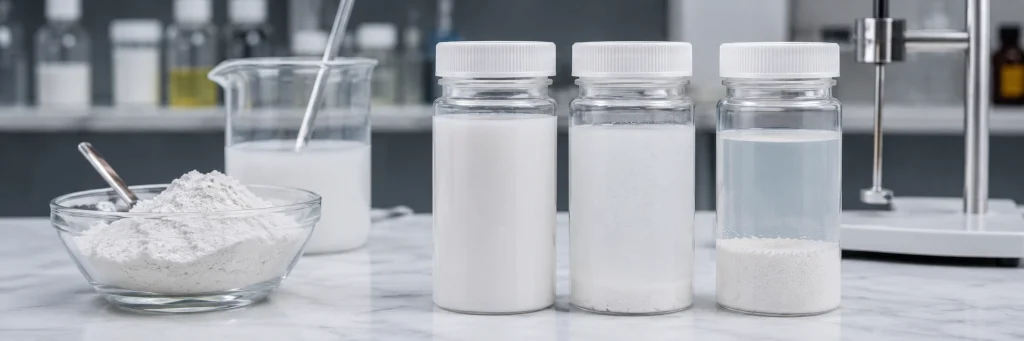
Sedimentation: The Most Common Stability Challenge
Sedimentation happens when suspended particles gradually move downward under gravity. Because hydroxyapatite particles are denser than water, some level of settling risk exists in low-viscosity formulas.
Sedimentation is especially common in:
- Mouthwash
- Water suspension
- Oral spray
- Low-viscosity gel
- Liquid toothpaste
- Pet oral care liquid
- Rinse-off formulas with low thickener content
In a toothpaste or high-viscosity gel, sedimentation may be less visible because the formula structure helps hold the particles. In a liquid mouthwash or suspension, sedimentation control becomes much more important.
How to Reduce Sedimentation
To improve suspension stability, formulators can consider:
- Using smaller particle-size hydroxyapatite
- Improving powder wetting before full mixing
- Increasing formula viscosity
- Using suitable suspending agents
- Reducing particle agglomeration
- Optimizing the mixing sequence
- Testing pre-dispersed hydroxyapatite suspension
- Selecting suitable packaging that allows shaking before use
Common suspending or viscosity-support ingredients may include cellulose derivatives, xanthan gum, carbomer-compatible systems, natural gums or other oral care-appropriate rheology modifiers. The exact choice depends on the product type and target market regulations.
For mouthwash or liquid products, a “shake well before use” direction may be considered, but this should not be used as a shortcut for poor formulation stability. A good product should still redisperse easily and maintain acceptable uniformity after shaking.
Particle Size and Dispersion Performance
Particle size has a major impact on hydroxyapatite stability.
Smaller particles usually stay suspended more easily than larger particles because they settle more slowly. However, very fine particles may also have a higher tendency to agglomerate if they are not properly dispersed.
Formulators should evaluate:
- Average particle size
- Particle size distribution
- Agglomeration tendency
- Surface properties
- Mouthfeel
- Dispersion behavior in water
- Compatibility with thickeners and surfactants
Nano hydroxyapatite is often selected for toothpaste and advanced oral care formulas because of its fine particle size and smooth feel. Micro hydroxyapatite may be more suitable for some powder, paste or chewable formats where a different texture is acceptable.
The best choice depends on the final application. A transparent mouthwash, a creamy toothpaste and a pet dental gel do not require the same hydroxyapatite grade.
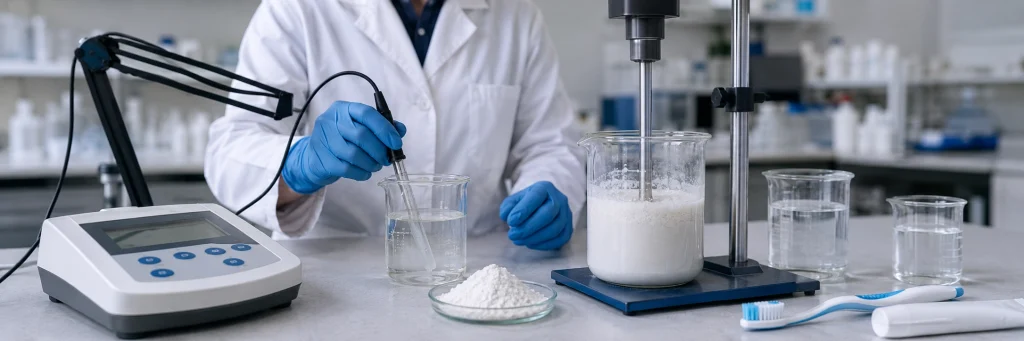
pH: A Key Factor for Hydroxyapatite Stability
pH is one of the most important factors in hydroxyapatite water-based formulas. Hydroxyapatite is more vulnerable under acidic conditions, while a neutral to mildly alkaline environment is usually more favorable for mineral stability.
For oral care applications, formulators often avoid overly acidic systems because low pH may increase the risk of mineral dissolution or formula instability. However, the ideal pH range must be determined according to the full formula, product type, preservative system and target application.
In general, formulators should consider:
- Avoiding strongly acidic formulas
- Monitoring pH drift during storage
- Checking compatibility with acidic flavor components
- Testing pH after adding hydroxyapatite
- Evaluating pH under accelerated stability conditions
- Confirming the final pH is suitable for oral care use
Some flavor systems, botanical extracts, preservatives or acids may shift the pH. This is why pH should not only be measured during the first lab batch. It should also be checked after stability testing.
Dispersion Tips for Hydroxyapatite Formulas
Good dispersion begins before the final formula is complete. If hydroxyapatite powder is added directly into a finished formula without proper wetting or mixing, it may form clumps that are difficult to break.
1. Pre-Wet the Powder
Pre-wetting hydroxyapatite with a suitable liquid phase can help reduce floating powder, clumping and uneven distribution. Depending on the formula, formulators may pre-wet the powder with water, glycerin, sorbitol or another compatible humectant phase.
2. Use Proper Mixing Equipment
For small lab batches, overhead stirring or high-shear mixing may be required. For industrial batches, homogenization, controlled shear and proper addition speed can help improve dispersion.
The goal is to break agglomerates without damaging the formula structure or creating excessive air bubbles.
3. Add Hydroxyapatite at the Right Stage
Hydroxyapatite can be added during the water phase, humectant phase or pre-gel stage depending on the formula. Adding it too late may make dispersion more difficult, while adding it too early may affect thickener hydration.
A practical approach is to test several addition sequences and compare appearance, viscosity, particle distribution and sedimentation.
4. Control Air Entrapment
High-speed mixing can introduce air, especially in toothpaste and gel formulas. Air bubbles may affect filling, appearance and stability testing. Vacuum mixing or deaeration may be useful for production-scale formulas.
5. Evaluate Compatibility with Other Ingredients
Hydroxyapatite may interact with ingredients that affect pH, ionic strength or surface charge. Surfactants, electrolytes, preservatives, flavors, sweeteners and thickeners may all influence dispersion.
A formula that looks stable on day one may still separate after one month if compatibility is poor.
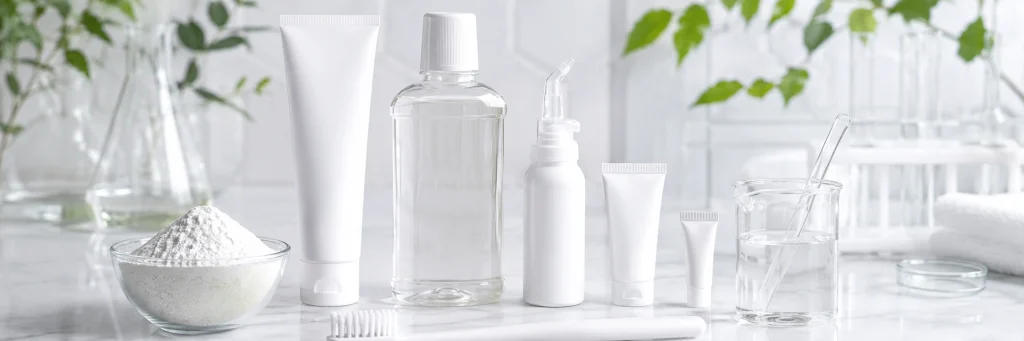
Hydroxyapatite in Toothpaste Formulas
Toothpaste is one of the most common applications for hydroxyapatite. Compared with mouthwash, toothpaste has a higher viscosity, which helps support particle suspension.
However, toothpaste still has several stability challenges:
- Rough or gritty texture
- Particle agglomeration
- Inconsistent paste appearance
- Poor extrusion
- Water separation
- pH drift
- Flavor compatibility issues
For hydroxyapatite toothpaste formulation, formulators should balance abrasive system, humectants, thickener, foaming agent, flavor and active mineral content.
A smooth toothpaste should disperse hydroxyapatite evenly without leaving a sandy mouthfeel. This requires suitable particle size and good manufacturing control.
Hydroxyapatite in Mouthwash and Liquid Suspensions
Mouthwash and liquid hydroxyapatite suspensions are more difficult to stabilize because they have much lower viscosity than toothpaste.
Key challenges include:
- Fast sedimentation
- Visible bottom layer
- Cloudy or uneven appearance
- Poor re-dispersion after shaking
- Incompatibility with flavors or preservatives
- pH instability
For these products, formulators may need a carefully designed suspension system. A pre-dispersed hydroxyapatite suspension can also be considered if the brand wants easier manufacturing and more consistent particle distribution.
For mouthwash products, the final sensory experience is important. The suspension should not feel chalky, heavy or gritty.
Hydroxyapatite in Oral Gels and Pet Oral Care
Hydroxyapatite can also be used in oral gels, dental gels and pet toothpaste. These formulas often have moderate to high viscosity, which helps reduce sedimentation.
However, pet oral care formulas require additional attention. Dogs and cats may swallow toothpaste or gel during use, so every ingredient must be selected for pet-appropriate formulation. Human toothpaste formulas should not be copied directly for pet products.
For pet toothpaste and dental gels, formulators should focus on:
- Mild texture
- Good palatability
- Stable suspension
- Safe ingredient selection
- Suitable pH
- Smooth mouthfeel
- Easy extrusion or application
Hydroxyapatite can support a mineral-based oral care concept, but the full formula must be tested for the intended species and market.
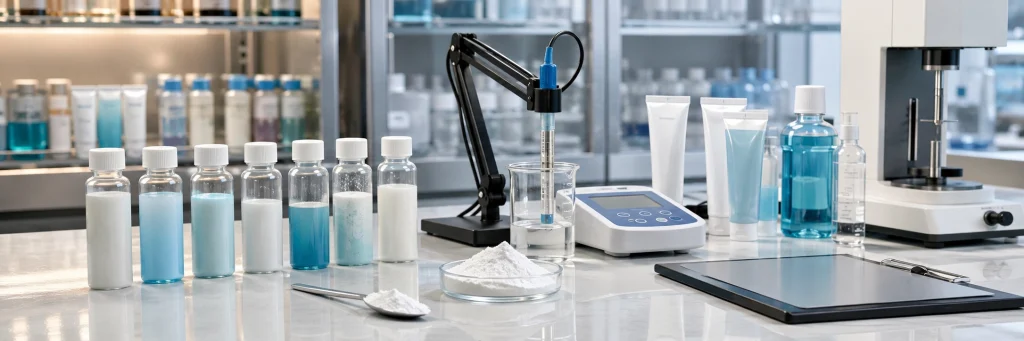
Stability Testing Checklist
Before launching a hydroxyapatite water-based formula, brands should conduct stability testing under different conditions.
Recommended tests include:
Appearance Test
Check color, texture, phase separation, visible particles and sediment layer.
Sedimentation Test
Observe whether particles settle over time and whether the formula can be easily redispersed.
pH Test
Measure pH at the initial stage and after storage under different conditions.
Viscosity Test
Track viscosity changes over time, especially for toothpaste, gel and suspension products.
Particle Distribution Test
Evaluate whether hydroxyapatite remains evenly dispersed or forms large agglomerates.
Freeze-Thaw Test
Check whether repeated temperature changes affect texture, separation or re-dispersion.
Accelerated Stability Test
Store samples at elevated temperature to observe potential long-term stability risks.
Packaging Compatibility Test
Check whether the formula interacts with the tube, bottle, pump or cap system.
A formula should be tested not only in the lab beaker but also in the final packaging.
How to Choose Hydroxyapatite for Water-Based Formulas
For water-based product development, raw material quality is critical. The same formula may perform differently if the hydroxyapatite grade changes.
When choosing a hydroxyapatite supplier, buyers should ask for:
- Particle size data
- Particle size distribution
- Purity information
- Heavy metal test report
- Microbial test report
- COA
- MSDS
- Suggested application guidance
- Dispersion recommendations
- Batch-to-batch consistency
- Support for powder or suspension grade selection
For toothpaste and mouthwash manufacturers, a supplier with application experience can reduce development time and avoid unnecessary trial-and-error.
Common Formulation Mistakes to Avoid
Adding Powder Too Quickly
Fast addition may create clumps that are difficult to disperse later.
Ignoring pH Drift
A formula may start at the right pH but change after storage.
Using the Wrong Particle Size
A particle size suitable for chewable tablets may not be suitable for mouthwash or toothpaste.
Relying Only on High-Speed Mixing
Mixing helps dispersion, but it cannot solve poor compatibility or weak suspension design.
Skipping Packaging Tests
A stable lab sample may behave differently in a tube, bottle or pump package.
Using Human Oral Care Logic for Pet Products
Pet oral care formulas require pet-specific ingredient selection and safety evaluation.
FAQ
Is hydroxyapatite soluble in water?
Hydroxyapatite is not typically used as a fully soluble ingredient in water-based formulas. It usually exists as dispersed mineral particles, so suspension and dispersion control are important.
Why does hydroxyapatite settle in water?
Hydroxyapatite particles are denser than water. If the formula does not have enough suspension support, particles may gradually settle to the bottom.
What pH is best for hydroxyapatite formulas?
A neutral to mildly alkaline environment is generally more favorable than a strongly acidic system. However, the final pH should be determined based on the complete formula, product type and stability testing.
How can I improve hydroxyapatite dispersion?
Pre-wetting the powder, using proper mixing equipment, selecting suitable particle size and adding suspending agents can help improve dispersion.
Is nano hydroxyapatite better than micro hydroxyapatite?
Nano hydroxyapatite may provide smoother texture and better suspension behavior in some formulas, while micro hydroxyapatite may be suitable for other applications. The best choice depends on the product format and performance requirements.
Can hydroxyapatite be used in mouthwash?
Yes, hydroxyapatite can be used in mouthwash or liquid suspension products, but sedimentation and re-dispersion must be carefully managed.
Conclusion
Hydroxyapatite offers strong potential for toothpaste, mouthwash, oral gels, pet oral care and other water-based oral care products. However, because it behaves as a dispersed mineral particle rather than a dissolved active, formulators must pay close attention to stability.
Sedimentation, pH, particle size, dispersion method, viscosity and packaging all influence the final product quality. A stable hydroxyapatite formula requires the right raw material grade, suitable processing method and complete stability testing.
For brands developing hydroxyapatite toothpaste, mouthwash, dental gel or water suspension products, working with an experienced hydroxyapatite supplier can help improve formulation efficiency, reduce stability risks and support successful product development.






Please leave us a message.