

Ergothioneine, a dark horse in the anti-aging world
2026-02-28
Ergothioneine (EGT) was first isolated from ergot fungi by scientist Charles Tanret in 1909, hence its name. It is a naturally occurring amino acid derivative widely distributed in fungi, some plants, and animals. In the human diet, mushrooms, grains, and certain seafood are its main sources. With in-depth research by modern science, the remarkable effects of ergothioneine have gradually come to light.
Anti-aging principles and mechanisms of action
Dual antioxidant effects
Direct scavenging of free radicals: EGT can rapidly neutralize various reactive oxygen species (ROS) and reactive nitrogen species (RNS), including superoxide anion (O₂⁻), hydrogen peroxide (H₂O₂), hydroxyl radicals (·OH), and singlet oxygen (¹O₂). This direct scavenging effect has been fully verified in in vitro experiments.
Comparative advantages
| Antioxidants | Hydroxyl radical scavenging ability (unit: μM’s 71) | Stability (half-life) | Cell permeability |
| Ergothioneine | 1.2*10^10 | >24 hours (neutral pH) | High (OCTN1 transfer) |
| Glutathione | 4.0*10^8 | 2 hours | Dependence on transporter |
| Vitamin E | 3.2*10^6 | Easily oxidized and degraded | Lipid-soluble, limited to membrane structures |
Regulation of the antioxidant defense system: EGT upregulates the expression of downstream antioxidant genes (such as HO-1, NQO1, SOD, and CAT) by activating the KEAP1-NRF2 signaling pathway. The nuclear translocation of NRF2 is regulated by the PI3K/AKT and PKC signaling pathways, and EGT may promote the release and nuclear translocation of NRF2 by modulating the thiol sensor of KEAP1.
Protective Role in Genome Stability
Reducing DNA Damage: EGT effectively inhibits ROS- and RNS-induced DNA damage, particularly in mitochondrial DNA (mtDNA). Studies have shown that cells lacking EGT transporters exhibit higher levels of DNA damage.
Promoting DNA Repair: EGT not only absorbs ultraviolet (UV) radiation but also promotes DNA repair after UV irradiation, protecting skin cells from photodamage.
Regulation of Epigenetic Modifications
Affecting the Synthesis of the Methyl Donor SAM: EGT indirectly affects the availability of S-adenosylmethionine (SAM) by regulating glutathione (GSH) levels, thereby regulating the activity of DNA methyltransferases (DNMTs) and histone methyltransferases (HMTs).
Maintaining Free Iron Ion Homeostasis: EGT maintains free iron ion homeostasis by scavenging ROS, thus ensuring the activity of demethylases (such as TETs and JmjC).
Interactions with the Sirtuin signaling pathway:
Upregulation of SIRT1/SIRT6 expression: EGT delays endothelial cell senescence and induces necrotizing apoptosis in colorectal cancer cells by upregulating the expression of SIRT1 and SIRT6.
Maintaining NAD⁺ levels: EGT enhances Sirtuin activity by regulating cellular redox status and maintaining the NAD⁺/NADH ratio.
Preparation Method
Natural Extraction Method:
EGT is found in natural products such as edible fungi, ergot, cereals, and animal tissues. Edible fungi have a high EGT content and are an important source of EGT.
However, the EGT content of natural products is generally very low, requiring large amounts of raw materials for extraction, resulting in high extraction costs. Furthermore, issues such as high levels of impurities and drug residues in the raw materials limit the industrial application of natural product extraction methods.
Chemical Synthesis Method: Traditional chemical synthesis of EGT uses histidine as a starting material, synthesizing EGT in aqueous solution through multiple steps including thiolation, thioprotection, methylation, and deprotection. This method has a lengthy synthetic route and low yield. In recent years, studies have imitated biosynthetic pathways to improve the chemical synthesis of EGT. For example, Erdelmeier et al. used histidine betaine, cysteine, and mercaptopropionic acid as starting materials to synthesize EGT using a simplified one-pot reaction, avoiding the introduction of thioprotective groups, shortening the synthetic route, and improving the yield.
Chemical synthesis also presents some challenges. For example, the chirality of the α-carbon in the carboxyl group easily leads to racemization under acidic or alkaline conditions, making it difficult to obtain high-optical-purity EGT. Furthermore, the raw materials required for chemical synthesis are expensive, the starting material 2-mercaptoimidazole is difficult to prepare, and post-processing of the product is also challenging. Therefore, researchers need to optimize and improve chemical synthesis methods to meet the needs of large-scale industrial production.
Microbial fermentation: Obtaining EGT through biosynthesis has advantages such as readily available raw materials and relatively low cost, and has become the main method for EGT preparation in recent years. In nature, EGT exists through two pathways: aerobic biosynthesis and anaerobic biosynthesis.
Aerobic Biosynthesis of EGT
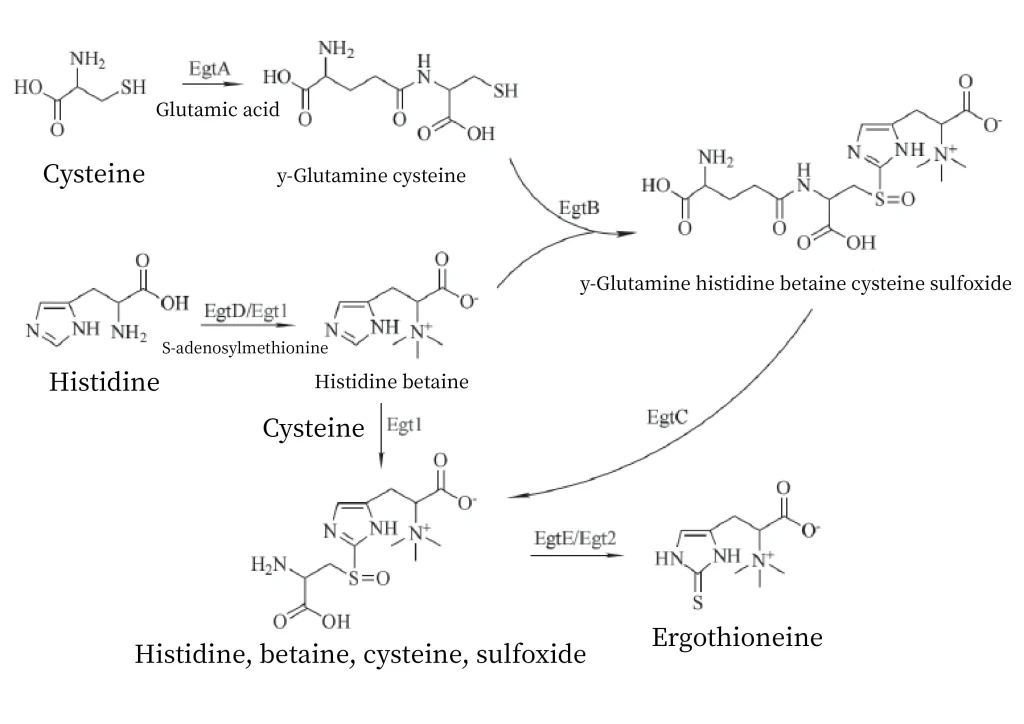
Many studies have elucidated the biosynthetic process of EGT. Basically, the aerobic biosynthetic pathway of EGT can be divided into bacterial and fungal pathways. Seebeck et al. elucidated and reconstructed the aerobic biosynthetic pathway of EGT in vitro in Mycobacterium smegmatis, identifying five genes involved in the pathway: EgtA, EgtB, EgtC, EgtD, and EgtE. These genes encode glutamylcysteine synthase (EgtA), Fe2+-dependent oxidase (EgtB), gamma-glutamyl transferase (EgtC), S-adenosyl methionine (SAM)-dependent histidine methyltransferase (EgtD), and pyridoxal phosphate-dependent C-S lyase (EgtE), respectively. In this process, EgtA catalyzes the condensation of glutamate and cysteine to generate γ-glutamylcysteine; EgtB catalyzes oxidative coupling in the presence of oxygen and ferrous sulfate, adding a thiol group from γ-glutamylcysteine to the side chain of histidine betaine (synthesized from histidine and SAM catalyzed by EgtD); EgtC then catalyzes the further formation of histidine betaine cysteine sulfoxide; finally, EgtE catalyzes the removal of pyruvate and ammonia to generate EGT.
In the fungal biosynthetic pathway, EGT mainly involves two synthase genes, Egt1 and Egt2. Bello et al. identified a specific synthase, NcEgt1, in *Neurospora crassa*, which contains domains similar to those in *Mycobacterium smegmatis*’s EgtB and EgtD. Egt1 participates in a two-step catalytic reaction: first, it catalyzes the conversion of histidine to histidine betaine, and then it catalyzes the combination of histidine betaine and cysteine to form histidine betaine cysteine sulfoxide. Similar to EgtE, Egt2 catalyzes the formation of EGT from histidine, betaine, and cysteine sulfoxide. As shown in the figure, because only two enzymes are involved, the biosynthetic pathway of EGT in fungi is much simpler than that in bacteria.
Anaerobic Biosynthesis of EGT
An anaerobic biosynthesis of EGT has been reported in a strictly anaerobic mud bacterium (Chlorobium limicola), where EGT biosynthesis is accomplished through a two-step reaction independent of oxygen. Burn et al. identified methyltransferase (EanA) and sulfotransferase (EanB) in this anaerobic mud bacterium. As shown in the figure, EanA catalyzes the conversion of histidine to histidine betaine, and then EanB, under anaerobic conditions, transfers a sulfur atom to the imidazole ring of histidine betaine to generate EGT. Although the anaerobic biosynthesis pathway is simpler, the catalytic rates of EanA and EanB are much lower than those of EgtD and EgtB in the aerobic biosynthesis pathway. Therefore, the aerobic biosynthesis pathway remains the dominant mode of EGT biosynthesis.
Application prospects
Ergothioneine possesses powerful antioxidant and anti-aging properties, and has broad application prospects in the food, cosmetics, functional food, and biopharmaceutical industries. Its application in the beauty and skincare field is particularly prominent, making it an important ingredient in anti-aging products.
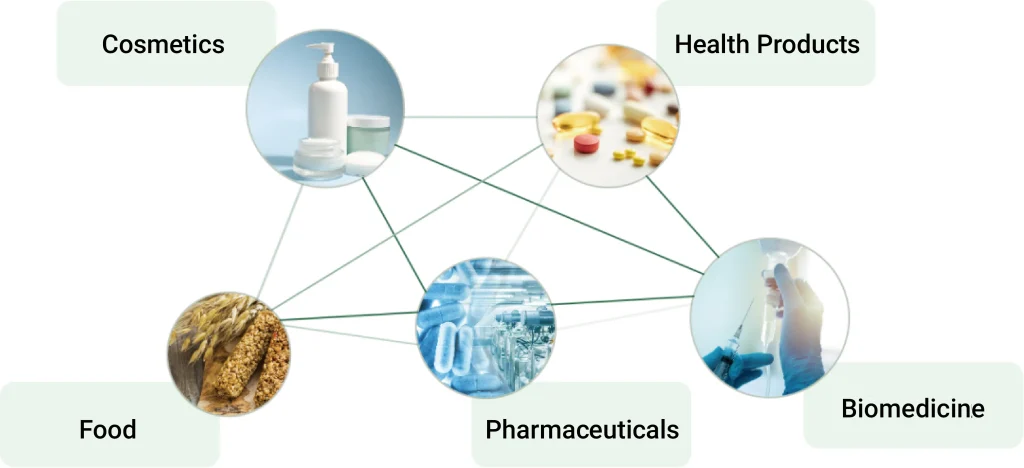
Its main benefits include:
- Antioxidant and Anti-aging: Ergothioneine’s powerful antioxidant capacity effectively combats free radicals, reduces oxidative damage to skin cells, delays skin aging, and reduces wrinkles and sagging.
- Whitening and Spot Reduction: Inhibits melanin production and deposition, improves pigmentation and dullness, and brightens skin tone.
- Anti-inflammatory and Soothing: Reduces skin inflammation, effectively relieves redness and itching, strengthens the skin’s protective barrier, and enhances its resistance.
- Moisturizing and Repairing: Effectively improves the skin’s barrier function, enhances skin hydration, and promotes the repair and regeneration of damaged skin.
- Photoprotection and Protection against UV Damage: Ultraviolet radiation is one of the main culprits of skin aging. Ergothioneine can reduce skin damage caused by ultraviolet radiation, protect the skin from photoaging, and provide effective sun protection.
Summarize
Ergothioneine, with its unique antioxidant mechanism and wide range of applications, is reshaping the anti-aging industry. With breakthroughs in synthetic biology and in-depth clinical research, it may become one of the core ingredients for delaying aging and improving quality of life. For consumers, choosing high-purity, scientifically formulated ergothioneine products may be a key to combating the effects of time.





Please leave us a message.