

Hydroxyapatite Powder for Dental Applications: Benefits, Uses and Quality Requirements
2026-03-31
Introduction
Hydroxyapatite powder for dental applications has become an important material in modern oral care, restorative dentistry, and dental biomaterial development. As a calcium phosphate compound that closely resembles the mineral structure of human teeth and bone, hydroxyapatite is valued for its biocompatibility, bioactivity, and ability to support enamel remineralization.
For toothpaste manufacturers, dental material suppliers, implant coating developers, and oral care brands, hydroxyapatite powder offers more than a functional ingredient. It provides a science-backed solution for improving enamel strength, reducing tooth sensitivity, supporting bone repair, and developing advanced fluoride-free dental products.
This article explains how hydroxyapatite powder is used in dental applications, why it is preferred by professionals, and what quality indicators buyers should consider when selecting a reliable hydroxyapatite supplier.
What Is Hydroxyapatite Powder?
Hydroxyapatite, often abbreviated as HA, is a naturally occurring calcium phosphate mineral with the chemical formula Ca₁₀(PO₄)₆(OH)₂. It is the main mineral component of tooth enamel and bone, which makes it highly compatible with dental tissues.
Hydroxyapatite powder is produced as a fine particulate material that can be added to dental formulations, coatings, composites, and bone repair products. Depending on the production method and intended application, hydroxyapatite powder may vary in particle size, purity, morphology, crystallinity, and surface activity.
In dental applications, these characteristics are especially important because the material must interact effectively with enamel, dentin, oral tissues, or implant surfaces. A high-quality hydroxyapatite powder should be stable, clean, bioactive, and suitable for the target formulation.
Why Hydroxyapatite Powder Is Used in Dentistry
The main reason hydroxyapatite powder is widely used in dentistry is its close similarity to natural tooth minerals. Instead of simply forming a protective layer, hydroxyapatite can help replenish mineral loss on the tooth surface and support the repair of early enamel damage.
In oral care products, hydroxyapatite powder can attach to microscopic defects in enamel and dentin. This helps smooth the tooth surface, reduce sensitivity, and improve resistance to acid challenges. In professional dental materials, hydroxyapatite may also act as a scaffold or coating material that supports tissue integration and bone regeneration.
For formulators and dental product developers, hydroxyapatite powder provides several advantages:
- Excellent biocompatibility with oral tissues
- Strong affinity with enamel and dentin
- Potential to support enamel remineralization
- Suitable for fluoride-free oral care concepts
- Useful in toothpaste, mouthwash, varnish, coatings, and bone graft materials
- High versatility across consumer and professional dental products
Hydroxyapatite Powder in Toothpaste and Oral Care Formulations
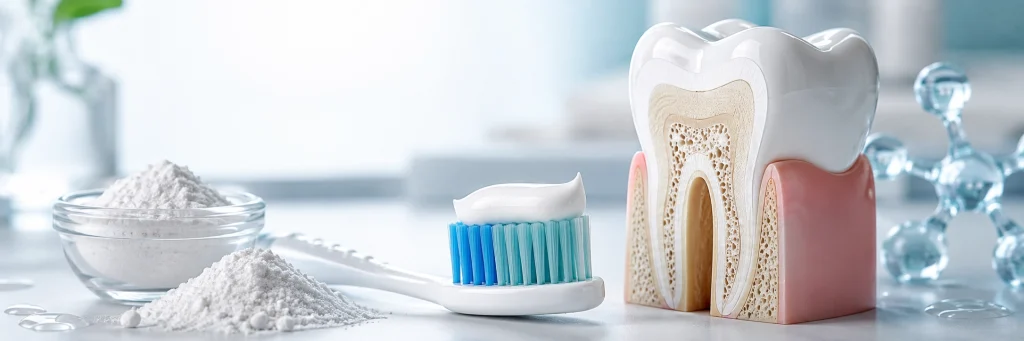
One of the most common uses of hydroxyapatite powder for dental applications is in toothpaste and daily oral care products. As more consumers look for gentle, fluoride-free, and enamel-friendly options, hydroxyapatite toothpaste has gained strong attention in the oral care market.
In toothpaste formulations, hydroxyapatite powder can help fill tiny defects on the enamel surface and support the replacement of lost minerals. This makes it suitable for products positioned around enamel care, sensitivity relief, whitening support, and daily cavity protection.
For oral care brands, hydroxyapatite powder can be used in:
- Fluoride-free toothpaste
- Sensitive teeth toothpaste
- Enamel repair toothpaste
- Children’s toothpaste
- Mouthwash or oral rinse formulations
- Dental gels and professional oral care products
When developing toothpaste with hydroxyapatite powder, formulators need to consider particle size, dispersion performance, abrasiveness, and compatibility with other ingredients. A well-selected hydroxyapatite powder should disperse evenly, remain stable in the formula, and provide a smooth user experience without excessive grittiness.
Hydroxyapatite Powder for Enamel Remineralization
Enamel demineralization occurs when acids from food, drinks, or oral bacteria dissolve minerals from the tooth surface. Over time, this can lead to rough enamel, sensitivity, white spot lesions, and higher risk of tooth decay.
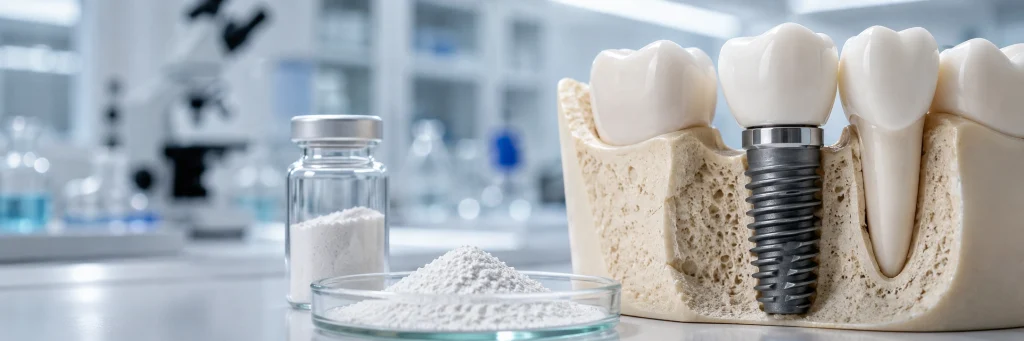
Hydroxyapatite powder is useful because it supplies calcium and phosphate in a form that is structurally similar to natural enamel minerals. When used in oral care products, hydroxyapatite particles can deposit on the tooth surface and help repair microscopic defects.
This makes hydroxyapatite especially suitable for products targeting:
- Early enamel mineral loss
- Tooth sensitivity
- Acid erosion
- White spot concerns
- Post-whitening enamel care
- Daily enamel protection
For brands developing enamel repair products, hydroxyapatite powder provides a strong technical story and clear consumer communication angle. It is not just a filler ingredient; it directly relates to the natural mineral structure of teeth.
Hydroxyapatite Powder in Dental Implants and Coatings
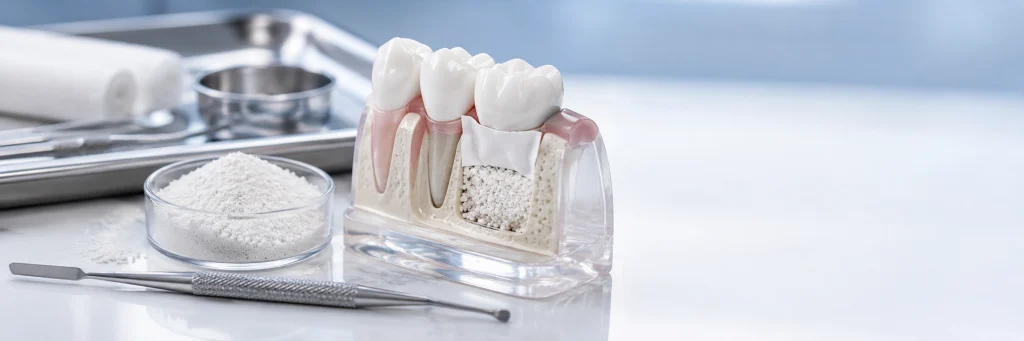
Beyond toothpaste and consumer oral care, hydroxyapatite powder is also used in professional dental materials. One important application is dental implant coating.
Dental implants need to integrate with the surrounding jawbone to achieve long-term stability. Hydroxyapatite coatings can improve the interaction between the implant surface and bone tissue. Because hydroxyapatite is osteoconductive, it can support bone cell attachment and encourage new bone growth along the implant surface.
In this application, hydroxyapatite powder may be processed into coatings through specialized techniques. The quality of the powder directly affects coating performance, including adhesion, surface structure, purity, and long-term stability.
For implant-related applications, manufacturers should pay close attention to:
- Particle size distribution
- Phase purity
- Crystallinity
- Heavy metal limits
- Coating compatibility
- Sterility and processing requirements
A reliable hydroxyapatite powder supplier should be able to provide consistent material specifications and technical documentation for professional dental material development.
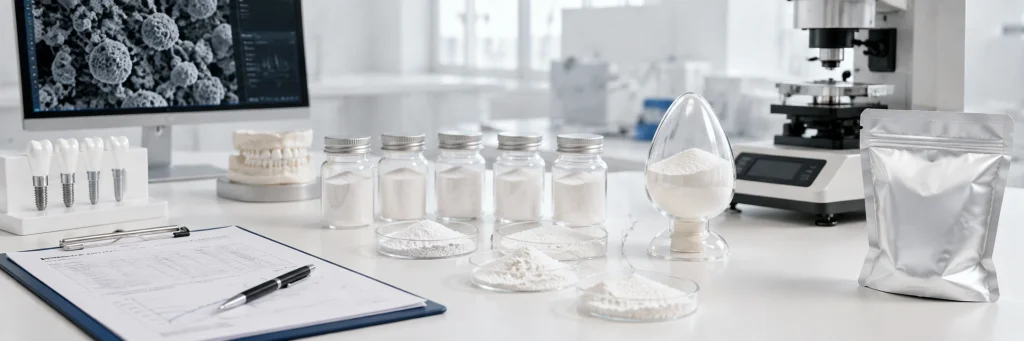
Hydroxyapatite Powder in Bone Graft and Periodontal Repair Materials
Hydroxyapatite powder is also used in bone graft materials and periodontal repair products. In oral surgery and implant dentistry, bone defects may need to be filled with a biocompatible scaffold that supports new bone formation.
Hydroxyapatite is suitable for this role because it provides a stable mineral structure that can guide bone regeneration. It does not replace biological healing, but it can create a supportive environment for new tissue growth.
Common professional uses include:
- Alveolar bone defect repair
- Periodontal bone regeneration
- Socket preservation
- Bone graft composites
- Implant-related bone augmentation
- Oral and maxillofacial repair materials
In these applications, hydroxyapatite powder is often combined with other biomaterials to improve handling, porosity, degradation behavior, or mechanical strength. The final performance depends not only on the hydroxyapatite itself but also on the complete formulation and clinical design.
Powder, Coating, Composite or Injectable: Which Form Is Better?
Hydroxyapatite can be used in different forms, but powder remains one of the most flexible raw material formats for dental applications.
Hydroxyapatite powder is ideal for toothpaste, oral care gels, bone graft materials, and dental composites. It allows manufacturers to adjust concentration, particle size, texture, and formulation performance according to the final product.
Hydroxyapatite coatings are more suitable for implants and hard tissue integration. These require specialized processing and strict quality control.
Hydroxyapatite composites combine HA powder with polymers, ceramics, or other calcium phosphate materials. They are often used in restorative or bone repair applications where improved structure and handling are needed.
Injectable hydroxyapatite materials are more common in aesthetic and regenerative medicine. Although they show the versatility of HA, they are not the main focus when targeting dental powder applications.
For most dental product developers and oral care brands, hydroxyapatite powder is the most practical and commercially relevant starting point.
Key Quality Requirements for Dental-Grade Hydroxyapatite Powder
When selecting hydroxyapatite powder for dental applications, quality consistency is critical. Poor-quality powder may affect formulation stability, product performance, safety, and customer trust.
Important quality indicators include:
1. Purity
High-purity hydroxyapatite powder helps reduce the risk of unwanted impurities in oral care and dental material formulations. Buyers should request specifications for purity, heavy metals, and microbiological control when applicable.
2. Particle Size
Particle size affects dispersion, texture, surface interaction, and bioactivity. Fine hydroxyapatite powder is often preferred for toothpaste and enamel care products because it can provide better surface contact and a smoother mouthfeel.
3. Morphology
The shape and surface structure of hydroxyapatite particles influence how the powder behaves in formulations. Uniform morphology can improve consistency during production.
4. Crystallinity
Crystallinity affects solubility, stability, and biological performance. The ideal crystallinity depends on the final application, whether it is toothpaste, implant coating, or bone repair material.
5. Bioactivity
Bioactivity is one of the most important reasons hydroxyapatite is used in dental applications. A suitable powder should interact well with dental tissues or biomaterial systems.
6. Batch Consistency
For commercial oral care products, batch-to-batch consistency is essential. Manufacturers need stable supply, predictable performance, and clear technical support from the supplier.
How to Choose a Hydroxyapatite Powder Supplier
Choosing the right hydroxyapatite powder supplier is not only about price. For dental applications, buyers should evaluate whether the supplier can support long-term formulation development, quality control, and regulatory documentation.
A qualified supplier should provide:
- Clear product specifications
- Particle size data
- Purity and heavy metal testing
- COA and MSDS documentation
- Application guidance for oral care or dental materials
- Stable batch supply
- Customization options if needed
For oral care brands, it is also helpful to work with a supplier who understands toothpaste formulation, enamel repair positioning, and global market trends. For professional dental material manufacturers, technical support and material consistency are even more important.
Market Potential of Hydroxyapatite Powder in Dental Care
The demand for hydroxyapatite powder in dental applications is growing because it meets several market trends at the same time. Consumers want gentler oral care products. Brands are looking for fluoride-free alternatives. Dental professionals continue to explore biomimetic materials that work with the natural structure of teeth and bone.
Hydroxyapatite powder fits these needs because it is science-based, versatile, and easy to communicate. It can be used in both consumer-facing products and professional dental materials, giving it strong commercial value across multiple categories.
For ingredient suppliers and oral care manufacturers, this creates opportunities in:
- Enamel repair toothpaste
- Sensitive teeth care
- Fluoride-free oral care
- Premium dental products
- Children’s oral care
- Dental biomaterials
- Implant and bone repair systems
FAQ
Is hydroxyapatite powder safe for dental applications?
Hydroxyapatite is widely valued for its biocompatibility because it is chemically similar to the mineral structure of teeth and bone. However, the safety of the final product depends on powder quality, formulation design, dosage, and compliance with relevant regulations.
Can hydroxyapatite powder be used in fluoride-free toothpaste?
Yes. Hydroxyapatite powder is commonly used in fluoride-free toothpaste concepts because it supports enamel remineralization and tooth surface repair.
What particle size is suitable for toothpaste?
Fine particle sizes are generally preferred for toothpaste because they improve dispersion, mouthfeel, and contact with the enamel surface. The ideal specification depends on the formula and product positioning.
Is hydroxyapatite only used in toothpaste?
No. Hydroxyapatite powder can also be used in dental varnishes, mouthwash, dental gels, implant coatings, composites, bone graft materials, and periodontal repair products.
What should buyers check before purchasing hydroxyapatite powder?
Buyers should check purity, particle size, heavy metal limits, COA, MSDS, batch consistency, application suitability, and supplier technical support.
Conclusion
Hydroxyapatite powder for dental applications is a valuable biomaterial for oral care products and professional dental materials. Its natural similarity to tooth enamel and bone gives it strong potential in enamel remineralization, sensitivity care, implant coatings, bone grafts, and periodontal repair.
For manufacturers, the key to successful application is choosing the right powder quality. Particle size, purity, morphology, crystallinity, and batch consistency all influence the final product’s performance.
As the demand for biomimetic and fluoride-free oral care continues to grow, hydroxyapatite powder will remain an important ingredient for brands, formulators, and dental material developers looking to create advanced, science-based dental solutions.





Please leave us a message.