

Nano-Hydroxyapatite: The Future of Biocompatible Innovation & R&D
2026-03-28
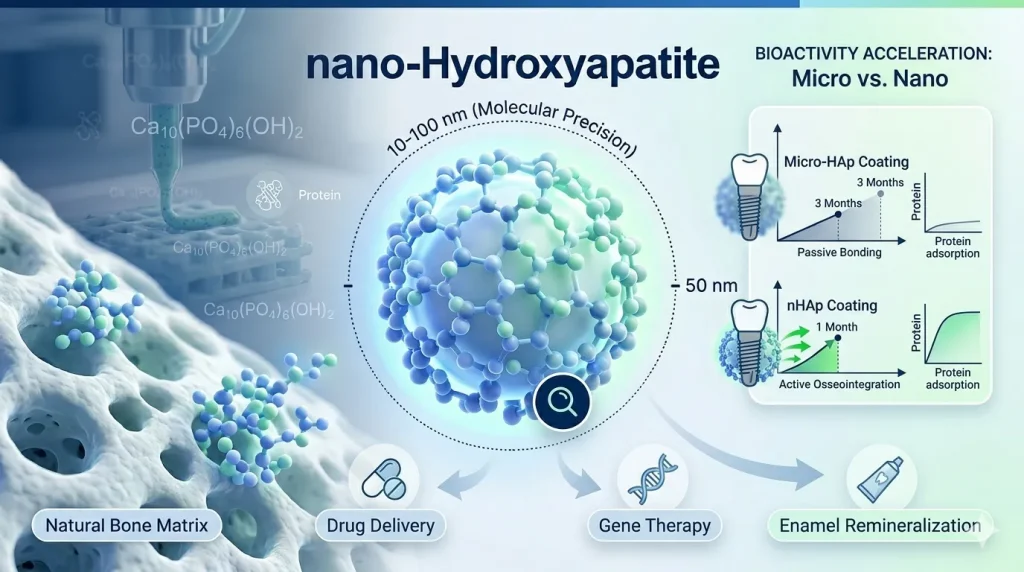
As we navigate the advancements of 2026, the intersection of nanotechnology and biology has moved from theoretical research to the cornerstone of high-performance manufacturing. For R&D managers, biomedical engineers, and product formulators, staying ahead of the curve means mastering materials that don’t just “function” but actively “interact” with biological systems. At the heart of this revolution is Nano-Hydroxyapatite (nHAp). Whether we are developing life-saving orthopedic implants or formulating the next generation of “clean-label” oral care, understanding the molecular precision of nHAp is no longer optional—it is a competitive necessity.
What is Nano-Hydroxyapatite?
Nano-hydroxyapatite is a bioactive ceramic material synthesized at the scale of 10–100 nanometers to mimic the natural mineral phase of human bone and dental enamel. It is primarily used in medical device coatings, regenerative medicine scaffolds, targeted drug delivery, and premium oral care products due to its exceptional biocompatibility and osseointegration.
I. The Biomimetic Advantage: Beyond Traditional Materials
In the world of bioceramics, “biomimetic” isn’t just a buzzword; it’s a functional requirement. Traditional hydroxyapatite has been used for decades, but its micro-sized particles often act as a passive filler. In contrast, we see nano-hydroxyapatite acting as a dynamic biological agent.
Because nHAp mirrors the natural $Ca_{10}(PO_{4})_{6}(OH)_{2}$ structure found in our bodies, the immune system recognizes it as “self” rather than “foreign.” This leads to a superior level of osseointegration—the structural and functional connection between living bone and the surface of a load-bearing implant. By utilizing the nano-scale, we can achieve healing rates and tissue-bonding strengths that were previously thought impossible with synthetic materials.
II. Technical Profile: Why Nano-Scale Matters
To understand why we are seeing a shift toward nano-scale integration, we must look at the physics of the surface.
Surface Area & Reactivity
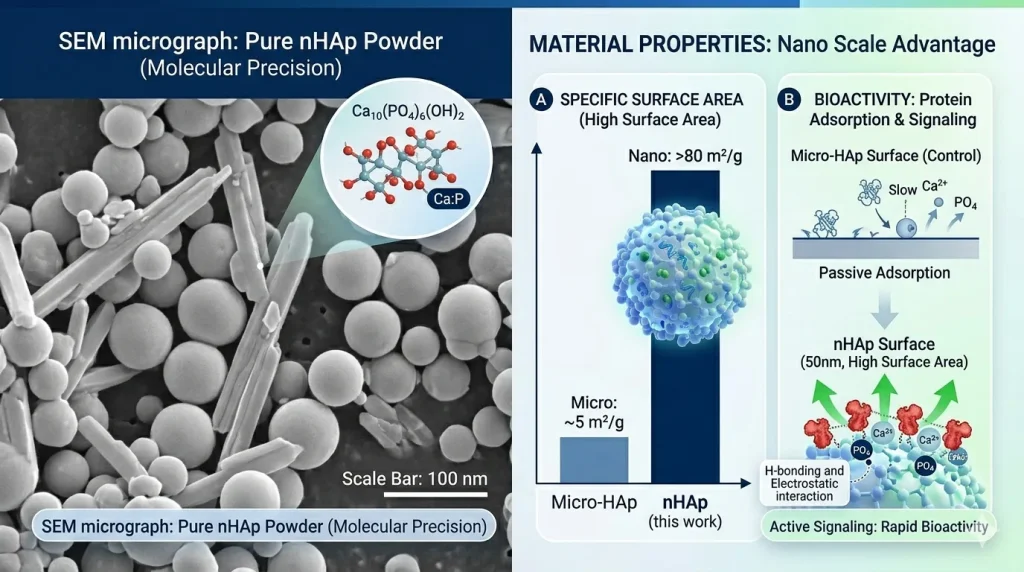
When we reduce particle size to the 10–100 nm range, the surface-to-volume ratio increases exponentially. This isn’t just a math exercise; it changes how the material behaves in a biological environment. High surface area leads to higher surface energy, which significantly increases protein adsorption. When an implant coated with nHAp enters the body, it immediately attracts the proteins necessary for cell adhesion, effectively “jump-starting” the healing process.
Chemical Synergy and Stability
The stoichiometric ratio of calcium to phosphorus in nHAp is critical. We find that by “nano-tuning” these particles, we can control the solubility and stability of the material. In drug delivery, this allows us to create carriers that dissolve at a specific rate, while in dental applications, it ensures the material remains stable enough to provide long-term enamel protection.
Comparison: Micro-HAp vs. Nano-HAp
| Feature | Micro-Hydroxyapatite | Nano-Hydroxyapatite |
| Particle Size | > 1 $\mu$m | 10–100 nm |
| Bioactivity | Moderate | Exceptionally High |
| Protein Adsorption | Low | High (Rapid Cell Signaling) |
| Primary Use | Bulk fillers, traditional coatings | Advanced scaffolds, gene therapy, oral care |
III. High-Impact Applications for 2026
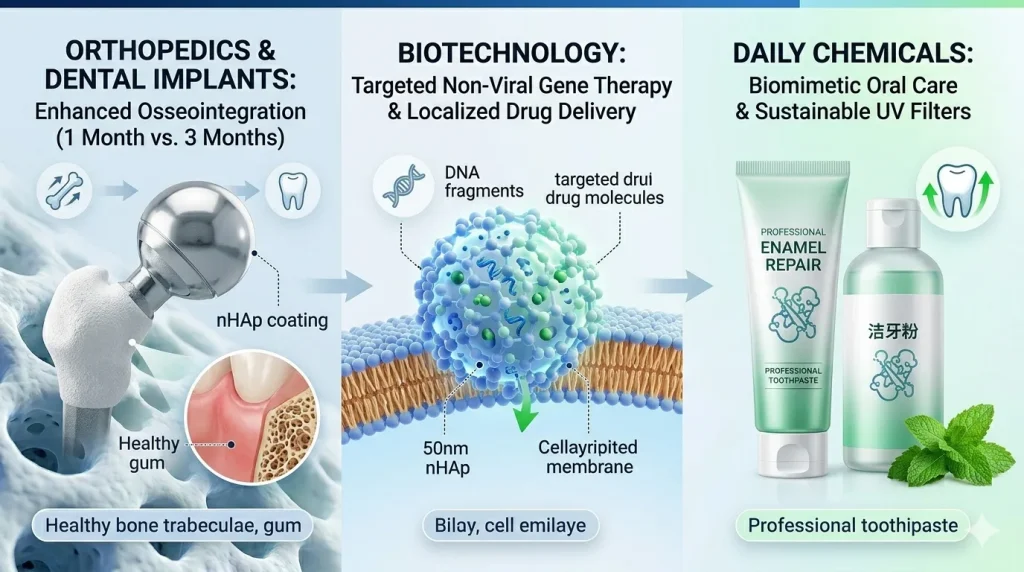
We are seeing nHAp disrupt three primary sectors this year:
1. Orthopedics & Dental Implants
The “smart” scaffolds of 2026 are 3D-printed using bio-inks infused with nHAp. These scaffolds don’t just hold space; they guide bone growth. In dental implantology, nHAp coatings have significantly reduced “peri-implantitis” (implant rejection) by creating a more natural transition between the titanium post and the jawbone.
2. Advanced Drug Delivery Systems
In biotechnology, we are increasingly using nHAp as a non-viral carrier. Because of its high affinity for DNA and proteins, it serves as an ideal vessel for targeted gene therapy. We can now engineer nHAp particles to release localized antibiotics or anti-inflammatory drugs exactly where they are needed, reducing systemic side effects.
3. Next-Gen Consumer Care (Beauty & Oral)
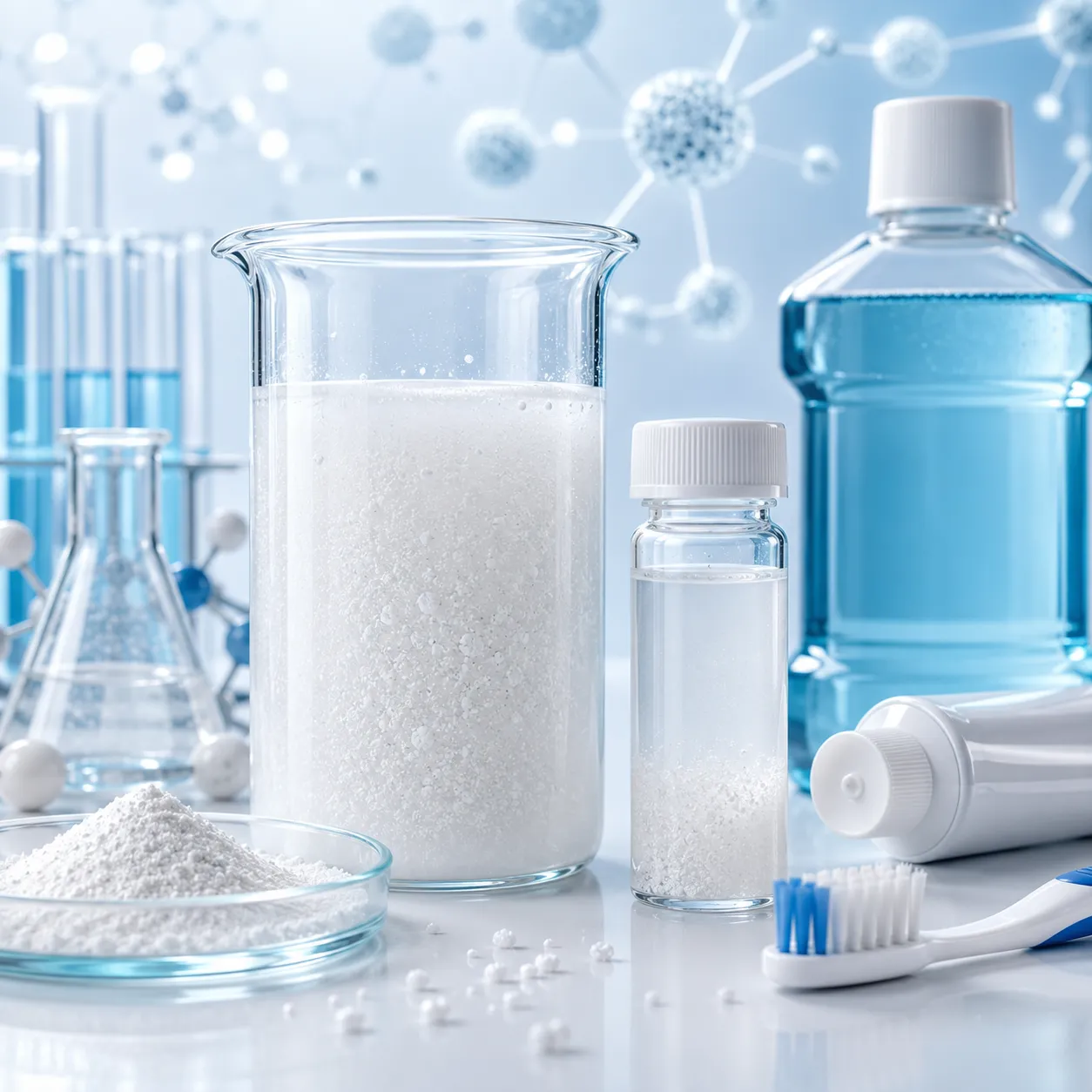
The “clean beauty” movement has embraced nHAp as a biocompatible alternative to fluoride. In professional oral care, nHAp particles fill microscopic fissures in enamel, remineralizing teeth and curing sensitivity at the source. Furthermore, in skincare, we are seeing nHAp used as a physical UV filter that is safer for both the skin and the marine environment.
IV. Manufacturing & R&D Integration
Choosing the right synthesis method is vital for maintaining the integrity of the nano-structure.
-
Sol-Gel vs. Hydrothermal: While Sol-Gel offers excellent control over purity at low temperatures, Hydrothermal synthesis is often preferred for large-scale industrial production where crystal morphology must be strictly uniform.
-
Regulatory Landscape: As of 2026, the ISO and FDA have tightened requirements for nanomaterial characterization. We must ensure that our nHAp sources provide rigorous documentation on particle size distribution and phase purity to meet MDR (Medical Device Regulation) standards.
-
Sustainability: We are seeing a major shift toward green synthesis. This involves sourcing hydroxyapatite from bio-waste (like eggshells or fish scales), reducing the carbon footprint of R&D while maintaining medical-grade quality.
V. Strategic Outlook: Scaling for Success
The market for nano-hydroxyapatite is projected to see a significant CAGR through 2030, driven largely by the surge in personalized 3D-printed medical devices. For procurement and R&D leaders, the challenge lies in selection criteria.
When we evaluate a raw material supplier, we focus on three pillars:
-
Particle Morphology: Are the particles needle-like, spherical, or plate-like? This dictates the final product’s strength and reactivity.
-
Phase Purity: Any residual impurities can lead to adverse biological reactions.
-
Batch Consistency: In regulated industries, the tenth batch must behave exactly like the first.
VI. Conclusion: Leading the Biocompatible Revolution
Nano-hydroxyapatite represents more than just a chemical compound; it is the bridge between synthetic engineering and natural biology. By mimicking the very building blocks of the human body, we are unlocking new potentials in healing, drug delivery, and consumer wellness. As we look toward the future of innovation, it is clear that those who master the application of this versatile raw material will lead their respective industries.






Please leave us a message.