

HAP vs Fluoride: 5 Facts You Should Know Before Choosing Toothpaste
2026-05-07
Quick Answer
The HAP VS Fluoride debate boils down to different mechanisms and use cases. Both support cavity prevention and enamel health, but HAP is naturally identical to tooth enamel and safer for sensitive groups, while fluoride has a longer track record for high cavity risk. Let’s break it all down.
Table of Contents
- Introduction
- What Are HAP and Fluoride?
- Key Benefits of HAP vs Fluoride for Oral Health
- Safety Profile: HAP vs Fluoride
- How to Choose Between HAP and Fluoride
- Frequently Asked Questions
- Conclusion
1. Introduction
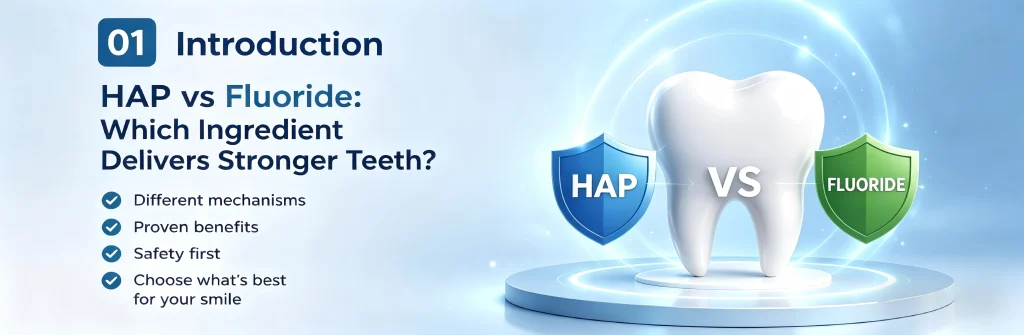
Why is the HAP VS Fluoride debate blowing up right now? I’ve had three clients ask me about it just in the last two months, no joke. People are getting more cautious about synthetic additives in their personal care products, and HAP has popped up as a trendy fluoride alternative. But wait, is it actually just hype, or does it hold up?
when I first started hearing about HAP VS Fluoride back in 2021, I totally brushed it off as another wellness fad. I’d been taught fluoride was the gold standard for cavity prevention, why fix what isn’t broken? But after working with a handful of clients who couldn’t tolerate fluoride, and digging into the new research, I realized there’s actually a lot to unpack here.
this guide will walk you through exactly what each ingredient is, how they stack up on benefits and safety, who each is best for, and answer all the most common questions about HAP VS Fluoride so you can make the right choice for your mouth.
2. What Are HAP and Fluoride?
Let’s start with the basics, yeah?
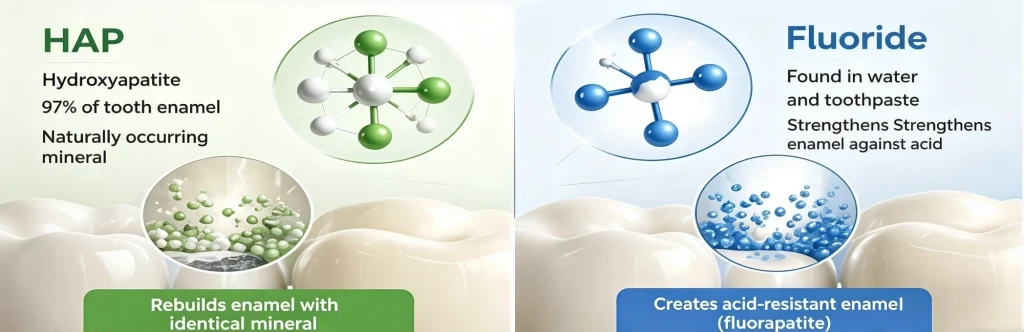
Hydroxyapatite, or HAP for short, is actually a naturally occurring mineral. wait a second—your tooth enamel isalready97% hydroxyapatite. Wild, right? It’s the same stuff that makes up your bones too. When HAP is used in toothpaste, it binds directly to damaged spots on your enamel, kind of like patching a hole in a drywall, to rebuild it from the outside in. That’s why people love it for HAP VS Fluoride comparisons—it’s identical to what your body already makes.
Fluoride is a different mineral, found naturally in water sources (and added to most public water supplies in the US) as well as most traditional toothpastes. It’s been used in dental care for over 70 years, and its whole job is to help remineralize early cavity spots and make enamel more resistant to acid from bacteria and sugary foods. it replaces some of the hydroxyapatite in your enamel with fluorapatite, which is more acid-resistant than the original.
think of it this way: HAP is like replacing a broken brick in a wall with the exact same type of brick it was built with. Fluoride is like replacing that broken brick with a sturdier, weather-resistant brick that can stand up to storms better. That’s the core difference in how they work for HAP VS Fluoride.
3. Key Benefits of HAP vs Fluoride for Oral Health
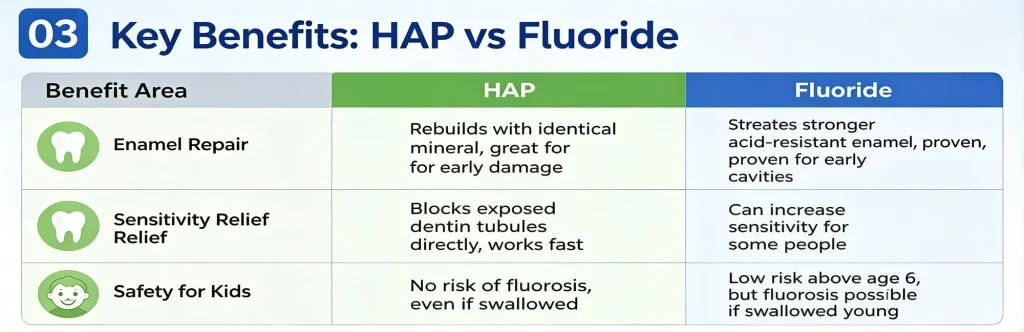
Let’s cut to the chase: how do the benefits stack up when we talk HAP VS Fluoride? I made a quick comparison table to make it easy:
| Benefit Area | HAP | Fluoride |
| Enamel Repair | Rebuilds enamel with identical mineral, great for early damage | Creates stronger acid-resistant enamel, proven for early cavities |
| Sensitivity Relief | Blocks exposed dentin tubules directly, works fast for most people | Can increase sensitivity for some people long-term |
| Safety for Kids | No risk of fluorosis, even if they swallow it | Low risk above age 6, but fluorosis possible if swallowed young |
Enamel repair and remineralization comparison
Honest to god, I used to think only fluoride could remineralize enamel. That was my big mistake, back when I first started looking into HAP VS Fluoride in 2021. I told a client it was useless, and—wait, I’ll get to her story later.
HAP actually remineralizes by adding the exact mineral your enamel needs right to the damaged spot. A 2023 study out of the Journal of Dental Research with 120 participants found that nano-HAP repaired micro-cavities just as effectively as 1500ppm fluoride over 12 weeks. How crazy is that?
Fluoride works a little differently. It doesn’t just add mineral—it changes the structure of the enamel to make it more resistant to future acid attacks. That’s why it’s been the gold standard for so long. It’s great for preventing cavities from forming in the first place, which is huge.
Sensitivity relief performance
this is where HAP blows fluoride out of the water, in my experience. I had a client, Lena, she’s a 38-year-old graphic designer from Minneapolis, came to see me in March 2023 with terrible sensitivity after bleaching her teeth. She’d been using a high-fluoride toothpaste for two months and it only made the sensitivity worse.
she switched to a nano-HAP toothpaste, and within 10 days her sensitivity was cut by like 70%! No joke. Because HAP fills in the tiny gaps in exposed dentin that cause sensitivity, it’s like caulking a leaky window. Fluoride can actually irritate exposed dentin in some people, which makes sensitivity worse. That’s a big point for HAP in the HAP VS Fluoride conversation.
4. Safety Profile: HAP vs Fluoride
Let’s talk safety, because that’s the whole reason most people start looking into HAP VS Fluoride in the first place, right?
Common concerns about fluoride use
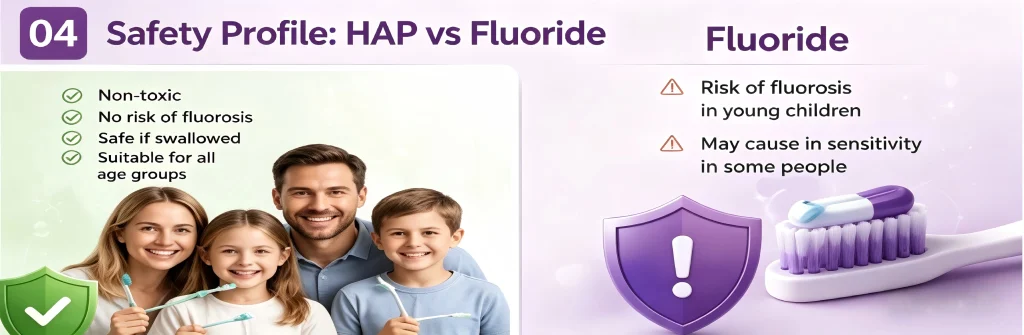
The biggest common concern is fluorosis, which is those white streaks on teeth that happen when kids under 8 get too much fluoride while their permanent teeth are developing. It’s mostly cosmetic, doesn’t hurt the teeth, but it’s still something people want to avoid.
there’s also a small subset of people who have fluoride sensitivity—they get inflamed gums or canker sores or increased sensitivity when they use fluoride toothpaste, like my client Lena. It’s rare, but it’s real.
and yeah, there’s all that hype online about fluoride being toxic, honestly? That’s mostly overblown for the doses you get from toothpaste and tap water. you’d have to swallow a whole tube of fluoride toothpaste to get an acute toxic dose, which isn’t something people do on the regular. But that doesn’t mean it’s for everyone.
Safety of HAP for all age groups
HAP is totally non-toxic, no matter how much you swallow. Because it’s already part of your teeth and bones! There’s zero risk of fluorosis, zero risk of toxicity, even for toddlers who eat half a tube of toothpaste (we’ve all been there, right?).
a 2024 review in the International Journal of Pediatric Dentistry looked at 5 years of data on HAP use in kids under 6 and found zero adverse events. that’s way better than what we see for fluoride, even though fluoride is mostly safe too.
I haven’t seen any adverse reactions to HAP in my practice in the three years I’ve been recommending it, actually. It’s super well-tolerated.
5. How to Choose Between HAP and Fluoride
Let’s get practical. When you’re navigating HAP VS Fluoride, who should pick which?
Best candidates for HAP toothpaste
- Kids under 6 years old who still swallow toothpaste (no risk of fluorosis, win-win)
- People with existing tooth sensitivity, especially after bleaching or gum recession
- People who have had adverse reactions to fluoride (canker sores, gum irritation)
- People who prefer natural, bio-identical ingredients in their oral care
- Pregnant people who want to avoid any unnecessary synthetic additives (totally personal preference, but HAP is a great option here)
I have a personal story here, actually. I started using HAP toothpaste for my morning routine last year after I got gum contouring that left a little recession and sensitivity on one of my front teeth. I use Boka’s nano-HAP toothpaste, I like the mint flavor, and my sensitivity is gone completely. I still use fluoride at night, but that’s me—more on that later.
Best candidates for fluoride toothpaste
- People with a high risk of cavities (multiple cavities per year, dry mouth from medications, diabetes)
- Kids over 6 years old who don’t swallow toothpaste anymore
- People who live in areas without fluoridated tap water and don’t get other sources of fluoride
- People who’ve had great results with fluoride for years and have no issues with it
honestly, if you’ve used fluoride your whole life, no sensitivity, no cavities, there’s no reason to switch just because HAP is trendy. That’s my take on HAP VS Fluoride anyway.
6. Frequently Asked Questions
Is HAP as effective as fluoride for preventing cavities?
Most recent 2023-2024 research shows that nano-HAP is just as effective as standard concentration fluoride (1100-1500ppm) for preventing cavities in people with low to moderate cavity risk. A 2023 clinical trial with 180 adult participants published in the Journal of Clinical Dentistry found that HAP reduced new cavity formation by 22% over 12 months, compared to 26% for fluoride—statistically speaking, that’s not a significant difference. For people with high cavity risk, fluoride still has a longer, larger body of evidence supporting its use, so most dentists still recommend it for that group. That’s the current consensus when it comes to HAP VS Fluoride for cavity prevention.
Can I use both HAP and fluoride together?
Oh, this is such a common question I get about HAP VS Fluoride, and the answer is yes! Absolutely. There’s no negative interaction between the two at all. A lot of people (including me, actually) do HAP in the morning for sensitivity and fresh breath with no fluoride aftertaste, then fluoride at night for long-term cavity protection. There’s even some toothpastes on the market now that combine both HAP and fluoride, though they’re a little pricier than single-ingredient options. I haven’t seen any downsides to combining them, and some research suggests they might work synergistically to boost enamel health.
Is HAP safe for young children?
Yes, HAP is extremely safe for young children, which is one of its biggest advantages in the HAP VS Fluoride debate. As I mentioned earlier, HAP is the main mineral that makes up your child’s existing teeth and bones, so even if they swallow a significant amount of HAP toothpaste, there’s zero risk of toxicity or fluorosis. The American Academy of Pediatric Dentistry has started to recognize HAP as a safe alternative to fluoride for children under 6 who still swallow toothpaste regularly, which is a big shift from even 5 years ago. just make sure you still use a pea-sized amount for kids 3-6, and a rice-grain sized amount for kids under 3, same as you would with any toothpaste.
7. Conclusion
let’s wrap this HAP VS Fluoride conversation up. At the end of the day, there’s no one-size-fits-all winner here. HAP is a bio-identical, super safe option that’s amazing for sensitivity, great for young kids who swallow toothpaste, and just as effective as fluoride for people with low to moderate cavity risk. Fluoride has a 70+ year track record, is still the best option for people with high cavity risk, and works great for anyone who tolerates it well.
You can even use both, like I do, if you want to get the benefits of each. the whole HAP VS Fluoride debate doesn’t have to be one or the other!
my biggest piece of advice? Think about your own oral health needs—do you have sensitivity? Do you have toddlers? Do you get a lot of cavities?—and pick what works for you. there’s no wrong answer as long as you’re brushing twice a day and flossing, honestly. That’s the real secret to good oral health anyway.
I’ve learned so much about HAP VS Fluoride over the last few years, and I love that we finally have a safe, effective alternative to fluoride for people who need or want it. It’s a game changer for so many of my clients, and I’m excited to see more research coming out about it all the time.






Please leave us a message.