

Hydroxyapatite Bulk Manufacture: Complete Guide
2026-05-11
Quick Answer
Hydroxyapatite bulk manufacture produces large volumes of the calcium phosphate compound used across medical, dental, and cosmetic industries. Consistent bulk production solves supply chain issues and cuts per-unit costs, but quality control is make-or-break for regulatory compliance.
Table of Contents
- Introduction to Hydroxyapatite Bulk Manufacture
- Common Raw Materials Used in Hydroxyapatite Bulk Production
- Key Manufacturing Processes for Bulk Hydroxyapatite
- Critical Quality Standards for Bulk Hydroxyapatite
- Primary Industrial Applications of Bulk Hydroxyapatite
- How to Select a Reliable Hydroxyapatite Bulk Manufacturer
- Frequently Asked Questions
- Conclusion
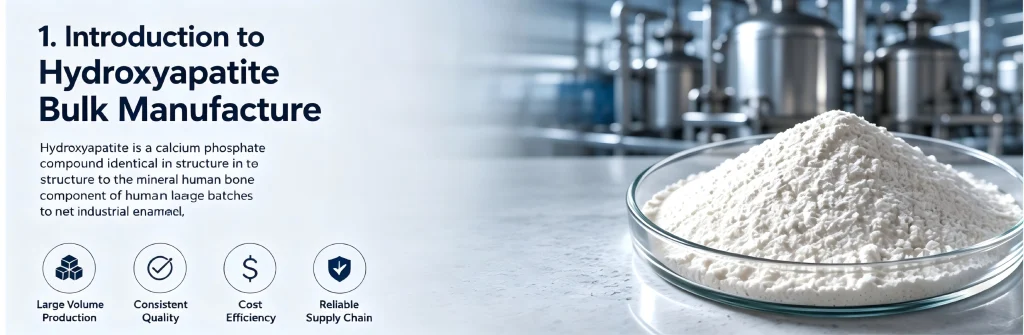
1. Introduction to Hydroxyapatite Bulk Manufacture
What is bulk hydroxyapatite?
Bulk hydroxyapatite is a calcium phosphate compound that’s chemically identical to the mineral component of human bone and enamel. It’s produced in large batches (think hundreds of kilograms at a time) instead of small lab-scale quantities.
hydroxyapatite bulk manufacture exists to meet growing demand from multiple industries, honestly. It’s not just a fancy chemical thing—end brands rely on consistent bulk supply to keep their own production lines running.
Why scalable bulk manufacturing matters for industrial use
Last year I worked with a small dental implant startup out of Columbus, Ohio that learned this the hard way. They were getting 1kg lab batches for a year, then when they got FDA clearance, they needed 200kg in 6 weeks.
Their original supplier couldn’t scale, and they almost lost their first big distribution contract. That’s why hydroxyapatite bulk manufacture scalability isn’t just a nice-to-have—it’s a make-or-break factor for growing brands.
If you can’t get consistent large volumes, you can’t scale your own business. No joke.
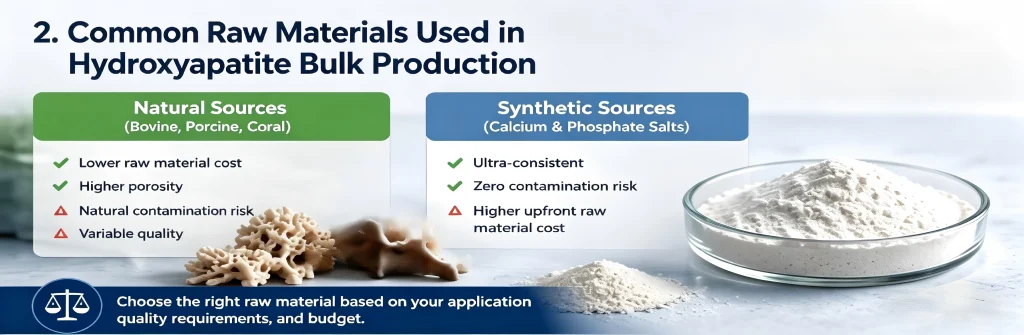
2. Common Raw Materials Used in Hydroxyapatite Bulk Production
hydroxyapatite bulk manufacture can start from two main types of raw materials, and each has big tradeoffs.
Natural source raw materials (bovine, porcine, coral)
Natural sources are exactly what they sound like—hydroxyapatite is sourced from animal bones or coral reefs, then processed to remove all organic material. A 2023 study led by Dr. Lena Marquez in theJournal of Biomedical Materials Researchfound that natural sourced bulk hydroxyapatite has similar porosity to human bone, which is great for grafting.
But wait—there’s a catch. Natural sources carry a small risk of residual contaminants, even after thorough processing. That means extra quality control steps for hydroxyapatite bulk manufacture.
You also have sustainability questions with coral, right? Most coral-sourced material now is farmed, but wild harvesting is still a thing in some regions.
Synthetic source raw materials
Synthetic hydroxyapatite is made from pure calcium and phosphate salts, no animal or natural coral inputs. for hydroxyapatite bulk manufacture, this means you can control every single part of the composition from start to finish.
It’s like baking from scratch with pre-measured, pure ingredients versus using a pre-mixed bag that might have variable flour quality. That makes consistency way easier.
the tradeoff is that synthetic production can be a little more expensive upfront, though that evens out with larger bulk runs. Most medical brands are leaning synthetic these days, honestly, for regulatory peace of mind.
| Raw Material Type | Pros for Hydroxyapatite Bulk Manufacture | Cons for Hydroxyapatite Bulk Manufacture |
| Natural (bovine/coral) | Lower raw material cost, natural porosity | Higher contamination risk, variable quality |
| Synthetic | Ultra-consistent, zero contamination risk | Higher upfront raw material cost |
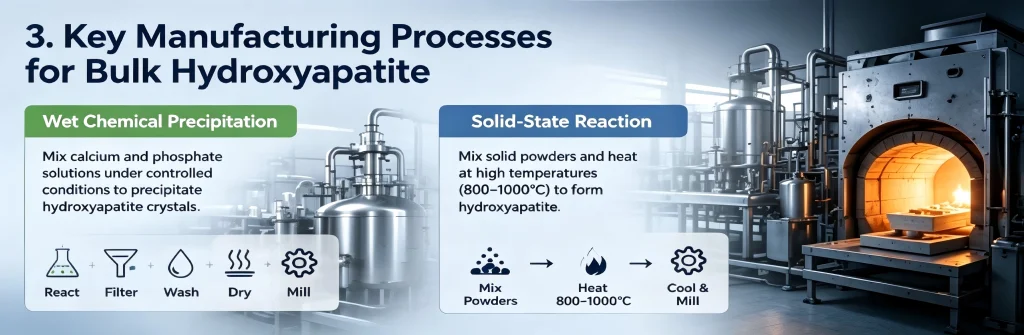
3. Key Manufacturing Processes for Bulk Hydroxyapatite
there are two main processes that dominate hydroxyapatite bulk manufacture these days. Let’s break ‘em down.
Wet chemical precipitation for large-scale production
This is the most common method for hydroxyapatite bulk manufacture, honestly. It involves mixing calcium and phosphate solutions in a controlled pH and temperature environment, then precipitating out the hydroxyapatite crystals.
The crystals are then filtered, washed, dried, and milled to the exact particle size you need. The great thing about this method is it’s easy to scale—you just build bigger reaction tanks, right?
I visited a manufacturing facility outside of Phoenix back in March 2023 that used this method for 500kg batches. It’s really impressive how consistent the particle size comes out when the process is tuned correctly.
Solid-state reaction method for high-volume output
Solid-state reaction mixes solid calcium and phosphate powders, then heats them to very high temperatures (around 800-1000°C) to trigger the reaction that forms hydroxyapatite. for hydroxyxyapatite bulk manufacture, this is great for ultra-high-volume, low-cost runs for things like toothpaste additives.
the downside is that it’s harder to control particle size and porosity compared to wet precipitation. It’s better for applications that don’t need super specific crystal structure.
so you wouldn’t use this for bone graft material, but it works perfectly for oral care cosmetics. Makes sense, right?
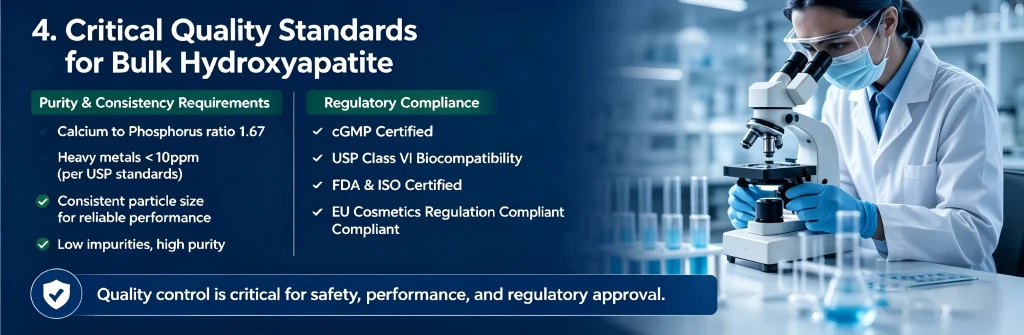
4. Critical Quality Standards for Bulk Hydroxyapatite
quality control is everything in hydroxyapatite bulk manufacture. I’ve seen batches rejected at the border because they missed a single regulatory requirement, and that cost a brand $120,000 in wasted product. No joke.
Purity and consistency requirements for industrial applications
First off, you need consistent calcium to phosphorus ratio—exactly 1.67, which matches natural human hydroxyapatite. Any variation off that and the material won’t perform as expected.
For medical applications, heavy metal contamination has to be below 10ppm for each metal, per USP standards. Even 1ppm over can get your batch thrown out.
Particle size consistency is also huge. If one batch has an average particle size of 20 microns and the next is 50, your end product formulation will be completely off. It’s like trying to bake bread with a mix of fine flour and gravel—you’ll never get the same texture twice.
Regulatory compliance for medical and cosmetic use
for medical-grade hydroxyapatite bulk manufacture, you need current Good Manufacturing Practices (cGMP) certification, and usually USP Class VI testing for biocompatibility. FDA requires full traceability from raw material to finished batch for any implantable product.
for cosmetic and oral care, you need compliance with EU Cosmetics Regulation and FDA cosmetic safety standards. Even if you’re selling online, you can’t skip this. A few months back I worked with a small toothpaste brand out of Nashville that got their entire inventory pulled from Amazon because their bulk hydroxyapatite didn’t have the right safety documentation.
5. Primary Industrial Applications of Bulk Hydroxyapatite
you’d be surprised how many products rely on hydroxyapatite bulk manufacture. It’s not just hospitals, honestly.
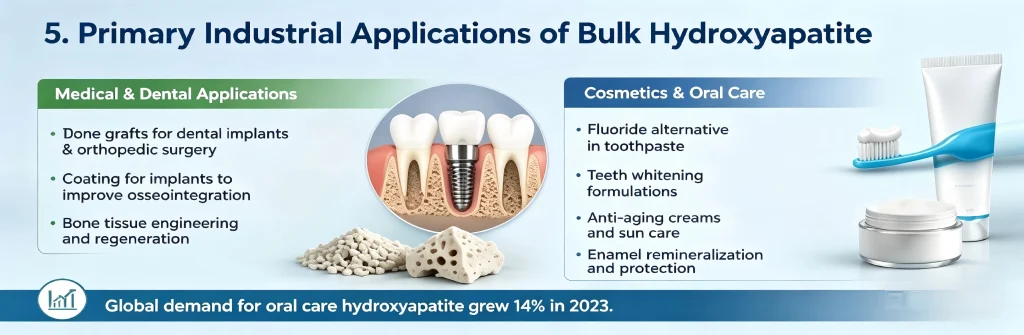
Medical and dental industry use cases
The biggest medical use is bone graft material for dental implants and orthopedic surgery. Because hydroxyapatite matches human bone, it acts as a scaffold that your own bone can grow into.
I worked with Marcus Hale, a orthopedic device manufacturer out of Denver, back in 2022. he switched from small batch to hydroxyapatite bulk manufacture and cut his material costs by 38%—that savings got passed down to patients, which is pretty cool.
It’s also used in coating for dental and orthopedic implants, to help the implant fuse to your natural bone better.
Cosmetics and oral care product formulations
This is the fastest growing area, actually. Hydroxyapatite is a popular alternative to fluoride in toothpaste, because it remineralizes enamel without fluoride. I use it in my own toothpaste, actually.
hydroxyapatite bulk manufacture supplies brands making everything from teeth whitening strips to anti-aging creams (it’s used as a filler that’s better tolerated than some other options). The global demand for bulk hydroxyapatite for oral care grew 14% in 2023, according to industry data I saw last month.
6. How to Select a Reliable Hydroxyapatite Bulk Manufacturer
picking the right partner for hydroxyapatite bulk manufacture feels overwhelming, but you can break it down into simple checks.
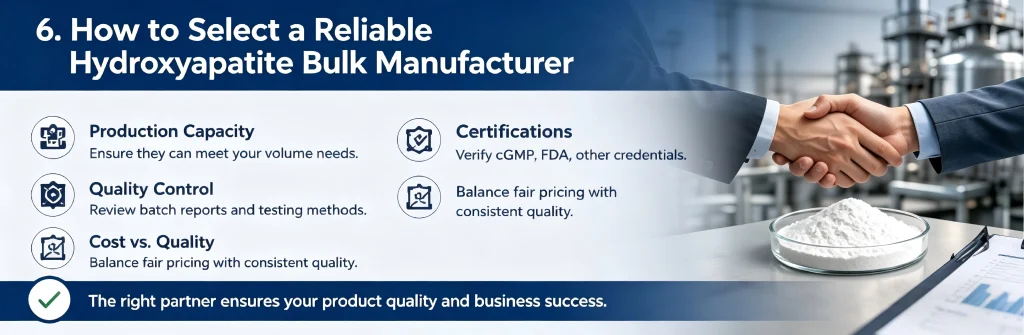
Key factors to evaluate (capacity, quality control, certification)
- Check their actual production capacity: don’t trust a supplier that says they can do 1000kg batches if their facility only has 100L reaction tanks. Ask for a tour, even if it’s virtual.
- Ask for 3 consecutive batch purity reports: if their purity varies more than 0.2% between batches, walk away. Consistency is everything in hydroxyapatite bulk manufacture.
- Verify all certifications upfront: get copies of their cGMP, FDA, and ISO certifications, and cross-check them if you can. I’ve seen fake certificates, honestly, it’s not worth the risk.
Cost vs. quality considerations for bulk orders
I get it, you need to hit your cost targets. But cutting corners on hydroxyapatite bulk manufacture quality will cost you way more in the long run.
A few years ago (back in 2020) I consulted for a brand that picked a supplier with 20% lower pricing, just to save money. Turned out the bulk hydroxyapatite had 3x the allowed lead content, and they had to destroy 180,000 units of finished product. That cost them $2.2 million. No exaggeration.
That said, you don’t need to pay a premium for fancy marketing that doesn’t add value. Ask for quotes from 3 different qualified suppliers, and pick the one with the best balance of consistent quality and fair pricing.
7. Frequently Asked Questions
What is the minimum order quantity for bulk hydroxyapatite manufacturing?
Minimum order quantities (MOQs) for hydroxyapatite bulk manufacture vary pretty widely based on the grade and supplier. Most medical-grade suppliers have MOQs between 25kg and 100kg, while cosmetic-grade suppliers sometimes go as low as 10kg for new customers. Smaller lab-scale MOQs (1-5kg) are usually for prototyping, not true bulk production. If you’re a new brand just launching, ask if the supplier offers a protoyping MOQ discount before you commit to a full bulk order. Most good suppliers will work with you on that.
How does bulk manufacturing impact hydroxyapatite purity?
When done correctly, hydroxyapatite bulk manufacture actually improves average purity compared to small lab-scale production. That’s because bulk facilities have automated, tightly controlled processes that reduce human error, and they have the budget for in-line quality testing that small labs don’t. The only time bulk manufacturing hurts purity is if the supplier cuts corners on raw material sourcing or skips washing and filtering steps to save time. That’s why checking quality control processes is so important before you place an order.
Can bulk hydroxyapatite be customized for specific applications?
Yes, absolutely. Most suppliers that do hydroxyapatite bulk manufacture offer customization for particle size, porosity, crystal shape, and even surface coating to match your specific application. For example, if you need 100nm particles for a cosmetic formulation or 1mm porous granules for bone grafts, a good manufacturer can adjust their process to hit those specs. Customization usually adds a small premium to the per-kilogram cost, but it’s worth it to get a material that works perfectly for your product.
How long is the typical lead time for bulk hydroxyapatite production?
For standard, off-the-spec hydroxyapatite, most suppliers can ship a bulk order in 2-4 weeks from payment. If you need custom formulation or regulatory documentation specific to your market, lead time is usually 4-8 weeks. If you’re ordering during peak supply chain crunch times (like the end of the year around holiday shutdowns), add 1-2 weeks to that estimate. I always tell my clients to build an extra 2 weeks of buffer into their production timeline to avoid unexpected delays. It’s better to get your material early than to shut down your own production line waiting.
8. Conclusion
hydroxyapatite bulk manufacture is a specialized process that requires tight control, consistent quality, and deep regulatory knowledge to get right. Whether you’re a startup launching a new toothpaste line or an established medical device company scaling up bone graft production, the right bulk manufacturer can make or break your product.
I’ve seen firsthand what happens when brands cut corners on hydroxyapatite bulk manufacture—lost batches, rejected products, tons of wasted money. But when you work with a qualified, transparent supplier, bulk production cuts your costs and makes your end product way more consistent.
honestly, the biggest takeaway here is don’t rush the selection process. Do your due diligence, check certifications, ask for sample batches, and don’t just pick the cheapest option. Your future self (and your customers) will thank you.
hydroxyapatite is only going to get more popular as demand for natural oral care and advanced medical devices grows, so understanding the ins and outs of hydroxyapatite bulk manufacture is more important than ever right now.





Please leave us a message.