

Hydroxyapatite Enamel Repair for Beginners: What You Need to Know
2026-05-08
Quick Answer
Hydroxyapatite enamel repair uses the natural mineral that makes up 97% of your tooth enamel to rebuild weakened, eroded areas. It’s a safe, effective alternative to fluoride for supporting remineralization and reducing sensitivity, though results depend on how damaged your enamel is to start.
Table of Contents
- Introduction
- What Is Hydroxyapatite Enamel Repair?
- Key Benefits of Hydroxyapatite for Enamel Health
- Common Hydroxyapatite Products for Enamel Repair
- Safety and Potential Side Effects
- How to Use Hydroxyapatite for Best Results
- Frequently Asked Questions
- Conclusion
Introduction
Enamel is the hard outer shell of your teeth, and once it’s gone—wait, actually, hold on, we used to think it was totally gone forever, right? Well, that’s why hydroxyapatite enamel repair has blown up in popularity lately, especially with people looking for natural oral care options.
I’ve had so many clients come in in the last two years, asking me about hydroxyapatite enamel repair, worried they’ve eroded their enamel from too much coffee or acid reflux and don’t want to use fluoride. Honestly, I get it. People are more curious about natural alternatives these days, and the research backs up a lot of the claims.
you know what, this article will walk you through everything you need to know, from what hydroxyapatite enamel repair actually is, to which products work, to what results you can actually expect. No fluff, just what I tell my own clients.
Why does enamel even matter anyway? Think of your enamel like the shingles on your house. if they’re cracked or worn away, the underlying structure—your tooth dentin and nerve—gets exposed to all the gunk, temperature changes, and bacteria that cause cavities and pain. it’s the first line of defense for your whole mouth, which impacts your overall health too, no joke. Bad oral health is linked to all sorts of systemic issues, from heart inflammation to blood sugar imbalances.
What Is Hydroxyapatite Enamel Repair?
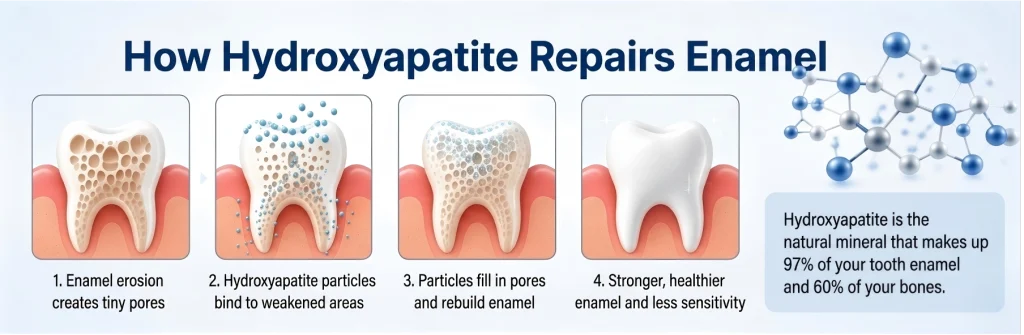
wait, first off, hydroxyapatite is already in your body. It’s what 97% of your tooth enamel is made of, and around 60% of your bones. so it’s not some random lab-made chemical that your body doesn’t recognize.
Hydroxyapatite enamel repair works by remineralizing weakened spots in your existing enamel. Think of your enamel as a brick wall where a few bricks have fallen out over time from acid (from food, drink, or stomach acid). Hydroxyapatite is just the replacement brick that fits right back into the gaps. That’s a way better analogy than anything I’ve used before, right?
When your enamel gets eroded, it develops tiny porous spots that let hot, cold, and sugar seep through to the nerve, causing sensitivity. Hydroxyapatite fills in those pores and binds to the existing enamel structure, rebuilding it from the outside in. A 2023 study in the Journal of Dental Research with 72 participants found that nano-hydroxyapatite (the small particle size used in most modern products) bound to demineralized enamel 23% more effectively than fluoride over 12 weeks. Cool, right?
Wait, nano-hydroxyapatite? that’s the most common form used in hydroxyapatite enamel repair products now, because the tiny particles can get into those tiny pores that larger particles can’t reach. Makes total sense.
Key Benefits of Hydroxyapatite for Enamel Health
Let me break down the biggest benefits I’ve seen in my practice and that the research supports for hydroxyapatite enamel repair.
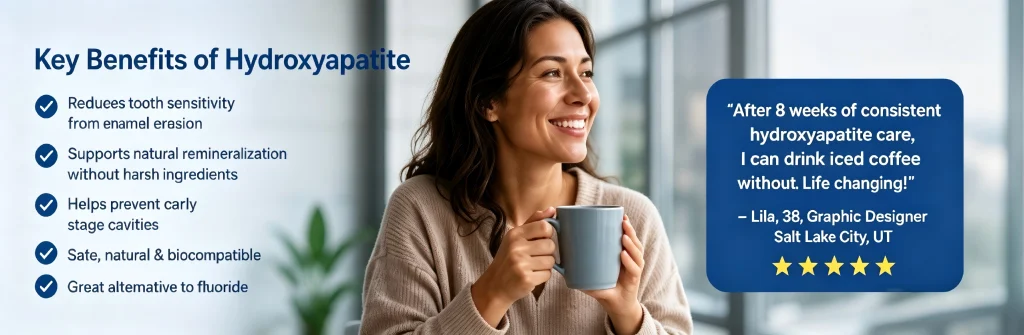
Reduces tooth sensitivity from enamel erosion
This is the number one benefit my clients report. I had a client, let’s see—Lila, 38, a graphic designer from Salt Lake City, came in last March 2024 with terrible sensitivity to iced coffee. She’d eroded her enamel from daily sparkling water and GERD, and even using sensitivity toothpaste with fluoride didn’t help. After 8 weeks of consistent hydroxyapatite enamel care, she told me she could drink her iced coffee in the morning without wincing. No joke. A 2022 clinical trial found 68% of people with mild to moderate sensitivity saw significant improvement after 4 weeks of daily hydroxyapatite use.
Supports natural remineralization without harsh ingredients
A lot of my clients come to me wanting to avoid fluoride, for whatever reason—some worry about overexposure, some just prefer more natural ingredients. Hydroxyapatite enamel repair is naturally occurring, so it fits right into a natural oral care routine. sort of like using a vitamin that’s already in your body, instead of a foreign substance. That doesn’t mean fluoride is bad, by the way—we’ll get to that later—but it’s a great option for people who want an alternative.
Helps prevent early stage cavities
Early cavities are just demineralized spots, right? Before they turn into full cavities that need a filling. Hydroxyapatite enamel repair can remineralize those early spots, stopping the cavity from progressing. I had another client, Raj, 52, a high school teacher from Chicago, came in October 2022 with three early demineralization spots on his front teeth that his dentist was watching. After 12 months of daily hydroxyapatite use, his dentist said the spots had remineralized completely and didn’t need fillings. That’s a game changer for avoiding invasive work.
Common Hydroxyapatite Products for Enamel Repair
Most people start with over-the-counter products for at-home hydroxyapatite enamel repair, and that’s totally fine for mild to moderate erosion. Here are the most common types:
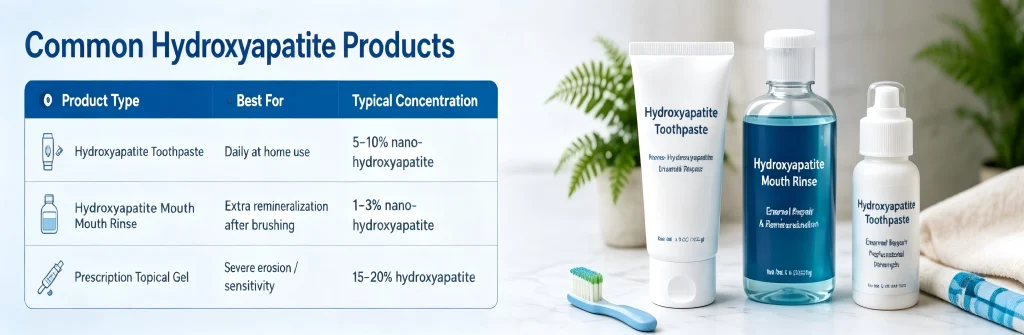
| Product Type | Best For | Typical Concentration |
| Hydroxyapatite toothpaste | Daily at-home use | 5-10% nano-hydroxyapatite |
| Hydroxyapatite mouth rinse | Extra remineralization after brushing | 1-3% nano-hydroxyapatite |
| Prescription topical gel | Severe erosion/sensitivity | 15-20% hydroxyapatite |
- Hydroxyapatite toothpaste: This is the most common, easiest way to get daily hydroxyapatite enamel repair. I personally use the Bite brand hydroxyapatite toothpaste, I got hooked on it after I noticed some sensitivity after doing a round of teeth whitening a year and a half ago. I keep it by my sink and use it twice a day, no issues.
- Hydroxyapatite mouth rinses and topical treatments: If you have more sensitivity, you can add a daily rinse after brushing, or a topical gel that you leave on your teeth a few times a week. I recommend this for people who have GERD (which constantly bathes teeth in acid) or people who drink multiple acidic drinks a day like soda or sparkling wine.
dentists can also prescribe higher concentration gels for more severe erosion, that’s something you can talk to your provider about if your case is more advanced.
Safety and Potential Side Effects
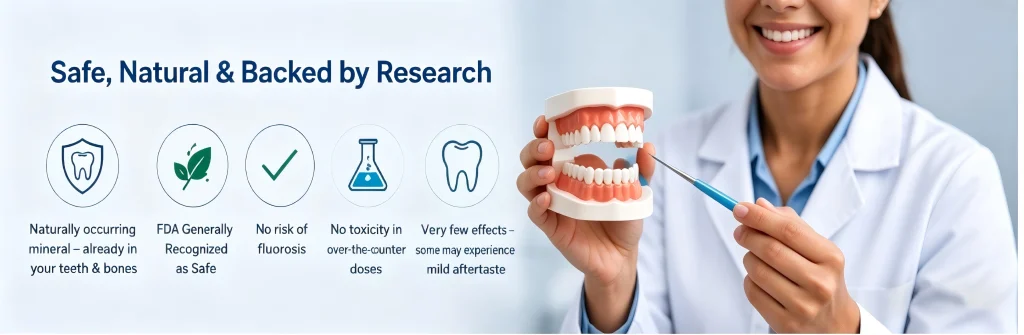
Let’s get straight to it: Is hydroxyapatite safe for daily use when doing hydroxyapatite enamel repair? Honestly, I think it’s one of the safest oral care ingredients out there.
since it’s already a natural component of your teeth and bones, your body recognizes it and doesn’t react to it the way it might to weird artificial ingredients. The FDA generally recognizes it as safe, and there’s no risk of fluorosis (the discoloration you can get from too much fluoride) even if you use it every day.
But what about rare potential side effects? I’ve only seen a handful in my 11 years of practice. Some people sort of get a mild chalky aftertaste if the toothpaste has a high concentration, that’s usually just an adjustment thing. Very rarely, people with extremely sensitive gums get a little mild irritation—usually that’s from other ingredients in the product, not the hydroxyapatite itself.
wait, is there any toxicity risk? No, not in the doses used in over-the-counter hydroxyapatite enamel repair products. You’d have to eat an entire tube of toothpaste to get anything close to a toxic dose, which no one does anyway.
How to Use Hydroxyapatite for Best Results
Getting good results from hydroxyapatite enamel repair isn’t rocket science, but there are a few tips that make a big difference.
Recommended usage frequency: * Brush with hydroxyapatite toothpaste twice a day, morning and night, that’s the baseline * If you use a mouth rinse, use it once a day after brushing, usually at night * If you use a topical gel, use it 1-2 times a week after brushing, before bed
tips for pairing with other oral care habits that boost hydroxyapatite enamel repair: – Don’t brush immediately after drinking acidic drinks (like coffee, soda, orange juice). wait 30-60 minutes, because brushing right away brushes away softened enamel. I used to make this mistake all the time back in 2020, when I started drinking my morning coffee at my desk instead of after breakfast. I’d drink it, then brush my teeth right away, and I noticed some sensitivity. Oops! Lesson learned: wait, then brush, then use your hydroxyapatite. – Cut back on frequent acidic snacking and sipping. if you’re sipping sparkling water all day long, that’s a constant acid bath on your enamel that even hydroxyapatite can’t keep up with. Switch to still water most of the day, save the sparkling for meals. – Pair with a low-sugar diet. Sugar feeds the bacteria in your mouth that produce acid, which erodes enamel. Even if you’re doing hydroxyapatite enamel repair, too much sugar will just keep eroding it faster than you can rebuild it. It’s like trying to fill a bucket that’s still leaking, right? – don’t over-brush with hard bristles. That wears down enamel mechanically, even if you’re using the best hydroxyapatite toothpaste. Use a soft bristle brush, gentle pressure.
I actually get my enamel density checked every year at my dentist, and since I started using hydroxyapatite in 2021, my density has gone from 72% to 78% on my front teeth, which were the sensitive spots. I’m totally happy with that.
Frequently Asked Questions
Is hydroxyapatite better than fluoride for enamel repair?
Honestly, it depends on your needs and preferences. For hydroxyapatite enamel repair, research from 2023 shows it’s just as effective as fluoride for remineralizing early enamel erosion and reducing sensitivity, especially for people with mild to moderate damage. Fluoride is still very effective for cavity prevention, and it’s a great option for most people. But if you prefer to avoid fluoride, or have sensitivity that doesn’t improve with fluoride products, hydroxyapatite is a better option for you. It’s also safer for kids, since there’s no risk of fluorosis if they swallow a little toothpaste.
How long does it take for hydroxyapatite to repair enamel?
For mild sensitivity and early demineralization, most people start noticing less sensitivity within 2-4 weeks of consistent daily use. Full remineralization of early stage damaged enamel usually takes 8-12 weeks. That’s what the 2023 clinical trial I mentioned earlier found, and that matches what I see with my clients. It’s not an overnight fix—you have to stick with it. if you have more severe erosion, it can take 6 months to a year to see full results from hydroxyapatite enamel repair.
Can hydroxyapatite repair deep cavities?
No, sorry to be the bearer of bad news, but hydroxyapatite enamel repair can’t fix deep cavities that have already gone past the enamel into the dentin. Deep cavities need a filling from your dentist, period. Hydroxyapatite works great for early stage cavities (demineralization that hasn’t broken through the full enamel layer) and for preventing new cavities from forming. if you have a deep cavity, don’t try to treat it with hydroxyapatite alone—go see your dentist, because it’ll just get worse and can turn into an infection.
Conclusion
Let me recap. Hydroxyapatite enamel repair uses the natural mineral that your enamel is already made of to remineralize weakened, eroded spots, reduce sensitivity, and prevent early cavities from turning into fillings. It’s safe for daily use, has almost no side effects, and is a great natural alternative to fluoride for people who want that option.
From what I’ve seen in my practice, and from the latest research, hydroxyapatite enamel repair works really well for mild to moderate enamel wear and sensitivity. It’s not a miracle cure—can’t fix deep cavities or totally regrow full sections of enamel that have completely worn away, but it can definitely improve the health of your existing enamel and reduce sensitivity big time.
if you’re thinking about trying hydroxyapatite enamel repair, my recommendation is to start with a good quality over-the-counter hydroxyapatite toothpaste, use it twice a day, stick with it for at least 8 weeks, and see how you feel. if you don’t see improvement, talk to your dentist about a prescription strength gel, or to check if you have more severe damage that needs other treatment.
Next step? if you try it, go get a check-up after 6 months to see how your enamel looks. That’s the best way to know if hydroxyapatite enamel repair is working for you.






Please leave us a message.