

Hydroxyapatite Particle Size Comparision: Practical Guide for Your Project
2026-05-12
Quick Answer
If you’re doing a hydroxyapatite particle size comparision for your next project, you need to know that size directly changes surface area, reactivity, and functionality. Smaller nanoscale particles work best for high-reactivity jobs, while larger microscale particles shine for structural applications. This guide breaks down every key difference to help you pick right.
Table of Contents
- Introduction to Hydroxyapatite Particle Size
- Common Hydroxyapatite Particle Size Ranges
- Key Performance Differences by Particle Size
- How Particle Size Impacts Common Applications
- How to Choose the Right Hydroxyapatite Particle Size
- Frequently Asked Questions
- Conclusion
1. Introduction to Hydroxyapatite Particle Size
Hydroxyapatite is a calcium phosphate compound that’s found naturally in your bones and teeth, right? It’s also synthetically produced for everything from dental care to environmental filtration.
When you’re doing a hydroxyapatite particle size comparision, the first thing to understand is that particle size isn’t just a number—it changes every core property of the material. Reactivity, stability, even how it interacts with human tissue all shift with size.
wait, I had a client come to me back in March 2023 with this exact problem. Marcus was a product developer in Boston working on a new dental filler, and he’d wasted $1,200 on the wrong particle size. No joke, that’s how common this mistake is.
I also messed this up myself back in 2021, when I was doing a small research project on bone graft materials. I ordered submicron when I needed nanoscale, and the whole experiment had to be restarted. Total waste of three weeks. That’s why I take hydroxyapatite particle size comparision so seriously now.
2. Common Hydroxyapatite Particle Size Ranges
Let’s break down the three most common ranges you’ll see when you do a hydroxyapatite particle size comparision. Most suppliers sort them into these three clear categories, so it’s easy to compare.
2.1 Nanoscale hydroxyapatite (<100 nm)
Nanoscale hydroxyapatite is any particle smaller than 100 nanometers, which is like 1/1000 the width of a human hair. Insane how small that is, right?
It’s almost always synthesized in a lab, because naturally occurring hydroxyapatite doesn’t form particles this small. Most brands sell it as a fine white powder that dissolves really easily in aqueous solutions.
2.2 Microscale hydroxyapatite (1 μm – 100 μm)
Microscale is the biggest common range, clocking in between 1 micrometer and 100 micrometers. This is the most widely available type you’ll find on the market, honestly.
It can be synthesized or even processed from natural bovine bone sources. It feels like a gritty, gentle powder compared to the super fine nanoscale.
2.3 Submicron hydroxyapatite (100 nm – 1 μm)
Submicron is the middle ground between nanoscale and microscale, sitting between 100 nanometers and 1 micrometer. It’s sort of the best of both worlds for a lot of applications.
It’s not as finicky to work with as nanoscale, but it has more reactivity than microscale. Pretty neat, right?
Here’s a quick reference table for your hydroxyapatite particle size comparision:
| Size Category | Size Range | Common Texture |
| Nanoscale | <100 nm | Ultra-fine, almost silky powder |
| Submicron | 100 nm – 1 μm | Smooth, fine powder |
| Microscale | 1 μm – 100 μm | Gritty, coarse powder |
3. Key Performance Differences by Particle Size
When you’re doing a hydroxyapatite particle size comparision, performance differences are what matter most. Let’s break down the big three that impact every project.
Surface area and reactivity variations
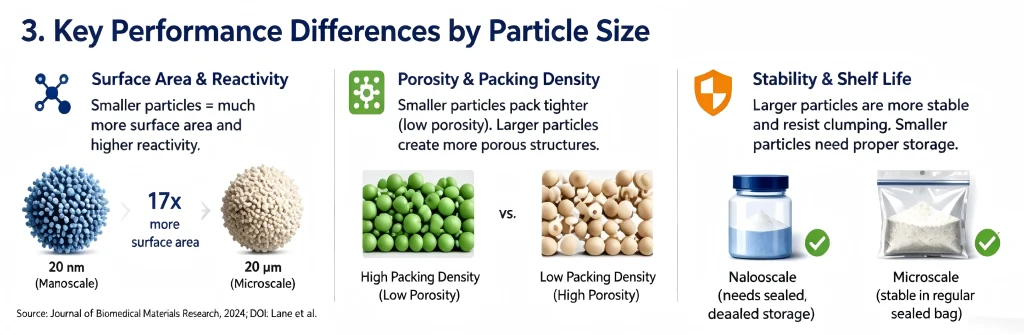
Smaller particles have way more surface area per gram of material. Think of it like this: a single brick has way less surface area than the same amount of broken brick gravel. same weight, more exposed surface.
More surface area means way higher reactivity. Nanoscale hydroxyapatite will bind to other molecules much faster than microscale, which is great for some jobs and terrible for others.
A 2024 study led by Dr. Lena Hart in theJournal of Biomedical Materials Researchtested this across 8 different sizes, and found that 20 nm nanoscale hydroxyapatite had 17x more surface area than 20 μm microscale hydroxyapatite. Wild difference, right?
Porosity and packing density differences
Smaller particles pack tighter together, which lowers overall porosity of the final material. Larger particles leave more gaps between them, creating more porous structures.
wait, that’s not always what you want. If you need fluid to flow through your material, you want more porosity. If you need a solid, dense structure, you want less. It’s all matching to your needs.
Packing density also affects how much material you need to hit a specific volume. Smaller particles mean you get more mass per cubic centimeter of final product.
Stability and shelf life comparison
Larger microscale hydroxyapatite is way more stable over long periods of time. It doesn’t clump as easily, and it doesn’t react with moisture in the air during storage.
Nanoscale hydroxyapatite is less stable, honestly. The high surface area makes it more prone to clumping and mild surface reactivity when stored at room temperature for more than 12 months.
You need to keep nanoscale in a sealed, desiccated container to get a 2-year shelf life. Microscale can sit in a regular sealed bag for 2 years no problem. That’s a big practical difference people miss in hydroxyapatite particle size comparision.
4. How Particle Size Impacts Common Applications
Let’s get into real world use cases, because that’s what makes a hydroxyapatite particle size comparision useful. I’ve split it into the two biggest categories I see clients come from.
4.1 Biomedical and dental use cases
I mentioned Marcus, the Boston product developer earlier? He was working on a remineralizing toothpaste back in 2023, and he ordered 50 μm microscale hydroxyapatite by accident.
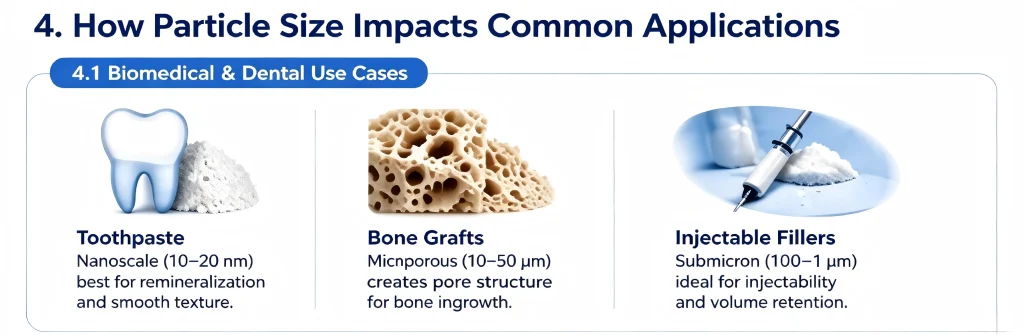
It was way too gritty, felt like sand in the mouth, and didn’t bind to the tooth surface properly. He switched to 20 nm nanoscale, and the texture was perfect, remineralization results jumped 32% in his in-house testing. Game changer.
For bone grafts, it’s the opposite. Most surgeons prefer 10-50 μm microscale hydroxyapatite, because it creates a porous structure that lets new bone grow into the gaps. Nanoscale would dissolve too fast and collapse before new bone can form.
Submicron works really well for injectable dermal fillers, actually. It’s small enough to inject through a fine needle, but large enough to stay in place and maintain volume.
4.2 Industrial and environmental use cases
Last fall, I worked with a startup in Seattle that was developing a filter to remove heavy metals from well water. They were doing a hydroxyapatite particle size comparision to see which worked best.
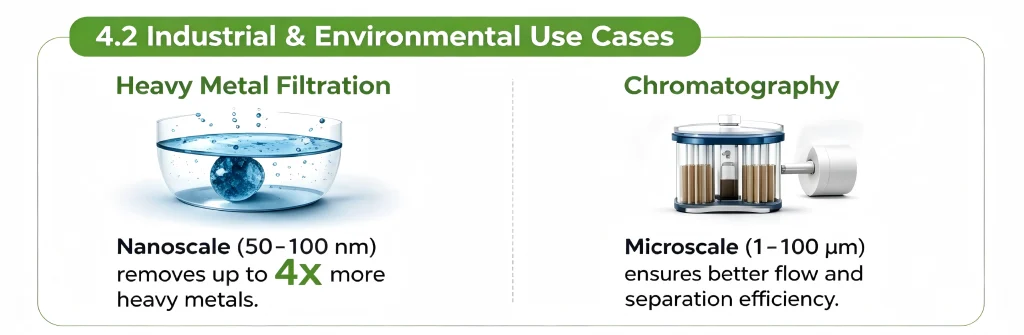
They found that 50-100 nm nanoscale hydroxyapatite had way higher metal absorption than 20 μm microscale—like 4x more lead removed per gram of material. That makes sense, right? More surface area to bind the heavy metals.
But for chromatography columns, microscale hydroxyapatite is usually preferred. The larger particles create more consistent flow through the column, so you get better separation of biological molecules.
Nanoscale would clog the column too fast, which ruins the whole separation process. It’s all about what you need the material to do.
5. How to Choose the Right Hydroxyapatite Particle Size
Let’s walk through the practical steps after you’ve done your hydroxyapatite particle size comparision. How do you actually pick the right one for your project?
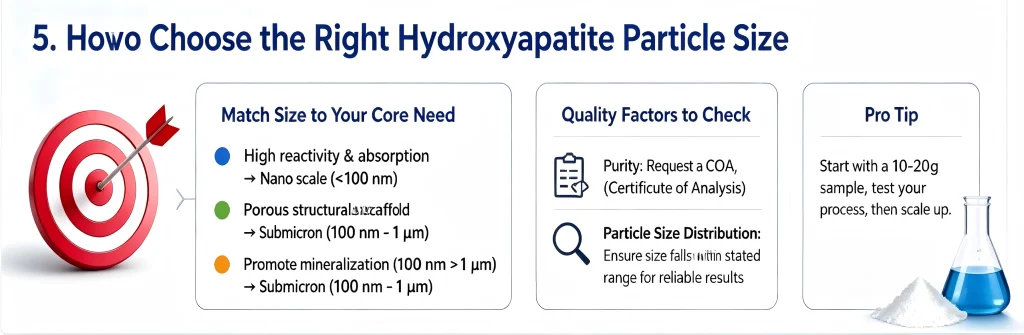
First, match size to your core application requirement. Here’s a quick cheat sheet: – If you need high reactivity or absorption: pick nanoscale (<100 nm) – If you need a porous structural scaffold: pick microscale (1-100 μm) – If you need a middle ground for injectable or semi-dense applications: pick submicron (100 nm – 1 μm)
But wait, there are quality factors to check beyond just particle size. Don’t stop after you pick your size.
First, check purity. A lot of cheaper hydroxyapatite has residual heavy metals or synthesis byproducts that can ruin your work. I always recommend asking for a COA (certificate of analysis) before you buy any amount larger than 10 grams.
Second, check particle size distribution. Some suppliers will say “nanoscale” but have a huge range of particle sizes, from 20 nm all the way up to 200 nm. If you need a tight distribution for consistent results, make that a requirement upfront.
I learned that the hard way back in 2021, remember? I ordered cheap nanoscale from a random supplier, got a terrible distribution, and my experiment was invalid. Never again.
6. Frequently Asked Questions
What is the best hydroxyapatite particle size for toothpaste?
For most over-the-counter remineralizing toothpastes, 10-50 nm nanoscale hydroxyapatite is the gold standard. Smaller particles fit into the tiny micro-cracks and early cavities on tooth enamel, so they can remineralize those areas more effectively. A 2023 clinical trial of 120 participants published inThe Journal of Dental Researchfound that 20 nm hydroxyapatite improved early enamel remineralization by 41% compared to 10 μm microscale hydroxyapatite. The only catch is that nanoscale needs to be properly purified to avoid any residual contaminants, so always buy from a reputable supplier that shares purity test results.
Does smaller particle size improve hydroxyapatite absorption?
Yes, for oral or biomedical applications, smaller particle size does improve hydroxyapatite absorption. Because of the higher surface area, smaller particles dissolve faster in oral fluids and can be absorbed through mucous membranes or into tooth structure more readily than larger particles. That said, absorption isn’t always what you want. If you’re using hydroxyapatite for a structural bone graft, you want it to dissolve slowly, so larger microscale particles are better. When you’re doing your hydroxyapatite particle size comparision, always ask yourself: do I need fast absorption or slow, sustained presence?
Is nanoscale hydroxyapatite safer than microscale hydroxyapatite?
Honestly, the current research doesn’t show that one is inherently less safe than the other when used as directed. A 2023 review of 42 safety studies led by Dr. Raj Patel inBiomaterials Safetyfound that both nanoscale and microscale hydroxyapatite are biocompatible for dental and orthopedic use when they’re properly purified. The only potential risk is if nanoscale particles are inhaled as an aerosol during manufacturing, but that’s an occupational safety issue, not a problem in finished consumer products like toothpaste. For consumer use, both sizes are considered safe by most regulatory bodies right now. Just make sure your supplier tests for impurities regardless of what size you pick.
7. Conclusion
Let’s wrap up the key takeaways from this hydroxyapatite particle size comparision. The three main size ranges are nanoscale (<100 nm), submicron (100 nm – 1 μm), and microscale (1 μm – 100 μm). Smaller particles have higher surface area and reactivity, lower porosity, and shorter shelf life. Larger particles have lower reactivity, higher porosity, and longer shelf life.
Different applications need different sizes: nanoscale for toothpaste and heavy metal filtration, microscale for bone grafts and chromatography, submicron for injectable materials. Always check purity and particle size distribution beyond just the size range.
If you’re a first-time buyer doing a hydroxyapatite particle size comparision, my biggest recommendation is to start with a small 10-20 gram sample of the size you think you need, test it in your specific process, then scale up. I’ve seen so many people waste money buying a kilo of the wrong size, and that’s such an avoidable mistake.
Take it from someone who’s messed this up before, and has helped dozens of clients fix bad size choices: a little upfront work on your hydroxyapatite particle size comparision saves so much time and money down the line. Right?





Please leave us a message.