

Hydroxyapatite Powder Raw Material: Properties, Grades and Applications
2026-03-30

Hydroxyapatite powder is a calcium phosphate raw material widely used in oral care, dental materials, bone repair, implant coatings, cosmetic formulations and biomaterial research. For manufacturers, choosing the right hydroxyapatite powder is not only about finding a white mineral powder. It requires careful evaluation of particle size, Ca/P ratio, purity, phase composition, morphology, safety data and application requirements.
As demand grows for functional oral care ingredients, dental-grade materials and biocompatible calcium phosphate raw materials, hydroxyapatite has become an important ingredient for product developers and purchasing teams. However, different hydroxyapatite grades may perform very differently in toothpaste, mouthwash, dental composites, implant coatings or bone repair materials.
This guide explains what hydroxyapatite powder is, how it is used, which specifications matter, and how to choose a reliable hydroxyapatite powder supplier.
What Is Hydroxyapatite Powder?
Hydroxyapatite is a calcium phosphate compound with the chemical formula Ca10(PO4)6(OH)2. It is chemically similar to the mineral phase found in human bones and teeth, which is one reason why it is widely studied and used in dental and biomedical material applications.
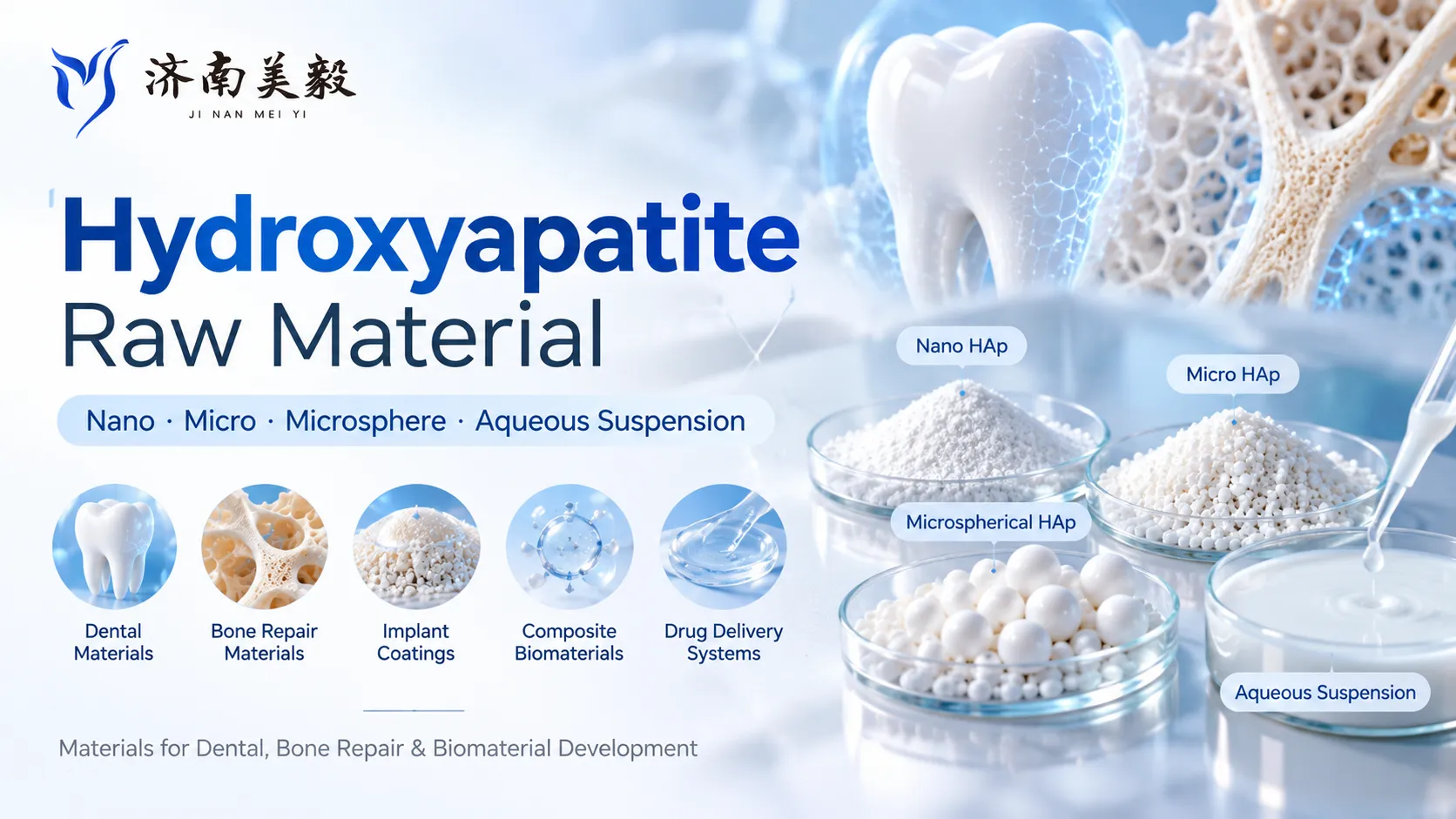
In raw material form, hydroxyapatite is usually supplied as a white or off-white powder. Depending on the production process, it can be manufactured in nano, micro, spherical, rod-like, needle-like, porous or irregular particle forms.
For B2B buyers, hydroxyapatite powder is not a single fixed material. It can be customized or selected based on:
- Particle size
- Particle morphology
- Ca/P ratio
- Purity
- Phase composition
- Crystallinity
- Surface area
- Heavy metal limits
- Microbial limits
- Application field
This makes hydroxyapatite a versatile raw material for oral care, dental materials and bone-related biomaterial development.
Key Properties of Hydroxyapatite Powder
Hydroxyapatite powder is valued because of its chemical similarity to hard tissues, mineral composition and broad formulation compatibility. However, performance depends strongly on technical specifications.
1. Calcium Phosphate Composition
Hydroxyapatite belongs to the calcium phosphate family. Its calcium and phosphate structure makes it highly relevant to dental and bone-related applications. For stoichiometric hydroxyapatite, the Ca/P molar ratio is commonly close to 1.67.
2. White Powder Appearance
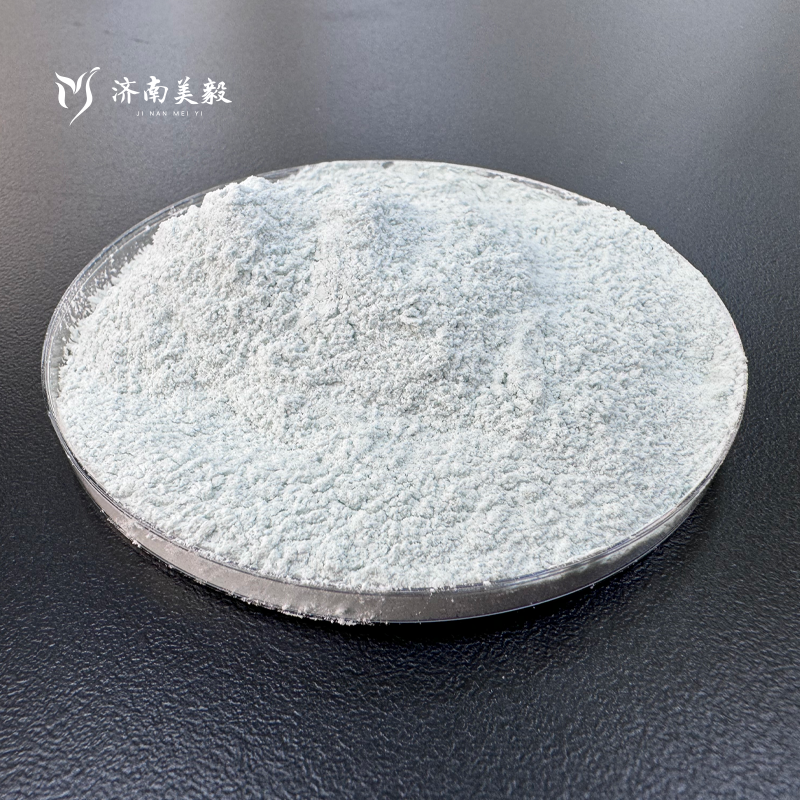
Commercial hydroxyapatite powder is usually white or off-white. A clean and consistent appearance can be important for toothpaste, cosmetic formulations and other visible product formats.
3. Particle Size
Particle size is one of the most important selection factors. Nano hydroxyapatite is often used in oral care formulations where close interaction with tooth surfaces is desired. Micro hydroxyapatite may be selected for polishing, bulk mineral content, coating, ceramic or biomedical applications.
4. Particle Morphology
Hydroxyapatite particles may be spherical, rod-shaped, needle-like, plate-like, porous or irregular. Morphology can affect dispersion, viscosity, flowability, surface interaction and composite performance.
5. Ca/P Ratio
The Ca/P ratio is an important quality indicator for hydroxyapatite powder. A Ca/P ratio close to 1.67 is commonly associated with stoichiometric hydroxyapatite. If the ratio is significantly different, buyers should check whether other calcium phosphate phases are present.
6. Phase Purity
Hydroxyapatite powder may contain different calcium phosphate phases depending on the synthesis method and processing conditions. For dental and biomedical applications, phase purity should be evaluated carefully.
7. Biocompatibility
Hydroxyapatite is widely used in biomaterial research because of its similarity to natural bone and tooth mineral. For advanced dental and bone-related materials, buyers should confirm whether the selected grade matches the intended application and regulatory pathway.
Main Grades of Hydroxyapatite Powder
Different applications require different hydroxyapatite grades. Choosing the wrong grade may lead to poor dispersion, unstable formulation, unsuitable texture or inconsistent product performance.
| Hydroxyapatite Grade | Typical Application Direction |
|---|---|
| Nano Hydroxyapatite Powder | Toothpaste, mouthwash, enamel-support formulas, sensitivity-focused oral care |
| Micro Hydroxyapatite Powder | Polishing, powder blends, ceramic materials, bulk mineral systems |
| Dental Grade Hydroxyapatite | Dental materials, oral care products, implant-related materials |
| Medical Grade Hydroxyapatite | Bone repair, implant coatings, biomaterial development |
| Cosmetic Grade Hydroxyapatite | Skincare, soft-focus formulas, texture improvement |
| Porous Hydroxyapatite | Bone graft substitutes, scaffolds, bone repair materials |
| Spherical Hydroxyapatite | Coatings, smooth dispersion systems, free-flowing powders |
| Custom Hydroxyapatite Powder | Application-specific particle size, morphology and purity requirements |
Applications of Hydroxyapatite Powder
Hydroxyapatite powder can be used in several industries. For SEO and product positioning, it is useful to separate applications clearly instead of mixing every use into one general paragraph.
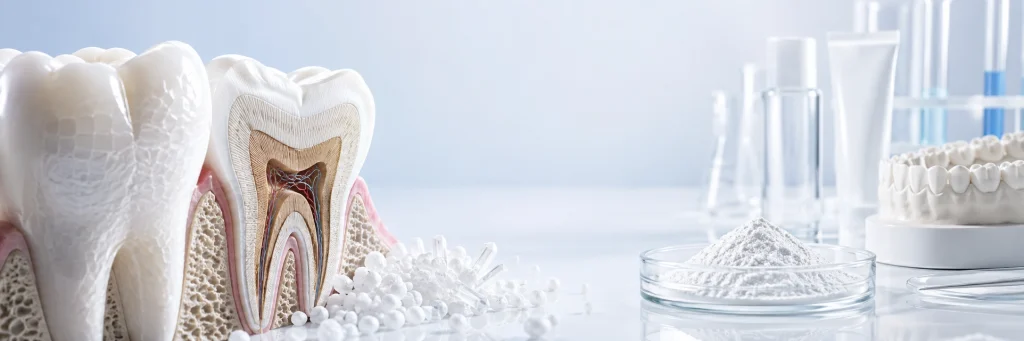
Hydroxyapatite Powder in Oral Care Formulations
Oral care is one of the most active application fields for hydroxyapatite powder. It is used in toothpaste, mouthwash, gels, tooth powders and sensitivity-focused oral care products.
Common oral care applications include:
- Fluoride-free toothpaste
- Enamel-support toothpaste
- Remineralization-focused products
- Sensitive teeth formulations
- Mouthwash suspensions
- Professional oral care products
For toothpaste formulations, formulators often focus on particle size, dispersion, mouthfeel and compatibility with humectants, thickeners and surfactants. Nano hydroxyapatite may be selected for products that target close surface interaction, while micro hydroxyapatite may be used in formulas where bulk mineral content or polishing behavior matters.
For mouthwash and liquid oral care products, dispersion stability is especially important. If hydroxyapatite powder is not properly dispersed, it may settle, form aggregates or affect product appearance.
Hydroxyapatite Powder in Dental Materials
Hydroxyapatite is also used in dental material development. Compared with consumer oral care products, dental material applications usually require stricter control over purity, phase composition, particle morphology and processing behavior.
Potential dental applications include:
- Dental composites
- Dental polishing materials
- Dentin desensitizing products
- Implant surface treatment
- Hydroxyapatite coatings for dental implants
- Enamel-related material development
For dental materials, hydroxyapatite powder should be evaluated together with Ca/P ratio, crystallinity, morphology and particle size distribution. A powder suitable for toothpaste may not automatically be suitable for implant coatings or dental composites.
Hydroxyapatite Powder in Bone Repair Materials
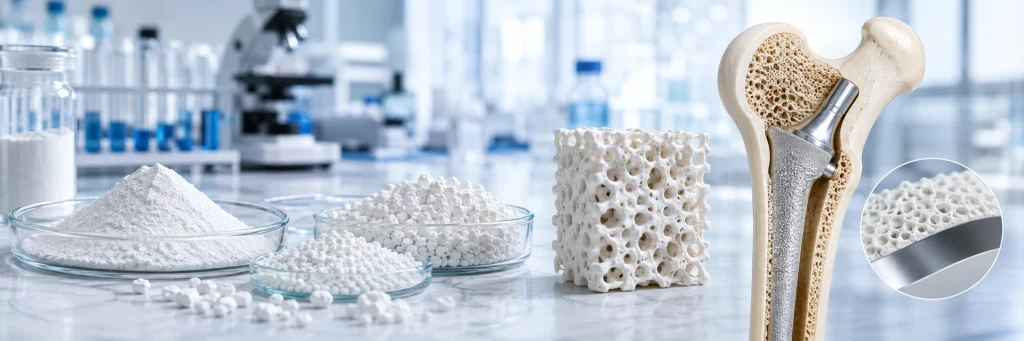
Hydroxyapatite is widely studied and used in bone repair and orthopedic biomaterial applications. Because it is chemically similar to natural bone mineral, it is often selected for materials that require osteoconductive support and mineral-based structure.
Common bone repair applications include:
- Bone graft substitute materials
- Bone void fillers
- Porous bioceramic scaffolds
- Hydroxyapatite/β-TCP composite systems
- Hydroxyapatite-polymer composites
- Orthopedic implant coatings
- 3D printed bone repair scaffolds
For bone repair materials, hydroxyapatite grade selection depends on porosity, particle size, resorption behavior, phase composition and mechanical requirements. Porous hydroxyapatite may be preferred for scaffold and bone ingrowth concepts, while spherical or spray-dried hydroxyapatite may be selected for coating processes.
Hydroxyapatite Powder in Implant Coatings
Hydroxyapatite coating materials are used in dental and orthopedic implant applications. The goal is usually to improve surface bioactivity and support bone integration around the implant.
For coating applications, powder flowability, particle size, phase purity and thermal behavior are important. Spherical or free-flowing hydroxyapatite powders may be useful for certain coating technologies because consistent powder flow can improve process stability.
Manufacturers should match hydroxyapatite powder specifications with the intended coating method, equipment requirements and final implant application.
Hydroxyapatite Powder in Cosmetic and Personal Care Products
Hydroxyapatite is also used in cosmetic and personal care product development. In cosmetic applications, it may be selected for texture, soft-focus effects, mineral-based positioning or specialty skin care concepts.
Possible personal care applications include:
- Cosmetic powders
- Skin care formulations
- Oral beauty concepts
- Mineral-based personal care products
For cosmetic use, formulators should focus on particle size, appearance, dispersion, skin feel, heavy metals and regulatory suitability.
Nano Hydroxyapatite vs Micro Hydroxyapatite
One common question from formulators is whether nano hydroxyapatite or micro hydroxyapatite is better. The answer depends on the application.
Nano hydroxyapatite has a smaller particle size and higher surface activity. It may be useful in enamel-support oral care products, smooth toothpaste systems and research-focused dental applications. However, nano powders may also agglomerate more easily and require stronger dispersion control.
Micro hydroxyapatite may be easier to handle in some powder systems. It can be useful for polishing, powder blends, coatings or bulk mineral formulations. However, its interaction with surfaces may differ from nano-sized particles.
Buyers should not choose a hydroxyapatite grade based only on the word “nano” or “micro.” A better approach is to evaluate:
- Application format
- Particle size distribution
- Aggregation state
- Morphology
- Surface area
- Dispersion behavior
- Ca/P ratio
- Phase purity
- Supplier documentation
Important Specifications for Hydroxyapatite Powder
For purchasing teams, a professional hydroxyapatite powder supplier should provide more than a product name. Technical data is essential.
| Parameter | Why It Matters |
| Appearance | Helps confirm visual consistency and suitability for visible formulations |
| Particle Size | Affects dispersion, texture, surface interaction and processing |
| Particle Morphology | Influences flowability, rheology, surface contact and composite behavior |
| Ca/P Ratio | Helps evaluate chemical balance and hydroxyapatite phase characteristics |
| Purity | Important for dental, cosmetic and biomedical applications |
| Phase Composition | Confirms whether the material is mainly hydroxyapatite or mixed calcium phosphate phases |
| Crystallinity | Affects stability, solubility and thermal behavior |
| Specific Surface Area | Influences reactivity, dispersion and interaction with other materials |
| Heavy Metal Limits | Important for safety and regulatory evaluation |
| Microbial Limits | Important for oral care and cosmetic formulations |
| COA/TDS/SDS | Essential documents for B2B purchasing and formulation development |
How to Choose the Right Hydroxyapatite Powder
The best hydroxyapatite powder depends on the final product. Buyers should first define the application and then evaluate technical requirements.
For Toothpaste and Oral Care
Choose hydroxyapatite powder with:
- Suitable particle size
- Good dispersion behavior
- Smooth mouthfeel
- Stable formulation compatibility
- Low heavy metal content
- Appropriate safety data
- Reliable batch quality
For Mouthwash and Liquid Systems
Choose hydroxyapatite powder with:
- Good suspension stability
- Low sedimentation tendency
- Fine and controlled particle size
- Suitable dispersibility
- Compatibility with stabilizers and surfactants
For Dental Materials
Choose hydroxyapatite powder with:
- Controlled Ca/P ratio
- High phase purity
- Suitable morphology
- Consistent particle size distribution
- Processing compatibility
- Technical and quality documentation
For Bone Repair Materials
Choose hydroxyapatite powder with:
- Application-matched particle size
- Suitable porosity or morphology
- Reliable phase composition
- Appropriate purity level
- Heavy metal control
- Biocompatibility-related data where required
- Strong supplier technical support
For Implant Coatings
Choose hydroxyapatite powder with:
- Good powder flowability
- Controlled particle size
- Stable phase composition
- Suitable thermal behavior
- Consistent batch-to-batch quality
- Coating process compatibility
What Documents Should Buyers Request?
Before ordering hydroxyapatite powder, buyers should request a complete technical package. Important documents may include:
- Certificate of Analysis
- Technical Data Sheet
- Safety Data Sheet
- Particle size distribution report
- Ca/P ratio data
- Phase composition information
- SEM or morphology images
- Heavy metal testing
- Microbial testing, if applicable
- Recommended application guidance
- Storage and handling information
For advanced dental or biomedical materials, additional testing may be required depending on the final product and local regulatory pathway.
How to Evaluate a Hydroxyapatite Powder Supplier
A reliable hydroxyapatite supplier should understand both raw material production and application requirements. Buyers should evaluate suppliers based on quality consistency, technical support and documentation.
Key questions to ask include:
- Can the supplier provide nano and micro hydroxyapatite grades?
- Is custom particle size available?
- Can the supplier provide Ca/P ratio data?
- Are COA, TDS and SDS available?
- Is phase purity tested?
- Are heavy metals controlled?
- Can the supplier provide SEM images or morphology data?
- Does the supplier understand oral care, dental and bone repair applications?
- Can the supplier support sample testing and scale-up?
Choosing the right supplier can reduce formulation risk, improve product development efficiency and support long-term raw material stability.
Common Buyer Mistakes
Mistake 1: Only Looking at Price
Low-cost hydroxyapatite powder may not provide stable particle size, purity or documentation. For professional product development, quality consistency is more important than a low initial price.
Mistake 2: Choosing Nano Hydroxyapatite Without Checking Dispersion
Nano hydroxyapatite may agglomerate if the formulation system is not properly designed. Buyers should evaluate actual dispersion performance, not only the advertised particle size.
Mistake 3: Ignoring Ca/P Ratio
Ca/P ratio helps indicate chemical balance and phase characteristics. It should be reviewed together with purity and phase composition.
Mistake 4: Using One Grade for All Applications
A grade designed for toothpaste may not be suitable for implant coatings or bone repair scaffolds. Application-matched selection is essential.
Mistake 5: Not Requesting Technical Documents
For B2B raw material purchasing, COA, TDS and SDS are basic requirements. For advanced applications, buyers should ask for additional testing data.

Why Hydroxyapatite Powder Quality Matters
Hydroxyapatite is used in products where material consistency matters. In oral care, poor dispersion may affect texture and stability. In dental materials, inconsistent morphology or phase purity may affect processing. In bone repair materials, inappropriate particle size or purity may affect the final biomaterial design.
That is why hydroxyapatite powder should be evaluated as a technical raw material, not only as a general mineral ingredient.
A professional hydroxyapatite powder supplier can help customers match the right grade to the right application, whether the project involves toothpaste, mouthwash, dental materials, bone repair, implant coatings or biomaterial composites.
Conclusion
Hydroxyapatite powder is a versatile calcium phosphate raw material used in oral care, dental materials, bone repair, implant coatings and cosmetic formulations. However, different grades of hydroxyapatite powder can have very different performance characteristics.
For manufacturers and formulators, the most important selection factors include particle size, morphology, Ca/P ratio, phase purity, crystallinity, heavy metal limits and documentation. Nano hydroxyapatite, micro hydroxyapatite, dental grade hydroxyapatite and medical grade hydroxyapatite should be selected based on final application requirements.
The right hydroxyapatite powder can support better formulation stability, stronger technical positioning and more reliable product development.
If you are developing oral care, dental, bone repair or biomaterial products, choosing a qualified hydroxyapatite powder supplier is the first step toward consistent performance and long-term quality control.
FAQ
What is hydroxyapatite powder used for?
Hydroxyapatite powder is used in oral care, toothpaste, mouthwash, dental materials, implant coatings, bone repair materials, cosmetic formulations and biomaterial research.
What is the difference between nano hydroxyapatite and micro hydroxyapatite?
Nano hydroxyapatite has smaller particles and higher surface activity, while micro hydroxyapatite may be easier to handle in some powder, polishing, coating or bulk mineral systems. The best choice depends on the application.
What Ca/P ratio is ideal for hydroxyapatite?
Stoichiometric hydroxyapatite commonly has a Ca/P molar ratio close to 1.67. Buyers should check Ca/P ratio together with phase purity and chemical composition.
Is hydroxyapatite powder suitable for toothpaste formulation?
Yes. Hydroxyapatite powder is widely used in toothpaste and oral care formulations, especially in enamel-support and sensitivity-focused products. Formulators should evaluate particle size, dispersion and formula compatibility.
Can hydroxyapatite powder be used in bone repair materials?
Yes. Hydroxyapatite is widely used in bone repair and biomaterial applications, including bone graft substitutes, scaffolds, implant coatings and hydroxyapatite composite systems.
How do I choose a hydroxyapatite powder supplier?
Buyers should check whether the supplier can provide COA, TDS, SDS, particle size data, Ca/P ratio, purity information, heavy metal testing, morphology data and application guidance.






Please leave us a message.