

In-depth analysis of superoxide dismutase (SOD): The body’s own “antioxidant guardian”
2026-01-14
When we talk about aging and health, we often hear the term “antioxidant.” But did you know that our bodies have a sophisticated antioxidant defense system, and superoxide dismutase (SOD) is a core member of this system? It acts like a loyal “free radical scavenger,” constantly protecting our cells from oxidative damage. Today, let’s take a closer look at this “anti-aging guardian.”
Understanding Free Radicals: The “Invisible Killers” of Cells
Before understanding SOD, we first need to understand its main target – free radicals.
Simply put, free radicals are unstable molecules produced during the body’s metabolism, and superoxide anion radicals (O₂⁻) are the most common and harmful type.
Superoxide anion radicals are produced through many pathways: they are naturally generated during mitochondrial respiration, and their levels are greatly increased by environmental pollution, ultraviolet radiation, electromagnetic radiation (such as prolonged use of electronic devices), strenuous exercise, mental stress, and unhealthy lifestyle habits such as smoking and drinking alcohol.
These free radicals have unpaired electrons and are highly reactive, acting like “robbers” that steal electrons from normal cells, leading to cell membrane damage, DNA mutations, and protein denaturation.
This cell damage caused by free radicals is called “oxidative stress,” and just like metal rusts, our cells gradually “age” in this process.
Studies have shown that oxidative stress is closely related to the occurrence and development of many diseases, including aging, arthritis, cardiovascular diseases, neurodegenerative diseases, and even cancer.
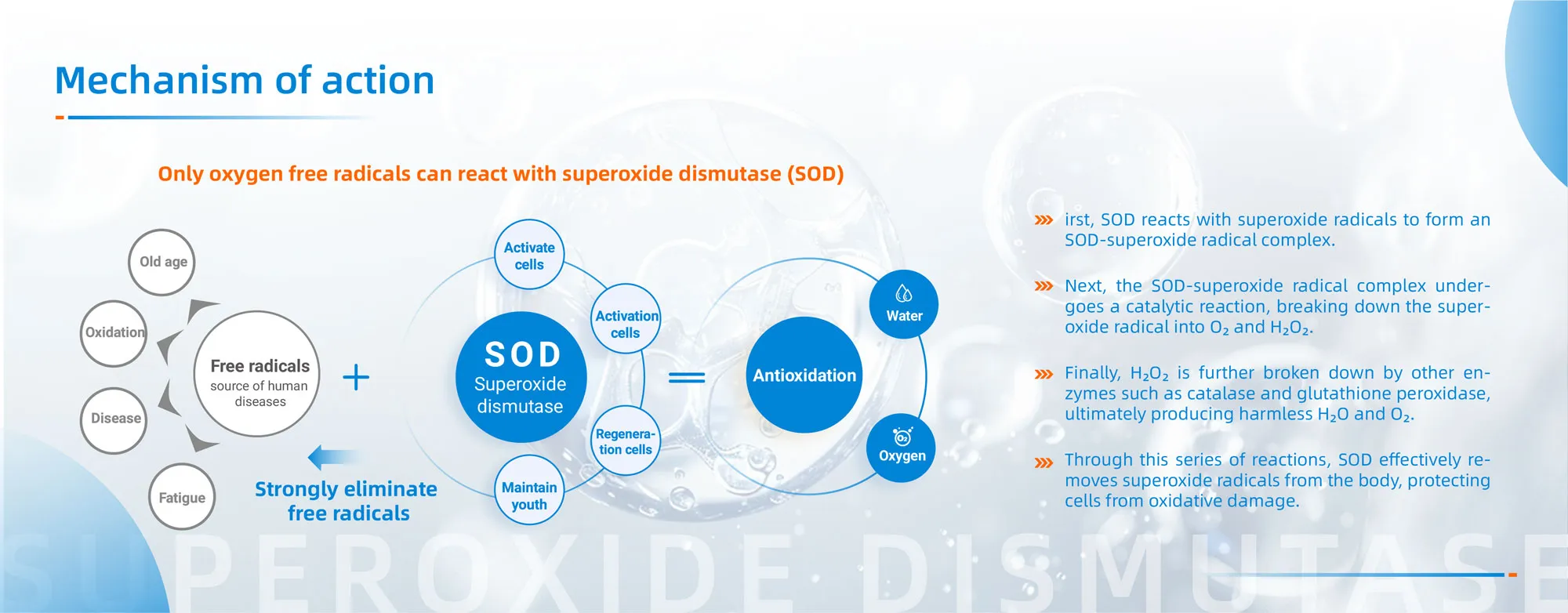
SOD: The “first line of defense” of the body’s antioxidant system.
Superoxide dismutase (SOD) is an antioxidant metalloenzyme widely present in living organisms and possesses very important biological activity.
Its main function is to catalyze the disproportionation reaction of superoxide anion radicals (.O2-), converting them into hydrogen peroxide (H2O2) and oxygen (O2). Hydrogen peroxide is then further broken down into harmless water by other antioxidant enzymes (such as catalase and glutathione peroxidase), thus eliminating free radicals and protecting cells from oxidative damage.
SOD plays an important role in disease prevention and improving human immunity, and also plays a significant role in anti-aging, anti-tumor, and anti-inflammatory processes.
SOD: The anti-aging substance, a world-changing discovery.
SOD was first discovered and studied by scientists in the 1930s. In 1938, American biomolecular expert Michael McCord, under the direction of Fredrick Fridovich, successfully extracted superoxide dismutase (SOD) from bovine red blood cells for the first time. In 1988, three renowned scientists-Ferid Murad, Robert Furchgott, and Louis Ignarro, who later won the Nobel Prize in Medicine-announced to the world:
“The deficiency and reduced activity of SOD are the fundamental causes of human aging, illness, and death. Supplementing SOD can prevent and treat various diseases and delay aging.”
Based on the metal ion bound to their active site, SODs are mainly divided into four categories:
Classification and distribution of SOD
Cu/Zn-SOD: Blue-green in color, mainly found in the cytoplasm of eukaryotic cells, and is the most widely distributed type of SOD. The SOD in human red blood cells and liver cells is mainly of this type.
Mn-SOD: Pink in color, mainly found in the mitochondria of prokaryotes and eukaryotes, and is crucial for maintaining mitochondrial function.
Fe-SOD: Yellowish-brown in color, initially discovered in *Escherichia coli*, and mainly found in prokaryotic cells and the chloroplasts of a few plant cells.
Ni-SOD: Emerald green in color, mainly found in lower organisms such as cyanobacteria, green algae, and *Streptomyces*.
Sources and product forms of SOD
Natural SOD is widely present in animals, plants, and microorganisms, but direct extraction faces problems such as low efficiency and poor stability. Currently, commercially available SOD products mainly come from the following sources:
Animal sources: Early products were mostly extracted from the blood of animals such as cattle and sheep (Cu/Zn-SOD). However, these products have a large molecular weight and are easily broken down by stomach acid when taken orally. Furthermore, animal-derived components may trigger allergies or carry pathogens.
Plant sources: Extracted from certain plants (such as sea buckthorn and spirulina), but their activity is easily affected by extraction and storage conditions, and they are easily broken down by digestive enzymes when taken orally, resulting in low bioavailability. Some sources also have high extraction costs or may contain trace amounts of plant-derived impurities.
Microbial fermentation (especially using recombinant genetically engineered bacteria) has become the absolute mainstream method for commercial SOD production, with significant advantages:
Safe and risk-free: It completely avoids the potential pathogen contamination (such as mad cow disease) and immunogenic risks of animal sources (such as bovine blood), ensuring extremely high safety.
High yield and low cost: Through genetic engineering technology, engineered bacteria such as E. coli and yeast can be modified to efficiently express human-derived or specific types of SOD. The yield is far higher than that of animal and plant extraction, significantly reducing production costs.
High purity and stable quality: Produced in closed, sterile fermentation tanks, the process is highly controllable and easy to purify downstream. The final product has high purity and consistent quality between batches.
No ethical controversy: The entire production process does not involve animal slaughter or large-scale destruction of plants, complying with green environmental protection and animal welfare ethical requirements.
SOD product forms
Injectable preparations: Used as prescription drugs for the adjuvant treatment of osteoarthritis, radiation sickness, etc. Recombinant human SOD is the preferred choice for clinical applications due to its high safety profile.
Oral preparations: Including capsules, lozenges, etc., some products utilize nanotechnology or glycosylation modification to improve bioavailability.
Cosmetic additives: Used for their antioxidant properties to delay skin aging. Recombinant SOD can be “miniaturized” through genetic engineering, making it easier to penetrate the stratum corneum of the skin and exert deep antioxidant effects.
Health foods: Added as an antioxidant ingredient to various health foods. Microbial fermentation-derived SOD is often used in the formulation of protein powders, probiotics, and other foods due to its low cost and high safety.





Please leave us a message.