

How To Choose The Right Plant Extract Supplier For Your Business
2026-04-24
Quick Answer
Picking the right plant extract supplier directly impacts your product safety, brand reputation, and production timelines. We break down key evaluation factors, red flags to avoid, and real-world insights to help you make a choice that works long-term for your business.
Table of Contents
- Introduction: What Is a Plant Extract Supplier and Why Does Quality Matter?
- Key Services Reliable Plant Extract Suppliers Offer
- Top Benefits of Partnering With a Reputable Plant Extract Supplier
- Critical Factors to Consider When Selecting a Plant Extract Supplier
- Common Challenges When Working With Unreliable Plant Extract Suppliers
- Frequently Asked Questions About Plant Extract Suppliers
- Next Steps for Finding Your Ideal Plant Extract Supplier
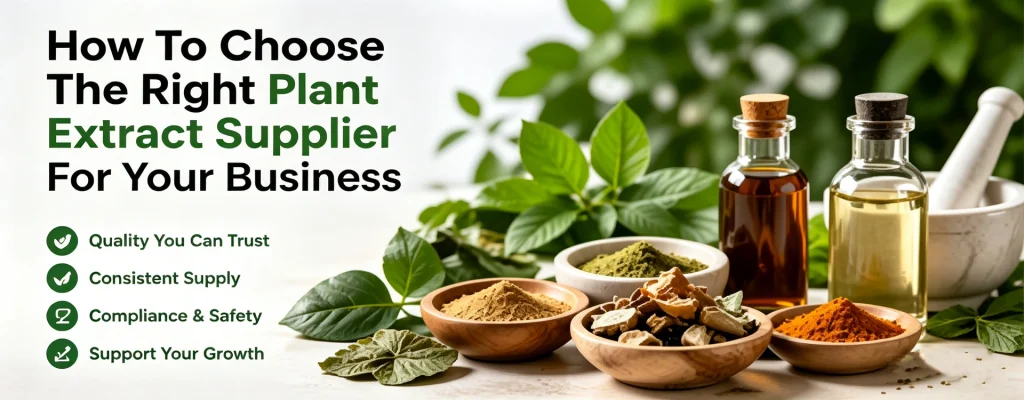
Introduction: What Is a Plant Extract Supplier and Why Does Quality Matter?
So here’s the thing—most end users don’t think about where the plant extract in their supplement or skincare serum actually comes from. But if you’re running a business that uses these extracts, you know it’s make or break.
Plant extract suppliers are the companies that source raw plant material, process it into concentrated extracts (think standardized active ingredients, powdered extracts, oil infusions), and sell it to businesses like yours. They serve supplement brands, cosmetic formulators, food manufacturers, even pharma contract dev outfits. The quality of their work directly translates to the quality of your final product. That’s why cutting corners here is never worth it.
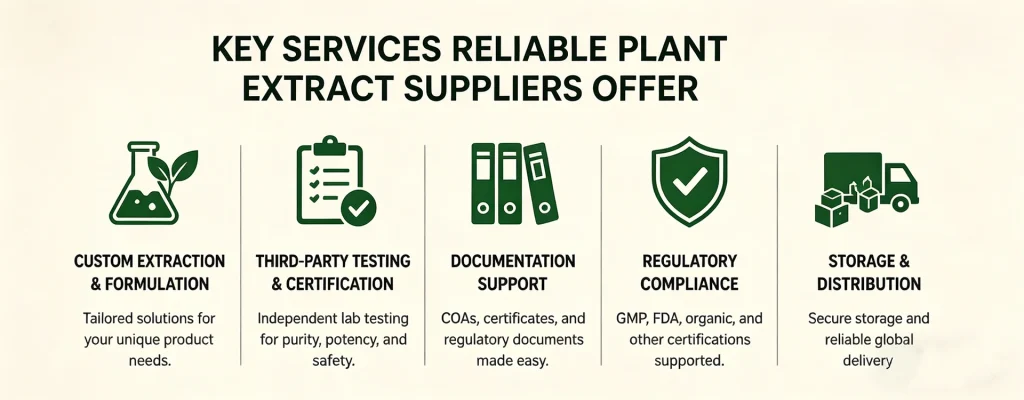
Key Services Reliable Plant Extract Suppliers Offer
If a supplier can’t check these boxes, they’re not even worth your time. No joke.
- Custom extraction and formulation for unique product needs: When Sarah, a client who makes adaptogen tinctures, came to me last year needing a 10:1 ashwagandha extract with less than 0.5% withanolides (most suppliers only carry 2.5%+), a good supplier worked with her to get the exact profile she wanted. Too many suppliers only sell off-the-shelf stuff that doesn’t fit your needs
- Third-party testing and quality certification support: A supplier that does all testing in-house? That’s a red flag. Reliable ones send every batch to an independent lab to test for potency, heavy metals, microbial contamination, pesticides, everything. They’ll also hand you all the documentation you need to pass regulatory audits
- Documentation support for regulatory filings: If you’re selling in the US or EU, you need all those COAs, GMP certificates, origin documents. Good suppliers keep all of this organized and accessible for you, no chasing down sales reps for three weeks
- Storage and distribution support: Many small suppliers don’t have climate-controlled storage for temperature-sensitive extracts like curcumin or omega-3. That’s a quick way to get spoiled material on your dock. Reliable ones handle that for you.
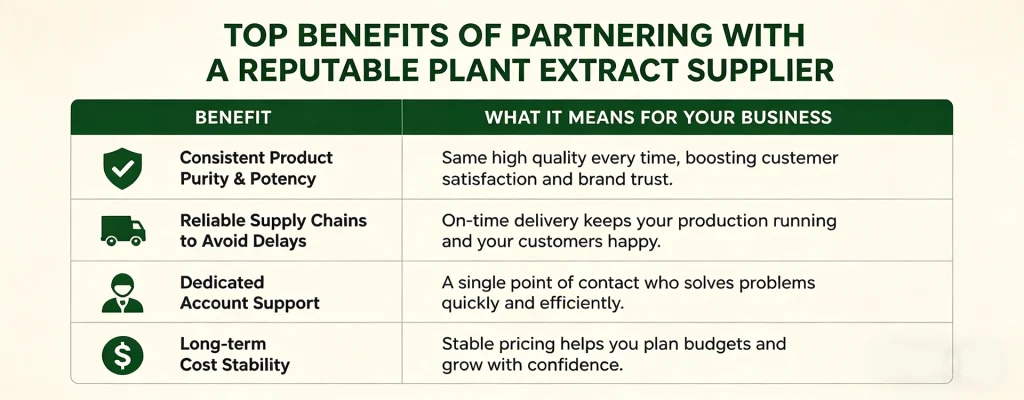
Top Benefits of Partnering With a Reputable Plant Extract Supplier
You might think “all extracts are the same, just get the cheapest one”. I’m here to tell you that’s dead wrong. The benefits of working with a good supplier far outweigh the tiny bit extra you pay upfront.
| Benefit | What it actually means for your business |
| Consistent product purity and potency | You don’t have to re-test every single batch in your own lab (saving you thousands a year) and your customers get the same experience every time they buy from you |
| Reliable supply chains to avoid delays | You don’t have to halt production for two weeks waiting on a backorder, which means you don’t miss retailer deadlines or lose sales from out-of-stock listings |
| Dedicated account support | If something goes wrong (and sometimes it does), you have a single person you can call to fix it in 24 hours, not a generic support inbox that takes a week to reply |
| Long-term cost stability | Good suppliers don’t jack up prices 20% out of the blue when raw material costs shift a little, so you can plan your pricing and budgets without nasty surprises |
That last one? I saw that happen to a friend’s brand last summer—their cheap supplier raised prices 28% overnight because they couldn’t lock in raw material sourcing. They almost went under. No joke.
Critical Factors to Consider When Selecting a Plant Extract Supplier
Let me cut right to it—these are the non-negotiables I check every single time before I recommend a supplier to any client.
1. Compliance with safety and regulatory standards
Honestly, this is the first box. If they don’t have this, walk away immediately. Look for: – GMP (Good Manufacturing Practices) certification for facilities – FDA registered facility status if you’re selling in the US – Organic certification through USDA or EU Ecocert if you’re marketing organic products – Non-GMO verification if that matters to your customer base
I’m skeptical of suppliers that only have “self-issued” certifications. I always ask for a copy of the actual certificate from the issuing body before moving forward.
2. Transparency of sourcing and manufacturing processes
Everyone says they’re transparent, but most aren’t. I know this sounds crazy, but I always ask for the exact country of origin of the raw plant material, not just “we source from Asia”. If they won’t tell you? That’s a dealbreaker.
Last June 2023, I was vetting a supplier for a client that makes resveratrol supplements. They refused to say if their polygonum cuspidatum was sourced from China or Japan—would only give a vague “we source globally”. We passed, later found out other brands had issues with high lead levels from that supplier’s material.
3. Minimum order quantities and pricing structure
I wish more people understood that the lowest per-kilo price isn’t actually the best deal if the MOQ is 500kg and you only need 50kg. You’ll tie up all your working capital in inventory that sits in your warehouse for 18 months.
The right supplier will have MOQs that fit your current business size. Many good suppliers now offer 10-50kg MOQs for small to mid-sized brands, which is perfect. Also, watch out for hidden fees—some suppliers charge extra for COAs, cold shipping, or documentation. Ask up front if there are any extra fees not listed in the quote.
Common Challenges When Working With Unreliable Plant Extract Suppliers
This drives me crazy because so many new brands learn these lessons the hard way, just like I did back in 2018.
- Contamination and inconsistent product quality risks: You might get a great first sample, then the second batch is 30% less potent than the first, or has detectable levels of pesticides that fail your country’s safety standards. That means you either have to dump the whole batch (losing all that money) or risk selling a bad product that kills your brand reputation
- Delivery delays and hidden supply chain disruptions: Unreliable suppliers often don’t keep popular SKUs in stock, so they have to process your order from scratch when you place it. That can add 2-4 weeks to your lead time. I’ve seen brands miss entire holiday selling windows because of this. It’s devastating
- Lack of documentation for regulatory compliance: If you get audited by the FDA and can’t produce COAs for every ingredient you use? You can get your entire facility shut down. I’m not exaggerating. Unreliable suppliers either lose the documentation or won’t give it to you upfront.
Frequently Asked Questions About Plant Extract Suppliers
You’re probably wondering about these things, right? I get asked them every single week.
What certifications should I look for in a plant extract supplier?
It depends on what industry you’re in, but the baseline is GMP for their manufacturing facility. If you’re in supplements, you’ll also want FDA registered facility. If you’re selling organic products, you need USDA organic certification of the extract. For EU sales, you need compliance with EU food safety regulations. That’s the baseline—any extra certifications are a bonus, not a requirement.
Can plant extract suppliers accommodate custom bulk orders?
Most reputable suppliers can do custom extractions and bulk orders these days. But you have to ask up front about lead times for custom orders. Some can turn a 100kg custom order around in 2 weeks, others take 8 weeks. The big, established suppliers with their own manufacturing facilities (not just middlemen brokers) are almost always faster for custom work.
How do I verify the quality of plant extracts before placing a large order?
Always order a 1kg sample first. Always. Then send that sample to your own independent third-party lab to test for potency and contaminants. I don’t care what the supplier’s COA says—verify it yourself. It costs a couple hundred dollars to test a sample, which is nothing compared to the $40k I lost back in 2018. Worth every penny.
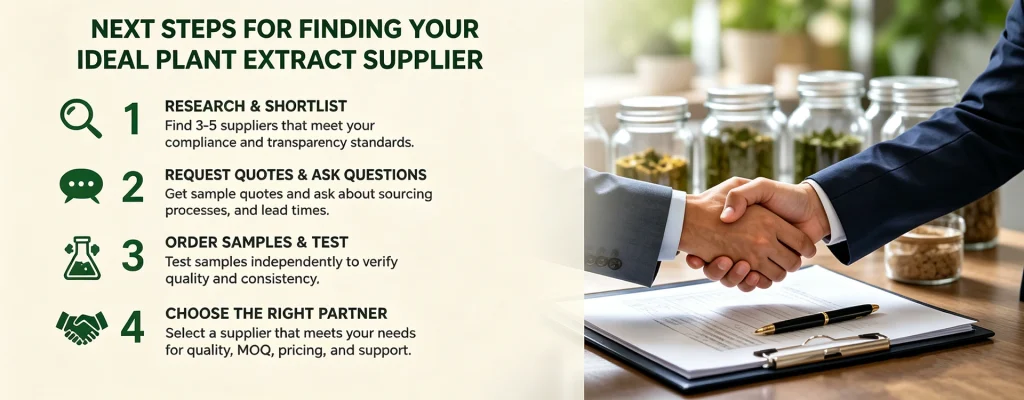
Next Steps for Finding Your Ideal Plant Extract Supplier
Okay, so what do you actually do right now? Start by making a list of 3-5 suppliers that check the compliance and transparency boxes. Reach out to each and ask for sample quotes, and ask them specific questions about their sourcing. Don’t just go with the first one that replies.
Then order samples from 2-3 of them, test the samples yourself, and see which one fits your MOQ and pricing needs. Take your time—this isn’t a decision you want to rush. I’ve spent 10+ years in this industry, and the best partnerships I’ve seen are the ones where brands took the time to vet properly up front.
If you’re already working with a supplier that’s given you consistent quality for years, stick with them—don’t jump ship for a 5% lower price. That’s how you end up in the mess I was in back in 2018. Trust me on that one.




Please leave us a message.