

Top 5 Qualities to Look For in a Reliable Raspberry Powder Supplier
2026-04-27
Quick Answer
Choosing a reliable raspberry powder supplier means prioritizing third-party testing, transparent sourcing, and clear pricing. Skipping vetting leads to bad batches, inconsistent flavor, and wasted money—here’s exactly what to check before you sign on.
Table of Contents
- Introduction
- Key Qualities of a Trustworthy Raspberry Powder Supplier
- Common Product Types Offered by Raspberry Powder Suppliers
- How to Verify Product Quality From Your Supplier
- Pricing and Order Considerations for Bulk Buyers
- Frequently Asked Questions (FAQ)
- Conclusion
1. Introduction
1.1 What is raspberry powder and its growing demand across industries
Raspberry powder is just freeze-dried or spray-dried whole raspberries ground into a fine powder, right? It’s used in everything from smoothie mixes and baked goods to dietary supplements and skincare products.
Demand has blown up over the last 3 years—plant-based product lines and clean label trends have more brands scrambling to source consistent raspberry powder. That means more new suppliers popping up, too, which makes vetting extra important.
1.2 Why choosing the right supplier impacts your product quality and business success
I learned this the hard way back in 2019, when we worked with a new raspberry powder supplier that cut corners on raw material sourcing. We got a batch with hidden added sugar, and a supplement brand client had to pull 10,000 units. Cost them over $150k, and we almost lost the account.
Bad raspberry powder from a bad supplier ruins your brand reputation, eats into your profits with wasted product, and can even get you in trouble with FDA regulators. It’s not something to wing.
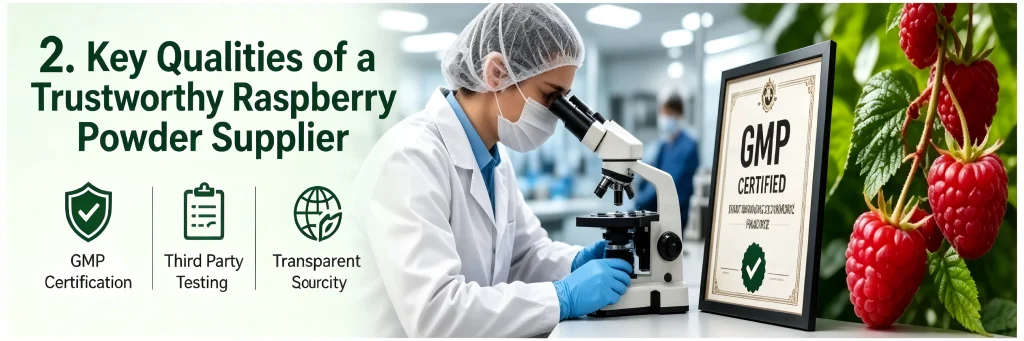
2. Key Qualities of a Trustworthy Raspberry Powder Supplier
A reliable raspberry powder supplier will check all these boxes before you even ask—if they hedge on either of these, walk away.
2.1 Good manufacturing practice (GMP) and third-party testing certifications
GMP certification means the facility follows strict FDA guidelines for production, so no cross-contamination with allergens like nuts or soy that you don’t know about.
Third-party testing is non-negotiable. Any reputable raspberry powder supplier will provide a certificate of analysis (COA) for every batch that shows pesticide levels, heavy metals, and additives. I’ve seen suppliers sell “pure” raspberry powder cut with 15% maltodextrin that didn’t show up on their in-house testing.
2.2 Transparent sourcing of raw raspberry ingredients
Transparent sourcing means they tell you exactly what region the raspberries are grown in, whether they’re organic or conventional, and if any processing aids are used.
Serbia and Poland produce some of the best whole frozen raspberries for powder, in my experience—they have ideal growing conditions and lower rates of mold than some other major producing regions. A good raspberry powder supplier won’t hide this info. If they say “sourced globally” and won’t get more specific? That’s a red flag.
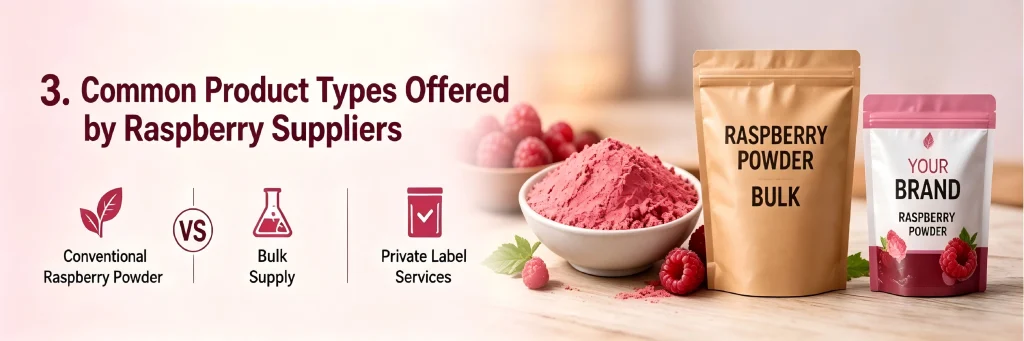
3. Common Product Types Offered by Raspberry Powder Suppliers
Not all raspberry powder is the same, and most suppliers offer multiple options to fit different business needs.
3.1 Organic vs. conventional raspberry powder options
Here’s a quick breakdown of the two:
| Feature | Organic Raspberry Powder | Conventional Raspberry Powder |
| Price | 20-35% higher | Lower upfront cost |
| Pesticide residue | Meets USDA/NOP standards, lower residual | Allowed low-level synthetic pesticides |
| Best for | Clean label, premium products | Bulk food service, value-priced goods |
Most good raspberry powder suppliers offer both, so you can pick what fits your product line. Don’t pay premium for organic if you’re making a value-priced blended smoothie mix—save the markup for your premium supplement line.
3.2 Bulk vs. private label service offerings
Bulk raspberry powder is just the raw product sold in large drums or totes, for you to process or package yourself. Private label means the supplier already packages it for you under your brand name.
Some suppliers only do bulk, others do both. If you’re a small startup, private label can save you a ton of upfront packaging and processing equipment cost. Just make sure you check the packaging quality before you commit.
4. How to Verify Product Quality From Your Supplier
You can’t just take a raspberry powder supplier’s word for it—you have to check for yourself.
4.1 Requesting free sample testing before placing a large order
Any reputable supplier will send you a free 100-200g sample for testing, no questions asked. If they charge you more than a small shipping fee? Walk away.
We always send samples out to an independent lab to test for additives and pesticide residue, even if the supplier provides a COA. Last year, a supplier’s COA said “no added sugar” but our test showed 8% added cane sugar. Saved us from another bad batch.
4.2 Checking customer reviews and industry references
Don’t just check the reviews on the supplier’s website—look for reviews on independent business forums, or ask the supplier for 2-3 references from similar-sized businesses in your industry.
Back in 2022, I got a reference from a small baked goods brand in Denver that had worked with a supplier I was vetting. They told me the supplier missed three shipping deadlines in six months during raspberry harvest season. That was a dealbreaker for us, since we need consistent delivery for our retail clients.
5. Pricing and Order Considerations for Bulk Buyers
There’s a big range in pricing for bulk raspberry powder, and a lot of small business owners don’t know what’s reasonable.
5.1 Average price ranges for bulk raspberry powder
As of 2024, here’s what you can expect to pay per pound for bulk orders: – Conventional spray-dried: $4.50-$7.00 per pound – Organic freeze-dried: $8.00-$12.00 per pound
Spray-dried is cheaper because it uses heat to remove moisture, which can kill some of the natural flavor and antioxidants. Freeze-dried retains more flavor and nutrients, so it costs more. If a supplier’s price is 20% lower than this range? They’re cutting corners somewhere.
5.2 Minimum order quantities and shipping terms to negotiate
Most raspberry powder suppliers have minimum order quantities (MOQs), but they’re often flexible if you ask. New suppliers will usually lower MOQs to get a new client, especially if you mention you’re planning to increase orders over time.
Common MOQs: – Bulk: 500-1000 pounds for conventional, 200-500 pounds for organic – Private label: 50-100 units of finished packaged product
Always negotiate free shipping for orders over a certain size, and ask for a discount for pre-payment. Most suppliers will knock 3-5% off if you pay upfront instead of net-30 terms.
6. Frequently Asked Questions (FAQ)
6.1 What is the typical shelf life of raspberry powder from a good supplier?
A good supplier will package raspberry powder properly to protect it from light and moisture, so shelf life is usually 12-18 months when stored in a cool, dry place. Freeze-dried powder usually lasts a little longer than spray-dried, since it has lower moisture content.
6.2 Do raspberry powder suppliers provide private labeling for small businesses?
More and more do now. A lot of mid-sized raspberry powder suppliers have started offering lower MOQ private label service to attract small businesses and startups. You just have to ask—some don’t advertise it on their website.
6.3 How do I confirm that my supplier’s raspberry powder is free of additives?
Ask for a full COA from an independent third-party lab that tests for fillers, added sugars, and anti-caking agents. You can also send a sample to your own lab for testing if you want to be 100% sure.
6.4 What is the minimum order I can place with a raspberry powder supplier?
It varies. Some bulk suppliers have MOQs as high as 1000 pounds, but many smaller suppliers will do 50-100 pound orders for new clients. Private label MOQs are usually lower, between 20-50 finished units.

7. Conclusion
7.1 Summary of key factors to evaluate when selecting a supplier
When you’re looking for a raspberry powder supplier, start with checking certifications and transparent sourcing first. Then test samples, verify references, and negotiate MOQs and shipping terms that work for your business.
Cutting corners on vetting to save a little money upfront almost always costs you more in the long run with bad batches, product recalls, or unhappy customers. I’ve seen it happen too many times.
7.2 Final tips for building a long-term relationship with your raspberry powder supplier
Once you find a good raspberry powder supplier that delivers consistent quality on time, stick with them. Place consistent orders, pay on time, and don’t nickel-and-dime them on every small price increase during bad raspberry harvest years.
I’ve worked with my main supplier for 7 years now, and they’ve bailed me out multiple times with rush orders when another supplier let me down. A good long-term relationship with a reliable supplier is worth more than any 5% discount you can find from a new vendor. No joke.






Please leave us a message.