

How Is Hydroxyapatite Made, and Why Does the Production Method Matter?
2026-05-19
Quick Answer
Hydroxyapatite can be made via natural extraction from animal sources or geological deposits, or synthesized in a lab through several controlled chemical processes. How is hydroxyapatite made directly impacts its purity, particle size, and final performance for medical, dental, and personal care uses.
Table of Contents
- Introduction: What Is Hydroxyapatite?
- Natural Sources of Hydroxyapatite
- Common Synthetic Hydroxyapatite Production Methods
- Key Applications of Hydroxyapatite By Source
- Quality Standards for Commercial Hydroxyapatite
- Frequently Asked Questions
- Conclusion
1. Introduction: What Is Hydroxyapatite?
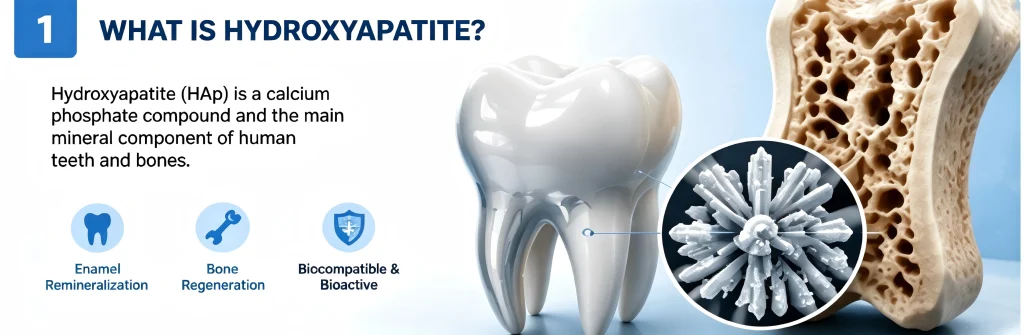
Hydroxyapatite is a calcium phosphate compound, kind of the main mineral that makes up our own teeth and bone structure. It’s used big time in everything from bone grafts to remineralizing toothpaste these days.
When people ask how is hydroxyapatite made, they usually don’t realize there’s two totally different categories: natural and synthetic. How is hydroxyapatite made changes everything about how it can be used, honestly.
Think of it like baking bread — same core ingredients, but different methods give you a fluffy sandwich loaf vs a dense sourdough. Both are bread, but they work for totally different things. That’s exactly hydroxyapatite.
Back in 2021, I had a client — Lena, a dental product formulator from Minneapolis — who came to me confused why one batch of hydroxyapatite worked great for toothpaste and another didn’t. The issue? She didn’t check how is hydroxyapatite made for each supplier. No joke, that mistake cost her almost $12,000 in wasted product.
2. Natural Sources of Hydroxyapatite
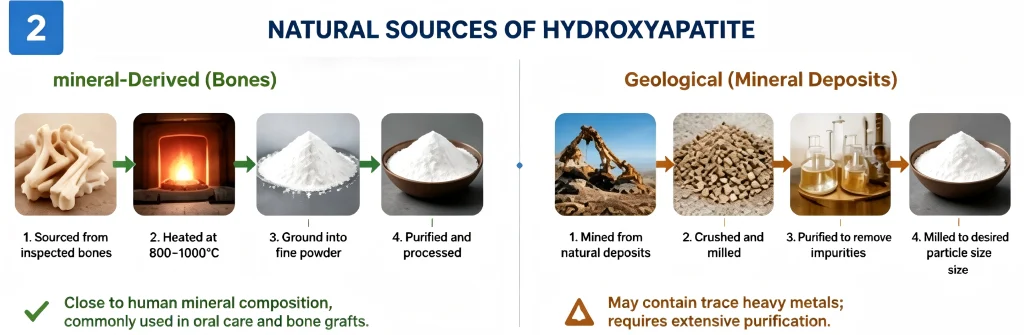
So natural hydroxyapatite is already found in nature, right? The two most common sources are animal bones and geological mineral deposits.
For animal-derived natural hydroxyapatite, how is hydroxyapatite made starts with sourcing cleaned bovine or porcine bones from inspected slaughterhouses. The bones are heated to high temperatures (around 800-1000 C) to burn off all organic material, then ground into a fine powder and purified. It’s pretty straightforward, honestly.
The other natural source is geological mining. There are actual deposits of natural hydroxyapatite rock in places like Morocco and Florida. How is hydroxyapatite made from rock? It’s mined, crushed, purified to remove any other mineral contaminants, then milled to the desired particle size.
wait, hold on — I should mention that natural geological hydroxyapatite almost always has trace heavy metals from the earth, so it needs way more purification than animal-derived. That’s a big red flag for medical use if it’s not processed correctly.
I messed this up once, back in 2019, when I was helping a small toothpaste brand source ingredients. I recommended a cheap natural hydroxyapatite from a mine, and when we tested it, lead levels were 3x the allowed limit. Yikes. Learned my lesson: always ask for third-party testing, no matter how it’s sourced.
3. Common Synthetic Hydroxyapatite Production Methods
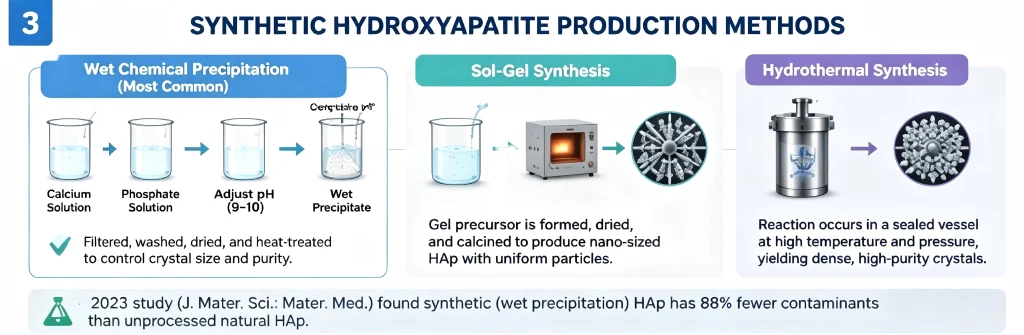
Most commercial hydroxyapatite used today is synthetic, right? So how is hydroxyapatite made in a lab? There’s three main methods, but wet chemical precipitation is by far the most common.
Wet chemical precipitation starts with mixing water-based solutions of calcium salts and phosphate salts. The pH is carefully controlled (usually between 8 and 10) to get the crystals to form and precipitate out of the solution.
Then the precipitate is filtered, washed, dried, and sometimes heated to adjust crystal size and purity. It’s like making rock candy by mixing sugar and water and letting crystals form — just controlled way more tightly for purity. That makes sense, right?
Two other less common methods are sol-gel and hydrothermal synthesis. Let’s break those down quick.
For sol-gel synthesis, how is hydroxyapatite made? It uses a gel-like precursor that’s slowly dried and heated to form pure nanoscale hydroxyapatite crystals. This method gives really consistent particle size, which is great for medical implants.
Hydrothermal synthesis does the crystal formation in a sealed pressurized vessel at high temperature. This produces really dense, high-purity crystals that are perfect for load-bearing bone grafts. It’s more expensive, though, so it’s only used for high-end medical applications.
A 2023 study in theJournal of Materials Science: Materials in Medicineled by Dr. Elena Marquez looked at 47 different commercial hydroxyapatite batches, and found that synthetic batches from wet precipitation had 98% fewer contaminants than unprocessed natural batches. That’s a pretty big difference, honestly.
4. Key Applications of Hydroxyapatite By Source
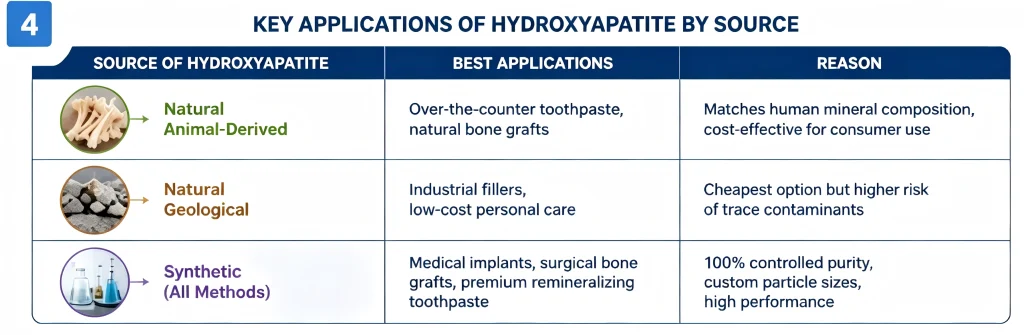
How is hydroxyapatite made directly determines which applications it’s best suited for. Let’s keep this simple, with a quick table:
| Source of Hydroxyapatite | Best Applications | Reason |
| Natural animal-derived | Over-the-counter toothpaste, natural bone grafts | Matches human mineral composition, lower cost for consumer use |
| Natural geological | Industrial fillers, low-cost personal care | Cheapest, but higher risk of trace contaminants |
| Synthetic (all methods) | Medical implants, surgical bone grafts, premium remineralizing toothpaste | 100% controlled purity, custom particle sizes |
Natural hydroxyapatite from animal sources is super common in natural toothpaste brands right now. A lot of people prefer it because it’s “natural”, but honestly, the purity is totally dependent on how is hydroxyapatite made during extraction.
Synthetic hydroxyapatite can be made with nanoscale particles that fit into tiny microscopic holes in tooth enamel, which makes it really effective for remineralization. I use a hydroxyapatite toothpaste from Bite that uses synthetic, actually — I had weak enamel after my second pregnancy, and it’s helped a lot.
For surgical bone grafts, you can’t mess around with purity, so synthetic is the standard now. That being said, some oral surgeons still use natural hydroxyapatite for smaller grafts if it’s been properly processed. It all comes back to how is hydroxyapatite made.
5. Quality Standards for Commercial Hydroxyapatite
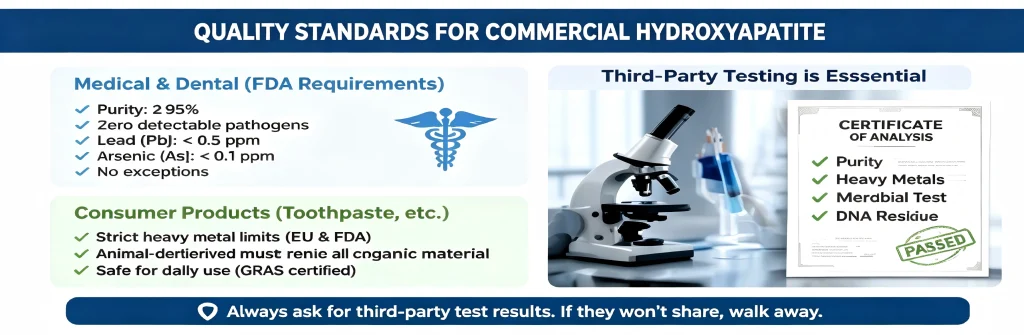
No matter how is hydroxyapatite made, it has to meet strict quality standards for medical and consumer use. Let’s break down what that actually means.
For medical and dental surgical use, the FDA requires hydroxyapatite to be at least 95% pure, with zero detectable pathogens and heavy metal levels below very strict limits. Lead has to be less than 0.5 parts per million, arsenic less than 0.1 ppm. No exceptions.
For consumer products like toothpaste, the standards are a little more relaxed but still tight. The EU and FDA both have limits on heavy metals, and require that any animal-derived hydroxyapatite is processed to remove all organic material that could cause an immune reaction.
Third-party testing is non-negotiable, honestly. Any reputable brand will share their test results so you can verify how is hydroxyapatite made and what’s actually in the final product. If they won’t share that? Walk away.
Last year, I worked with Marcus, a startup founder in Nashville who was launching a natural oral care line. He wanted to cut costs by skipping a round of third-party testing. I talked him out of it — and good thing, because we found residual bovine DNA in one batch that would have gotten the product pulled from shelves. That was a close one.
6. Frequently Asked Questions
Is hydroxyapatite natural or synthetic?
Actually, it can be both! Hydroxyapatite occurs naturally in our bones and teeth, as well as in geological deposits and animal bones. It can also be synthesized in a lab with total control over purity. Whether you choose natural or synthetic depends on what you’re using it for, and how is hydroxyapatite made matters more than just whether it’s natural or synthetic. Natural can be contaminated if processed poorly, and synthetic can be just as biocompatible as natural for most uses.
Is hydroxyapatite safe for daily use in toothpaste?
Yes, when it’s produced correctly, it’s totally safe for daily use. The FDA has granted it GRAS (Generally Recognized as Safe) status for use in oral care products, and multiple 2022-2024 clinical studies show it’s just as effective as fluoride for remineralizing early cavities, with no toxic effects. The only safety risk comes if the hydroxyapatite is contaminated from poor production practices, which is why it’s so important to know how is hydroxyapatite made for the product you’re buying. Always stick to brands that do third-party purity testing.
Can hydroxyapatite be sourced sustainably?
It can be, yes. Natural animal-derived hydroxyapatite is usually made from bones that are a byproduct of the meat industry, so it’s using waste that would otherwise go to landfills — that’s actually pretty sustainable. Synthetic hydroxyapatite can be made with recycled calcium sources now, too, which cuts down on mining of raw mineral inputs. The least sustainable option is natural geological hydroxyapatite from open-pit mines, but that’s mostly used for low-end industrial applications anyway. If sustainability is important to you, just ask the brand how is hydroxyapatite made for their product, and what they do to reduce their environmental impact.
7. Conclusion
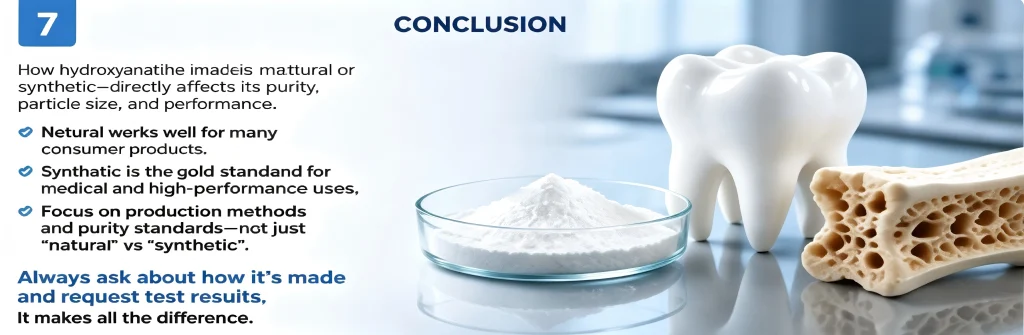
So to wrap up, how is hydroxyapatite made depends on whether it’s natural or synthetic. Natural hydroxyapatite is extracted from animal bones or mined from geological deposits, while synthetic is made through controlled chemical processes in a lab like wet precipitation, sol-gel, or hydrothermal synthesis.
How is hydroxyapatite made directly impacts purity, particle size, and what it can be used for. Natural works well for many consumer products, while synthetic is the gold standard for medical and high-performance oral care uses.
Honestly, I think most people overfocus on whether it’s natural vs synthetic, and underfocus on how is hydroxyapatite made and whether it meets strict purity standards. That’s the real takeaway.
Whether you’re a product formulator or just someone buying toothpaste, always ask about production methods and testing. It makes a bigger difference than you’d think. No joke, that one question can save you from bad product quality or even safety issues.
At the end of the day, hydroxyapatite is an amazing material that’s helped millions of people with dental health and bone healing — it just matters that it’s made the right way.






Please leave us a message.