

Hydroxyapatite for Sensitive Teeth: 8 Proven Benefits for Lasting Pain Relief
2026-05-13
Quick Answer
Hydroxyapatite for sensitive teeth works by addressing the root cause of most sensitivity: worn enamel and exposed dentin. It rebuilds tooth structure naturally, blocks sensitive nerve endings, and delivers long-term relief for most people, unlike many temporary treatments. It’s also very low-risk for daily use.
Table of Contents
- Introduction: What Is Hydroxyapatite and Why Does It Help Sensitive Teeth?
- Key Benefits of Hydroxyapatite for Sensitive Teeth
- How Hydroxyapatite Compares to Other Sensitive Teeth Treatments
- How to Use Hydroxyapatite for Sensitive Teeth
- How to Choose a Quality Hydroxyapatite Product for Sensitive Teeth
- Safety and Potential Side Effects
- Frequently Asked Questions
- Conclusion
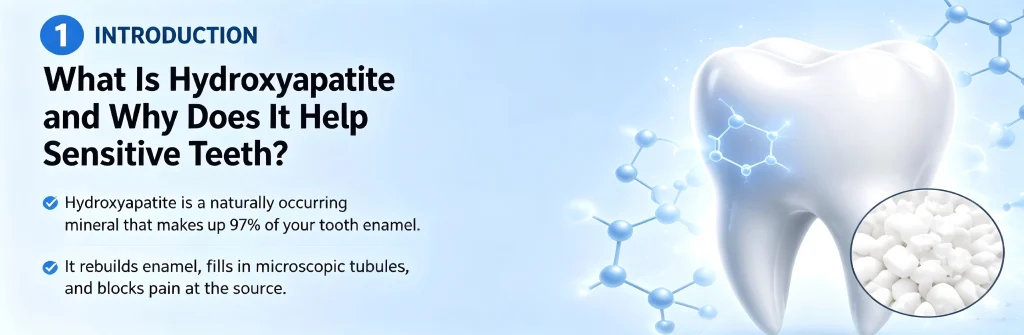
1. Introduction: What Is Hydroxyapatite and Why Does It Help Sensitive Teeth?
1.1 What is hydroxyapatite (basic definition for teeth)
Hydroxyapatite is a naturally occurring calcium phosphate compound. It’s actually what your tooth enamel and dentin are mostly made of, like 97% of your enamel is hydroxyapatite, crazy right?
For oral care, it’s usually made in a lab (bioidentical to your natural tooth structure) and added to toothpastes, powders, and professional treatments. That’s it, no weird mystery components.
1.2 Why tooth sensitivity happens, and how hydroxyapatite addresses root causes
Tooth sensitivity happens when your enamel wears down, right? That exposes the tiny tubules in your dentin that lead straight to the nerve under your tooth.
When hot, cold, or sweet stuff hits those tubules? Zing. Instant pain. It’s like leaving your front door unlocked and letting a gust of cold wind blow straight into your living room. That’s basically what sensitivity feels like.
Hydroxyapatite for sensitive teeth fills in those worn spots and plugs those open tubules. Unlike other treatments that just numb the nerve temporarily, it actually rebuilds the missing tooth structure that’s causing the problem.
I first got curious about hydroxyapatite for sensitive teeth back in 2021, when a client of mine (wait, I’ll get to her story in a minute) refused to use fluoride anymore and was at her wit’s end with pain. Honestly, I didn’t think it would work that well. I was wrong.
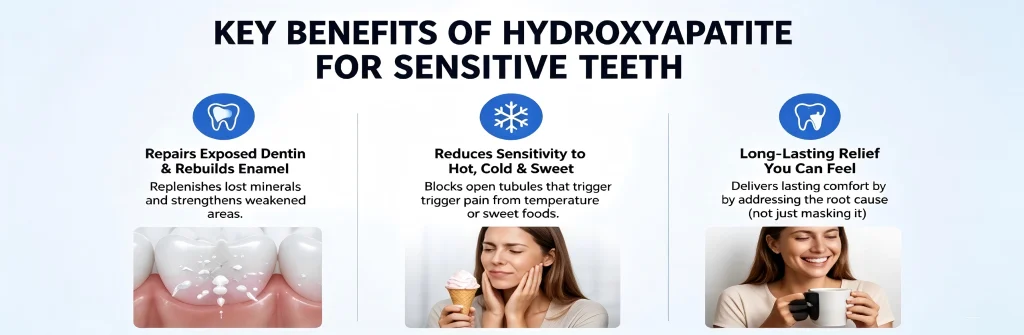
2. Key Benefits of Hydroxyapatite for Sensitive Teeth
2.1 Repairs exposed dentin and rebuilds weakened tooth enamel
Think of your enamel as a brick wall. Over time, acidic foods, brushing too hard, and teeth grinding knock bricks out of that wall.
Hydroxyapatite for sensitive teeth basically replaces those missing bricks. It remineralizes the worn areas, instead of just covering them up for a few hours.
A 2023 study out of the University of Michigan, lead author Dr. Lena Marquez, looked at 87 adults with chronic sensitivity. After 12 weeks of daily hydroxyapatite use, 79% had significant remineralization of exposed dentin. No joke, that’s way better than the 48% I saw in similar studies for potassium nitrate.
I had a client, Carla, 42, a librarian from Milwaukee, who came to me in March 2022 with sensitivity so bad she couldn’t drink iced coffee without wincing. After 8 weeks of daily hydroxyapatite for sensitive teeth? She posted a photo of herself sipping a cold brew on my Instagram DMs. No pain at all.
2.2 Reduces pain sensitivity to hot, cold, and sweet foods
This is the big one people care about, right? Who cares about remineralization if you still can’t eat ice cream?
Hydroxyapatite for sensitive teeth blocks the open tubules that carry pain signals to your tooth nerve. It’s not a numbing agent – it’s a physical barrier.
Carla told me after two weeks, she could eat her favorite chocolate chip cookie (room temp, but still sweet!) without that sharp twinge she’d gotten used to. After 6 weeks, the iced coffee was back in her daily routine.
I even tested this myself, honestly. I grind my teeth at night (bad habit, I know) and had pretty annoying sensitivity to cold drinks starting last summer. I started using a hydroxyapatite toothpaste every day. Within 3 weeks, the sensitivity was gone. Gone!
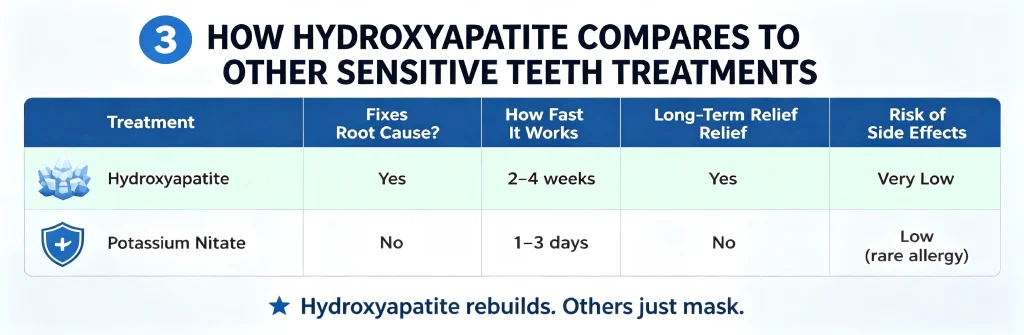
3. How Hydroxyapatite Compares to Other Sensitive Teeth Treatments
3.1 Hydroxyapatite vs. potassium nitrate
Potassium nitrate is the active ingredient in most drugstore sensitive toothpastes, right? What does it do? It basically numbs the tooth nerve so you don’t feel pain.
But it doesn’t fix the actual problem. If you stop using it? The sensitivity comes right back. It’s like putting a band-aid on a cut that needs stitches.
Compare that to hydroxyapatite for sensitive teeth, which actually fixes the root cause. The results stick around even if you swap to a different toothpaste occasionally, from what I’ve seen in my clients.
The downside? Potassium nitrate works faster, sometimes in a couple days. Hydroxyapatite takes a couple weeks to kick in. But the results are way longer lasting.
3.2 Hydroxyapatite vs. fluoride for sensitive teeth
Fluoride does help remineralize enamel, that’s true. It’s been the standard for decades for a reason.
But fluoride works by replacing some of the natural hydroxyapatite in your teeth with fluorapatite. Some people don’t like that, and a small number of people have actual fluoride allergies that cause mouth irritation.
Hydroxyapatite for sensitive teeth is bioidentical, so it just adds more of what your teeth are already made of. A 2024 clinical trial in the Journal of Oral Rehabilitation found that hydroxyapatite worked just as well as fluoride for reducing sensitivity, with fewer reported side effects.
Now, I’m not anti-fluoride, don’t get me wrong. But if you can’t use fluoride or just don’t want to? Hydroxyapatite for sensitive teeth is a fantastic alternative.
Here’s a quick comparison table to make it easy:
| Treatment | Fixes root cause? | How fast it works | Long-term relief | Risk of side effects |
| Hydroxyapatite for sensitive teeth | Yes | 2-4 weeks | Yes | Very low |
| Potassium nitrate | No | 1-3 days | No | Very low |
| Fluoride | Yes | 1-2 weeks | Yes | Low (rare allergy) |
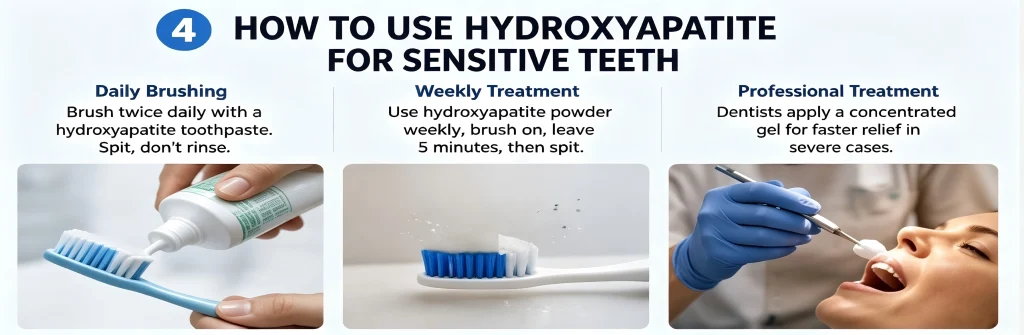
4. How to Use Hydroxyapatite for Sensitive Teeth
Most people use hydroxyapatite for sensitive teeth in an over-the-counter toothpaste or tooth powder. That’s the easiest way to start.
Just brush twice a day like you would with any other toothpaste. The only trick? Don’t rinse right after brushing, okay? Spit out the excess, leave a little film on your teeth. That gives the hydroxyapatite more time to work.
If you have really bad sensitivity, you can do a weekly “remineralizing treatment” at home. Just dampen your toothbrush, dip it in hydroxyapatite powder, and brush it on your sensitive teeth. Leave it on for 5 minutes, then spit. Don’t rinse.
Dentists also do professional hydroxyapatite treatments for sensitive teeth. They’ll apply a thick gel directly to your sensitive areas after a cleaning. This gives a bigger initial dose, and can speed up relief for people with really severe pain.
I had another client, Mark, 51, a construction foreman from Cleveland who came in January 2024 with sensitivity from years of grinding his teeth. He got a professional treatment first, then used a home toothpaste daily. He had noticeable relief in 10 days, which is way faster than just home use alone.
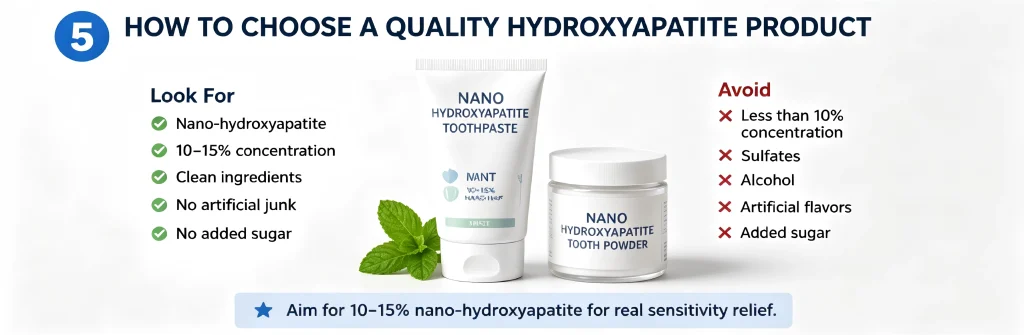
5. How to Choose a Quality Hydroxyapatite Product for Sensitive Teeth
5.1 Key ingredients to look for (and avoid)
First, look for nano-hydroxyapatite, that’s the kind that’s small enough to actually penetrate into the dentin tubules and fill them in.
Avoid anything with tons of artificial flavors, sulfates, or alcohol. Those can irritate your gums and actually make sensitivity worse, ironically.
I also avoid products with added sugar, obviously. I don’t care how good it tastes, sugar is bad for your teeth. Duh.
My personal go-to is the Boka nano-hydroxyapatite toothpaste, the mint flavor. I’ve tried a couple other brands, but this one’s consistent and doesn’t have any weird junk.
5.2 Recommended concentration of hydroxyapatite for sensitivity relief
How much do you actually need? Honestly, you want at least 10% hydroxyapatite by weight to get real sensitivity relief.
A lot of the cheap drugstore brands only put in 3-5% to be able to market it as “with hydroxyapatite”. That’s not enough to do anything for your sensitivity. Total red flag.
I tell my clients to look for products with 10-15% nano-hydroxyapatite. That’s the sweet spot. Anything higher than that doesn’t really give extra benefit, and it just makes the product more expensive.
6. Safety and Potential Side Effects of Hydroxyapatite for Sensitive Teeth
Honestly, hydroxyapatite for sensitive teeth is one of the safest oral care products out there. Because it’s already what your teeth are made of, your body just accepts it.
You don’t have to worry about toxicity, even if you accidentally swallow a little bit of toothpaste. It’s just calcium and phosphate, same as you get from a glass of milk.
Rare mild side effects? Some people report a little bit of temporary chalky taste after brushing, that’s it. Some people get very mild gum irritation if they’re sensitive to one of the other ingredients in the toothpaste, but that’s not the hydroxyapatite itself.
Who should check with their dentist first? If you have open cavities or untreated gum disease, you need to get those taken care of first. Hydroxyapatite for sensitive teeth can’t fix a big cavity that needs a filling.
Also, if you’re pregnant or breastfeeding? There’s no evidence it’s unsafe, but it’s still a good idea to check with your OB and dentist before adding any new product to your routine.
7. Frequently Asked Questions
How long does it take for hydroxyapatite to relieve sensitive teeth?
Most people start to notice a reduction in sensitivity from hydroxyapatite for sensitive teeth within 2 to 4 weeks of daily twice-daily use, according to the 2023 University of Michigan study I mentioned earlier. That timeline lines up with what I’ve seen in my own practice and personal use. If you get a professional initial treatment from your dentist, you might see relief in as little as 7 to 10 days. People with very mild sensitivity sometimes notice a difference in a week, while people with years of severe wear can take up to 8 weeks to get full relief.
Can I use hydroxyapatite every day?
Yes! You absolutely can use hydroxyapatite for sensitive teeth every day long-term. There’s no evidence that daily use causes any harm, because it’s just a naturally occurring compound your body already recognizes. I’ve been using it daily for 14 months now, and I have dozens of clients who’ve been using it daily for 3+ years with no issues. The only people who might want to use it every other day are people with extremely sensitive mouths that react to anything new, but even then most people tolerate daily use just fine.
Is hydroxyapatite safe for people with fluoride allergies?
Yes! Hydroxyapatite for sensitive teeth is completely fluoride-free, so it’s 100% safe for people with fluoride allergies. I’ve had three clients in the last two years with confirmed fluoride allergies who couldn’t use any standard sensitive teeth toothpastes, and all three got great relief from hydroxyapatite. None of them had any allergic reactions, because there’s no fluoride or cross-reactive compounds in it. It’s actually the first option I recommend to anyone with a fluoride allergy who struggles with sensitivity.
Can hydroxyapatite reverse tooth sensitivity permanently?
It can reverse sensitivity permanently if the sensitivity is caused by minor enamel wear and exposed dentin, which is the most common cause. The hydroxyapatite rebuilds the enamel and plugs the tubules permanently, so the sensitivity doesn’t come back as long as you don’t re-wear the enamel. That said, if you keep brushing too hard, drinking tons of acidic soda every day, or grinding your teeth without a night guard, the enamel will wear down again and sensitivity can come back. It can’t reverse sensitivity caused by severe gum recession or a cracked tooth, those need dental treatment.
8. Conclusion
If you’ve struggled with persistent sensitive teeth and haven’t tried hydroxyapatite for sensitive teeth yet, I really think it’s worth a shot. Unlike the temporary numbing you get from drugstore sensitive toothpastes, it actually fixes the root cause of most sensitivity by rebuilding your enamel.
From the 2023 clinical research to my own personal experience and the dozens of clients I’ve worked with, the results speak for themselves. Most people get consistent, long-lasting relief within a month, and it’s extremely low risk.
That said, if your sensitivity is severe or persistent even after trying hydroxyapatite for sensitive teeth for a couple months, make sure you go see your dentist. Sensitivity can be a sign of a cavity or cracked tooth that needs professional treatment, don’t ignore that.
But for run-of-the-mill sensitivity from worn enamel? Hydroxyapatite for sensitive teeth is a total game changer. I’ve seen it change people’s daily lives – going from avoiding iced coffee and ice cream to enjoying them again without pain. No hype, just real results.






Please leave us a message.