

Hydroxyapatite Toothpaste: Benefits, Safety and Formulation Guide
2026-04-20
Hydroxyapatite Toothpaste: Benefits, Safety and Formulation Guide
Hydroxyapatite toothpaste is becoming an important direction in modern oral care, especially for brands developing enamel-care, fluoride-free and sensitivity-focused toothpaste formulas. Hydroxyapatite is a calcium phosphate mineral closely related to the mineral structure of human tooth enamel and dentin, making it a valuable ingredient for biomimetic oral care products.
For consumers, hydroxyapatite toothpaste is often associated with enamel care, sensitivity relief and fluoride-free daily use. For oral care brands, formulators and ingredient buyers, the key question is deeper: how to choose the right hydroxyapatite grade, particle size, purity and dispersion performance for a stable toothpaste formula.
This guide explains what hydroxyapatite toothpaste is, how it works, its key benefits, safety considerations and formulation points for oral care product development.
What Is Hydroxyapatite Toothpaste?
Hydroxyapatite toothpaste is a toothpaste formula containing hydroxyapatite as a functional mineral ingredient. Hydroxyapatite is a form of calcium phosphate and is widely recognized for its similarity to the mineral component of teeth and bones.
In toothpaste, hydroxyapatite is usually added as a fine powder or nano-sized material. It can be used in different types of oral care products, including daily toothpaste, fluoride-free toothpaste, sensitive teeth toothpaste, children’s toothpaste, enamel-care toothpaste, dental gels and mouthwash formulas.
Unlike ordinary toothpaste ingredients that mainly support cleaning, foaming or texture, hydroxyapatite is valued for its tooth-like mineral structure and its role in enamel-care product positioning.
Why Hydroxyapatite Is Popular in Toothpaste
The oral care market is shifting from basic cleaning to more advanced care concepts. Consumers are paying more attention to enamel health, tooth sensitivity, fluoride-free options and gentle daily oral care.
Hydroxyapatite fits this trend because it has a clear ingredient story: it is similar to the mineral structure naturally found in teeth. This makes it easier for brands to explain the product concept to consumers.
For oral care brands, hydroxyapatite toothpaste offers several advantages:
- Biomimetic oral care positioning
- Fluoride-free toothpaste development
- Sensitive teeth care concepts
- Enamel remineralization support
- Premium toothpaste line extension
- Science-based ingredient communication
This is why hydroxyapatite is increasingly used in toothpaste, dental gel, mouthwash and other oral care product development.
How Does Hydroxyapatite Toothpaste Work?
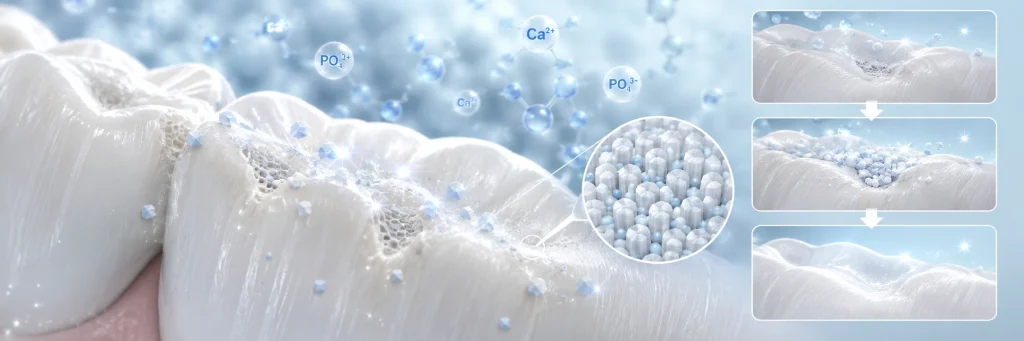
Hydroxyapatite toothpaste works mainly through mineral-based surface interaction. When used in toothpaste, hydroxyapatite particles can interact with the tooth surface and support enamel-care positioning.
The working mechanism is usually explained from three aspects.
1. Mineral Similarity to Tooth Enamel
Human tooth enamel contains a high proportion of mineral material, and hydroxyapatite is closely related to that mineral structure. Because of this similarity, hydroxyapatite is often described as a biomimetic oral care ingredient.
This makes it different from ingredients that only provide cleaning, flavor or foaming effects.
2. Surface Deposition and Micro-Defect Filling
Fine hydroxyapatite particles may help deposit on the tooth surface and fill tiny surface irregularities. This supports a smoother tooth surface and enamel-care product concept.
For brands, this mechanism is useful when developing toothpaste products positioned around enamel protection, remineralization support or sensitive teeth care.
3. Calcium and Phosphate Mineral Support
Hydroxyapatite contains calcium and phosphate, which are important components of tooth mineral structure. In toothpaste formulas, hydroxyapatite provides a mineral-based approach to oral care.
However, product claims should be based on formulation testing, local regulations and scientific support. Brands should avoid exaggerated medical claims unless supported by appropriate evidence.
Main Benefits of Hydroxyapatite Toothpaste
Supports Enamel Care
Hydroxyapatite toothpaste is widely used in enamel-care formulas because of its tooth-like mineral structure. It can help brands build products focused on daily enamel support and tooth surface protection.
This makes hydroxyapatite especially suitable for premium toothpaste, fluoride-free toothpaste and dentist-inspired oral care products.
Suitable for Fluoride-Free Toothpaste Concepts
Many consumers are looking for fluoride-free toothpaste options. Hydroxyapatite is commonly used as a key ingredient in these products because it provides a more functional story than simple cleaning toothpaste.
For brands, hydroxyapatite can help create a fluoride-free formula with stronger professional positioning.
Helps Sensitive Teeth Product Development
Tooth sensitivity is a common consumer concern. Hydroxyapatite can be used in toothpaste formulas designed for sensitive teeth care, especially when the product concept focuses on dentin surface protection and mineral support.
For brands, this creates opportunities in sensitive teeth toothpaste, gentle oral care and premium daily-use toothpaste products.
Consumer-Friendly Ingredient Story
Hydroxyapatite is relatively easy to explain. Consumers can understand it as a mineral similar to the natural structure of teeth.
This makes it helpful for packaging, website education, social media content and product training materials.
Nano Hydroxyapatite vs Micro Hydroxyapatite in Toothpaste
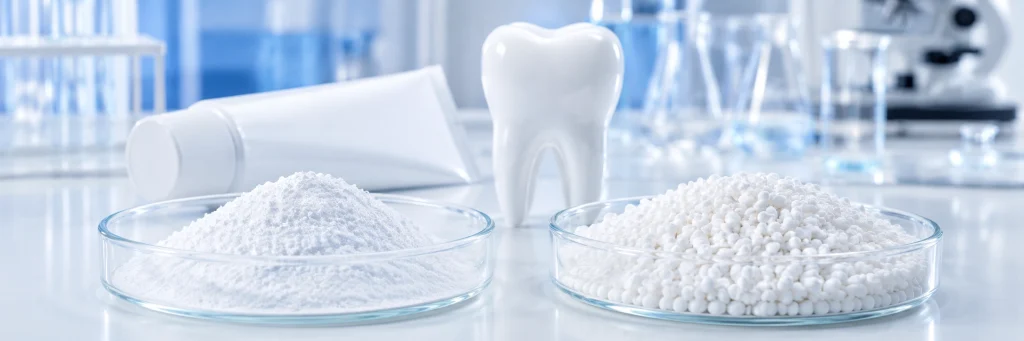
Particle size is one of the most important factors when choosing hydroxyapatite for toothpaste formulation.
Different particle sizes may affect dispersion, surface interaction, mouthfeel, stability and product positioning.
| Type | Key Features | Suitable Applications |
|---|---|---|
| Nano hydroxyapatite | Smaller particle size, larger surface area, stronger surface interaction | Premium toothpaste, sensitive teeth toothpaste, enamel-care formulas |
| Micro hydroxyapatite | Larger particle size, easier handling in some systems | Daily oral care toothpaste, general toothpaste formulas |
| Hydroxyapatite suspension | Pre-dispersed form, easier to use in water-based systems | Mouthwash, dental gel, liquid oral care products |
Nano hydroxyapatite is often used in higher-end toothpaste concepts because of its small particle size and biomimetic positioning. Micro hydroxyapatite may be selected when brands need easier handling, cost control or specific formula stability.
The best choice depends on the product type, target market, regulatory requirements and formula system.
What Percentage of Hydroxyapatite Is Used in Toothpaste?
There is no single fixed percentage suitable for all hydroxyapatite toothpaste formulas. The right use level depends on the product concept, particle size, formula type, local regulations, cost target and stability testing results.
In toothpaste development, brands may evaluate different levels depending on the product positioning:
| Product Direction | Formulation Consideration |
| Basic enamel-care toothpaste | Lower use level may support concept positioning |
| Daily fluoride-free toothpaste | Medium use level may balance cost and function |
| Sensitive teeth toothpaste | Higher use level may be evaluated with testing |
| Premium enamel repair concept | Particle size, dispersion and claim support become more important |
Before finalizing the dosage, brands should complete formula stability testing, safety assessment and regulatory review.
Is Hydroxyapatite Toothpaste Safe?
Hydroxyapatite is widely used in oral care products, but safety should always be evaluated based on raw material grade, particle size, purity, dosage, formulation system and local regulations.
Brands should avoid broad claims such as “safe for everyone” or “completely risk-free.” A more professional approach is to confirm whether the hydroxyapatite raw material is suitable for oral care use and whether the finished product has passed relevant safety and stability evaluations.
For toothpaste development, brands should check:
- Raw material grade
- Particle size distribution
- Purity
- Ca/P ratio
- Heavy metal limits
- Microbial limits
- COA
- SDS/MSDS
- TDS
- Local regulatory requirements
If the product is intended for children, sensitive groups or special markets, additional regulatory review and product testing may be required.
Hydroxyapatite Toothpaste vs Fluoride Toothpaste
Hydroxyapatite toothpaste and fluoride toothpaste have different mechanisms and different market positioning.
Fluoride toothpaste is widely used and strongly established in many markets. Hydroxyapatite toothpaste is often positioned as a biomimetic, fluoride-free or enamel-care alternative.
For brands, it is usually better not to simply say one is better than the other. A more professional approach is to explain the different product directions.
| Toothpaste Type | Main Positioning |
| Fluoride toothpaste | Traditional cavity protection and enamel support |
| Hydroxyapatite toothpaste | Biomimetic enamel care and fluoride-free positioning |
| Fluoride + hydroxyapatite toothpaste | Combined mineral care concept, depending on local regulations |
| Potassium nitrate toothpaste | Sensitive teeth relief positioning |
| Hydroxyapatite sensitive toothpaste | Mineral-based sensitive teeth care concept |
The final choice should depend on target consumers, brand strategy, market regulations and product claims.
Hydroxyapatite Toothpaste Formulation Tips for Oral Care Brands
Hydroxyapatite toothpaste formulation requires attention to both ingredient performance and formula stability.
Choose the Right Particle Size
Particle size affects dispersion, texture, surface interaction and product positioning. Brands should not only ask whether the material is “nano” or “micro,” but also request particle size distribution data.
Control the pH Range
Hydroxyapatite is generally more stable in neutral or mildly alkaline conditions. Strong acidic systems may influence its stability and mineral behavior.
For toothpaste formulas, pH should be carefully controlled during development and stability testing.
Improve Dispersion
Poor dispersion may cause particle aggregation, rough texture or uneven appearance. Formulators should optimize the wetting and mixing process.
Key factors include addition sequence, mixing speed, humectant system, thickener system, surfactant compatibility and homogenization process.
Check Compatibility with Abrasives
Toothpaste often contains abrasive ingredients. If the abrasive system is too harsh, it may conflict with a gentle enamel-care product positioning.
For hydroxyapatite toothpaste, the abrasive system should support the formula’s target mouthfeel and cleaning level.
Run Stability Testing
Before launching a hydroxyapatite toothpaste, brands should test formula stability under different conditions.
Common tests include room temperature stability, high-temperature stability, freeze-thaw testing, centrifuge testing, appearance evaluation, viscosity change, pH change and packaging compatibility.
A stable hydroxyapatite toothpaste should maintain acceptable appearance, texture, pH and performance throughout shelf life.
How to Choose Hydroxyapatite Powder for Toothpaste
For B2B toothpaste development, choosing the right hydroxyapatite raw material supplier is very important. The supplier should provide not only powder, but also quality documents and technical communication.
Brands should check the following points before purchasing.
Application Grade
Not all hydroxyapatite powders are suitable for toothpaste. Some are used for biomaterials, coatings, cosmetics or research purposes. Toothpaste brands should confirm whether the material is suitable for oral care applications.
Particle Size Data
Brands should request clear particle size information instead of relying only on general descriptions.
Useful questions include:
- What is the average particle size?
- Is it nano hydroxyapatite or micro hydroxyapatite?
- Is the particle size distribution stable between batches?
- Can the supplier provide different particle size options?
Purity and Ca/P Ratio
Purity and Ca/P ratio are important for material consistency. A reliable supplier should provide clear specification data and batch documents.
Heavy Metals and Microbial Control
Because toothpaste is used in the mouth, quality control should be strict. Heavy metals, microbial limits and other safety-related indicators should be reviewed before purchase.
Documentation
A professional hydroxyapatite supplier should be able to provide COA, SDS/MSDS, TDS, specification sheet, heavy metal test data and microbial test data when applicable.
Sample Support
Before bulk order, brands should request samples for formula testing. Sample testing helps evaluate dispersion, texture, pH stability and compatibility with the full toothpaste system.
Common Mistakes When Developing Hydroxyapatite Toothpaste
Only Comparing Price
Low-cost material may create problems if particle size, purity or batch consistency is not stable. For toothpaste brands, reliable quality is more important than the lowest price.
Ignoring Particle Size
Particle size can affect both formula performance and marketing positioning. Brands should choose particle size based on final product needs.
Making Overstated Claims
Hydroxyapatite is a valuable oral care ingredient, but claims should be accurate and compliant. Avoid exaggerated claims such as guaranteed enamel repair, cavity reversal or medical treatment effects unless supported by appropriate evidence and local regulations.
Skipping Stability Testing
Even if the raw material quality is good, the final formula still needs stability testing. Brands should not skip pH, viscosity, appearance and packaging compatibility tests.
Who Should Consider Hydroxyapatite Toothpaste?
Hydroxyapatite toothpaste can be considered by brands developing:
- Fluoride-free toothpaste
- Enamel-care toothpaste
- Sensitive teeth toothpaste
- Children’s oral care products
- Premium toothpaste lines
- Natural or clean-label oral care products
- Dentist-inspired toothpaste
- Mouthwash or dental gel formulas
For oral care brands, hydroxyapatite provides both functional value and a strong consumer education story.
MeiyiBio Hydroxyapatite for Toothpaste and Oral Care
MeiyiBio supplies hydroxyapatite powder for oral care, cosmetic and biomaterial applications. For toothpaste brands and formulators, we can support different development needs, including enamel-care toothpaste, fluoride-free toothpaste, sensitive teeth toothpaste and water-based oral care formulas.
Our hydroxyapatite raw material can be evaluated for toothpaste formulas, mouthwash formulas, dental gels, oral care powders, enamel-care product concepts and sensitive teeth product development.
We support B2B customers with sample testing, technical communication and product documentation.
If you are developing hydroxyapatite toothpaste, mouthwash or dental gel products, you can contact MeiyiBio to discuss suitable hydroxyapatite grades and sample evaluation.
Conclusion
Hydroxyapatite toothpaste is becoming an important direction in modern oral care product development. It supports enamel-care, fluoride-free and sensitivity-focused product concepts, while also offering a strong biomimetic ingredient story.
For consumers, hydroxyapatite toothpaste is easy to understand as a tooth-like mineral care ingredient. For brands, the key to success is choosing the right hydroxyapatite grade, particle size, purity, documentation and supplier support.
If your brand is developing fluoride-free toothpaste, sensitive teeth toothpaste or enamel-care oral care products, hydroxyapatite powder may be a valuable ingredient to evaluate in your next formula.
FAQ
Q1: What is hydroxyapatite toothpaste?
Hydroxyapatite toothpaste is a toothpaste formula that contains hydroxyapatite, a calcium phosphate mineral related to the mineral structure of teeth. It is commonly used in enamel-care, fluoride-free and sensitive teeth toothpaste formulas.
Q2: Is hydroxyapatite toothpaste fluoride-free?
Many hydroxyapatite toothpaste products are fluoride-free, but this depends on the formula. Some brands may also develop formulas containing both fluoride and hydroxyapatite, depending on local regulations and product positioning.
Q3: Is nano hydroxyapatite better than micro hydroxyapatite?
Nano hydroxyapatite has a smaller particle size and larger surface area, which may support stronger surface interaction. Micro hydroxyapatite may be easier to handle in some formulations. The best choice depends on the final product.
Q4: What percentage of hydroxyapatite is used in toothpaste?
There is no universal fixed percentage. The proper use level depends on particle size, product concept, local regulations, formula stability and safety assessment.
Q5: Can hydroxyapatite toothpaste help sensitive teeth?
Hydroxyapatite can be used in toothpaste formulas designed for sensitive teeth care, especially in products positioned around dentin surface protection and mineral support. Finished product claims should be supported by testing and local regulatory review.
Q6: What should brands check when buying hydroxyapatite powder for toothpaste?
Brands should check particle size, purity, Ca/P ratio, heavy metals, microbial limits, documentation, dispersion performance and supplier experience in oral care applications.
Q7: Can MeiyiBio provide hydroxyapatite samples?
Yes. MeiyiBio can support hydroxyapatite sample evaluation for toothpaste, mouthwash, dental gel and other oral care product development.






Please leave us a message.