

SOD vs Vitamin C in Skincare: What Is the Difference?
2026-06-27
Introduction
Antioxidant skincare has become one of the most important directions in modern cosmetic formulation. From daily facial serums to anti-aging creams and brightening products, brands are looking for ingredients that can help protect skin from environmental stress and support a healthier-looking complexion.
Among many antioxidant ingredients, Superoxide Dismutase (SOD) and Vitamin C are two names that often appear in skincare discussions. Both are connected with antioxidant protection, but they are not the same type of ingredient. They work in different ways, have different formulation requirements, and are suitable for different product concepts.
For skincare brands, formulators, and raw material buyers, understanding the difference between SOD and Vitamin C can help create more stable, effective, and marketable cosmetic products.
What Is SOD in Skincare?
SOD, short for Superoxide Dismutase, is an antioxidant enzyme. In cosmetic formulations, SOD is often used as a functional antioxidant ingredient to help support the skin against oxidative stress caused by environmental factors such as UV exposure, pollution, and daily lifestyle stress.
Unlike traditional antioxidants that directly neutralize certain free radicals, SOD is an enzyme-based ingredient. Its main role is associated with converting superoxide radicals into less reactive molecules. This makes SOD an interesting ingredient for skincare products that focus on antioxidant care, anti-aging support, soothing concepts, and daily environmental protection.
For cosmetic use, SOD is commonly positioned as:
- An antioxidant enzyme ingredient
- A skin conditioning ingredient
- A premium active for anti-aging formulas
- A supportive ingredient for sensitive-skin-friendly products
- A functional ingredient for serum, cream, lotion, and mask formulations
Because SOD is an enzyme, formulators need to pay attention to its activity, stability, storage, and compatibility with the final product system.
What Is Vitamin C in Skincare?
Vitamin C is one of the most widely used antioxidant ingredients in skincare. It is popular in brightening, anti-aging, and tone-improving product concepts. In cosmetic formulations, Vitamin C may appear in different forms, including pure L-ascorbic acid and various Vitamin C derivatives.
Vitamin C is often used to support:
- A brighter-looking skin tone
- More even-looking complexion
- Antioxidant protection
- Collagen-related skincare concepts
- Anti-aging product positioning
However, Vitamin C also has well-known formulation challenges. Pure L-ascorbic acid can be sensitive to light, oxygen, pH, and temperature. Some Vitamin C derivatives are more stable, but they may require conversion in the skin and can perform differently depending on the formula.
This is why formulators often need to balance performance, stability, skin feel, pH, packaging, and marketing claims when developing Vitamin C skincare products.
SOD vs Vitamin C: Main Difference
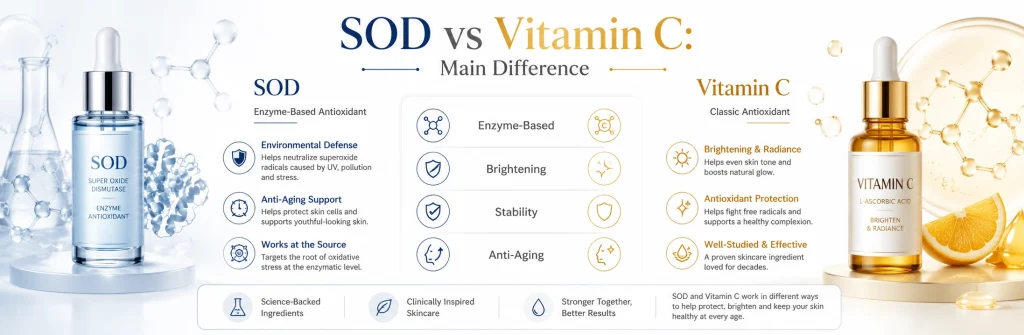
The biggest difference between SOD and Vitamin C is their antioxidant mechanism.
SOD is an enzyme-based antioxidant ingredient, while Vitamin C is a small-molecule antioxidant ingredient.
SOD works through enzymatic activity and is mainly associated with superoxide radical management. Vitamin C works more directly as a reducing antioxidant and is also strongly linked with brightening and tone-improving skincare concepts.
In simple terms:
SOD is more suitable for antioxidant defense and environmental stress care.
Vitamin C is more suitable for brightening, tone improvement, and classic antioxidant skincare.
Both ingredients can be valuable, but they are not interchangeable.
Comparison Table: SOD vs Vitamin C in Skincare
| Item | SOD | Vitamin C |
|---|---|---|
| Full Name | Superoxide Dismutase | Ascorbic Acid or Vitamin C Derivatives |
| Ingredient Type | Antioxidant enzyme | Small-molecule antioxidant |
| Main Skincare Direction | Antioxidant support, environmental stress care, anti-aging concepts | Brightening, antioxidant care, uneven tone support |
| Formulation Challenge | Enzyme activity and stability | Oxidation, pH sensitivity, discoloration |
| Suitable Products | Serum, cream, lotion, mask, premium anti-aging care | Serum, cream, essence, brightening products |
| Marketing Position | Advanced antioxidant enzyme | Classic brightening antioxidant |
| Key Buyer Concern | Activity, purity, stability, storage | Stability, irritation potential, derivative type, pH |
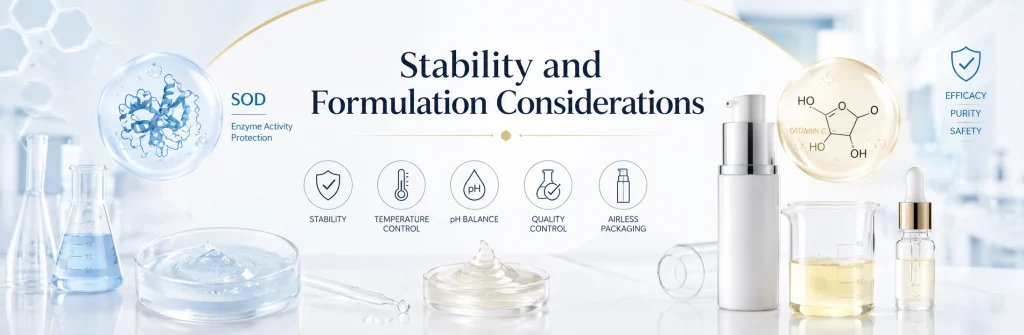
Which Ingredient Is More Stable?
Stability is one of the most important differences between SOD and Vitamin C.
Vitamin C, especially pure L-ascorbic acid, is known for being unstable in many cosmetic systems. It may oxidize when exposed to air, light, high temperature, or unsuitable pH. This can cause color change, odor change, and reduced performance over time. To improve stability, brands often use airless packaging, low-pH systems, protective antioxidants, or more stable Vitamin C derivatives.
SOD also requires careful formulation, but the stability concern is different. Since SOD is an enzyme, formulators need to protect its activity. High heat, extreme pH, strong oxidizing systems, and unsuitable processing conditions may affect enzyme performance.
For raw material buyers, this means the supplier should provide clear information about:
- SOD activity
- Product specification
- Recommended storage conditions
- Suitable formulation pH range
- Processing temperature suggestions
- COA and quality control data
In short, Vitamin C is mainly challenged by oxidation, while SOD is mainly challenged by enzyme activity preservation.
Which Ingredient Is Better for Brightening?
Vitamin C is usually the stronger choice for brightening-focused skincare. It is widely recognized in the beauty market and has strong consumer awareness. If a brand wants to create a product around “glow,” “radiance,” “brightening,” or “uneven tone,” Vitamin C is often easier to communicate.
SOD, on the other hand, is not mainly a brightening ingredient. Its value is more related to antioxidant support and environmental stress protection. It can be used in products that support healthy-looking, balanced, and resilient skin, but it should not be positioned exactly the same way as Vitamin C.
For a brightening serum, Vitamin C may be the hero ingredient. For an antioxidant repair-style or daily defense-style product, SOD can be a premium supporting ingredient.
Which Ingredient Is Better for Anti-Aging Skincare?
Both SOD and Vitamin C can be used in anti-aging skincare concepts, but their positioning is different.
Vitamin C is commonly used in anti-aging products because it is associated with brightening, antioxidant care, and collagen-related cosmetic positioning. It is suitable for products that focus on visible radiance, fine-line care, and uneven tone.
SOD is suitable for anti-aging formulas that focus on oxidative stress, skin comfort, and environmental protection. It can be used in premium anti-aging creams, antioxidant serums, and daily protection products.
For brands, SOD can make an anti-aging formula feel more advanced and technology-driven, especially when combined with peptides, hyaluronic acid, ceramides, or plant antioxidants.
Can SOD and Vitamin C Be Used Together?
Yes, SOD and Vitamin C can be used in the same skincare concept, but the formula must be designed carefully.
From a marketing perspective, the combination can be attractive because it brings together two different antioxidant approaches:
- Vitamin C for radiance and brightening support
- SOD for enzyme-based antioxidant protection
- Other ingredients for hydration, barrier care, or soothing support
However, formulators should carefully evaluate pH, stability, processing temperature, and packaging. If pure L-ascorbic acid is used in a very low-pH system, it may not be the best environment for SOD enzyme activity. In this case, a more stable Vitamin C derivative or a separated product format may be considered.
Possible product concepts include:
- Antioxidant brightening serum
- Daily environmental defense cream
- Anti-aging essence
- Sensitive-skin-friendly antioxidant lotion
- Radiance and barrier care formula
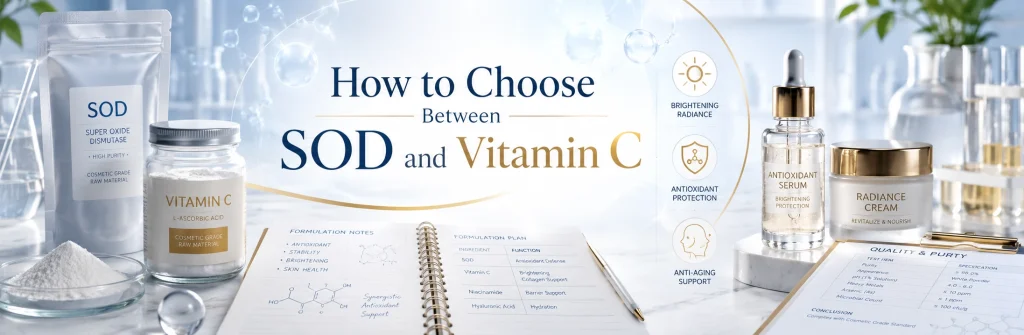
How to Choose Between SOD and Vitamin C
The best choice depends on the product positioning.
Choose Vitamin C if your formula focuses on:
- Brightening
- Glow and radiance
- Uneven skin tone
- Classic antioxidant skincare
- Strong consumer recognition
Choose SOD if your formula focuses on:
- Advanced antioxidant care
- Environmental stress protection
- Premium anti-aging concepts
- Sensitive-skin-friendly antioxidant formulas
- Enzyme-based skincare technology
Choose both if your brand wants a more complete antioxidant story, but make sure the formulation system can protect both ingredients.
What Should Buyers Check When Sourcing Cosmetic Grade SOD?
For cosmetic brands and manufacturers, choosing a reliable SOD raw material supplier is important. Since SOD is an activity-based enzyme ingredient, quality control should not only focus on appearance or purity.
Key points to check include:
- Enzyme activity
Activity is a key quality indicator for SOD. Buyers should ask for activity data and test methods. - COA and specification
A complete COA should include relevant quality parameters such as appearance, activity, purity, microbiological limits, and storage conditions. - Stability information
Buyers should understand how the ingredient performs under different formulation and storage conditions. - Recommended application range
A professional supplier should provide guidance for product types such as serum, cream, lotion, and mask. - Batch consistency
For long-term product development, stable batch quality is very important. - Packaging and storage
Enzyme ingredients should be protected from unsuitable temperature, moisture, and light exposure according to supplier recommendations.
Formulation Tips for SOD and Vitamin C
When using SOD or Vitamin C in skincare products, formulators should pay attention to the following:
- Avoid unnecessary high-temperature processing for enzyme ingredients.
- Choose suitable packaging to reduce exposure to air and light.
- Evaluate formula pH before combining active ingredients.
- Conduct stability testing before final launch.
- Use compatible antioxidant systems when needed.
- Avoid overstating claims beyond cosmetic functions.
- Work with suppliers that can provide technical support and documentation.
For B2B skincare development, ingredient performance is not only about marketing trends. It also depends on formula compatibility, manufacturing process, packaging, and long-term stability.
Conclusion
SOD and Vitamin C are both valuable antioxidant skincare ingredients, but they are not the same.
Vitamin C is a classic antioxidant ingredient with strong brightening and radiance positioning. It is well known by consumers and widely used in serums, creams, and tone-improving products.
SOD is an enzyme-based antioxidant ingredient that fits well in advanced skincare formulas focused on environmental stress protection, anti-aging support, and premium cosmetic positioning.
For skincare brands, the decision should depend on the product concept, target market, formula system, and stability requirements. Vitamin C may be the better choice for brightening products, while SOD can add a more advanced antioxidant story to anti-aging and protective skincare formulas.
For brands looking to develop antioxidant skincare products, choosing high-quality cosmetic grade SOD raw material and working with an experienced ingredient supplier can help improve formulation reliability and product positioning.
FAQ
Is SOD better than Vitamin C in skincare?
SOD is not simply better than Vitamin C. They have different functions and formulation roles. Vitamin C is stronger for brightening concepts, while SOD is more suitable for enzyme-based antioxidant and environmental stress care formulas.
Can SOD be used in anti-aging skincare?
Yes. SOD can be used in anti-aging skincare concepts because oxidative stress is an important concern in cosmetic product development. It is suitable for serums, creams, lotions, and masks.
Is Vitamin C difficult to formulate?
Vitamin C, especially pure L-ascorbic acid, can be sensitive to oxygen, light, temperature, and pH. Many brands use derivatives, protective packaging, or optimized formula systems to improve stability.
Can SOD and Vitamin C be used together?
They can be used together, but the formulation system should be carefully designed. pH, temperature, packaging, and ingredient compatibility should be evaluated before final production.
What is the best product type for SOD?
SOD can be used in facial serums, creams, lotions, masks, and premium anti-aging products. It is especially suitable for antioxidant and environmental protection skincare concepts.
What should buyers ask from a SOD supplier?
Buyers should ask for COA, specification, enzyme activity data, recommended storage conditions, stability information, and application guidance for cosmetic formulations.






Please leave us a message.