

Unveiling PDRN: Is this highly sought-after skincare ingredient a marketing gimmick or does it truly deliver results?
2026-01-14
Recently, PDRN (polydeoxyribonucleotide) has frequently appeared in the promotional materials of functional skincare and medical aesthetic products. Labels such as “salmon DNA injection” and “DNA-level repair” have quickly made it popular, but also sparked controversy: Is this merely a marketing gimmick created by capital, or is it a truly effective active ingredient with substantial benefits? This article will analyze the true value of PDRN from a scientific perspective, combining clinical research and industry application data.
The core definition and functional logic of PDRN
PDRN is a polymer formed by deoxyribonucleotides linked by phosphodiester bonds, with a molecular weight ranging from 50 to 1500 kDa. Its core biological activity originates from the adenosine structure. Currently, compliant raw materials are mainly extracted from salmon reproductive cells, but can also be prepared through microbial fermentation and synthetic biology techniques, and require multiple tests for nucleic acid purity and biological activity.
Its mechanism of action has clear biological basis, mainly divided into two pathways:
1.Anti-inflammatory regulatory pathway: As an adenosine A2A receptor agonist, it can precisely upregulate the anti-inflammatory factor IL-10 and downregulate the pro-inflammatory factors IL-6 and TNF-α, balancing the skin microenvironment and inhibiting oxidative stress damage;
2.Repair and synthesis pathway: As a nucleotide precursor for cell DNA synthesis, it can provide raw materials for genetic material reconstruction in damaged cells, accelerating epidermal proliferation and barrier structure repair. This mechanism has been verified in multiple in vitro cell experiments and clinical studies.
Verifying the effectiveness: Core functions supported by research.
1.Barrier Repair and Anti-inflammatory Soothing: Clinically Proven Core Advantages
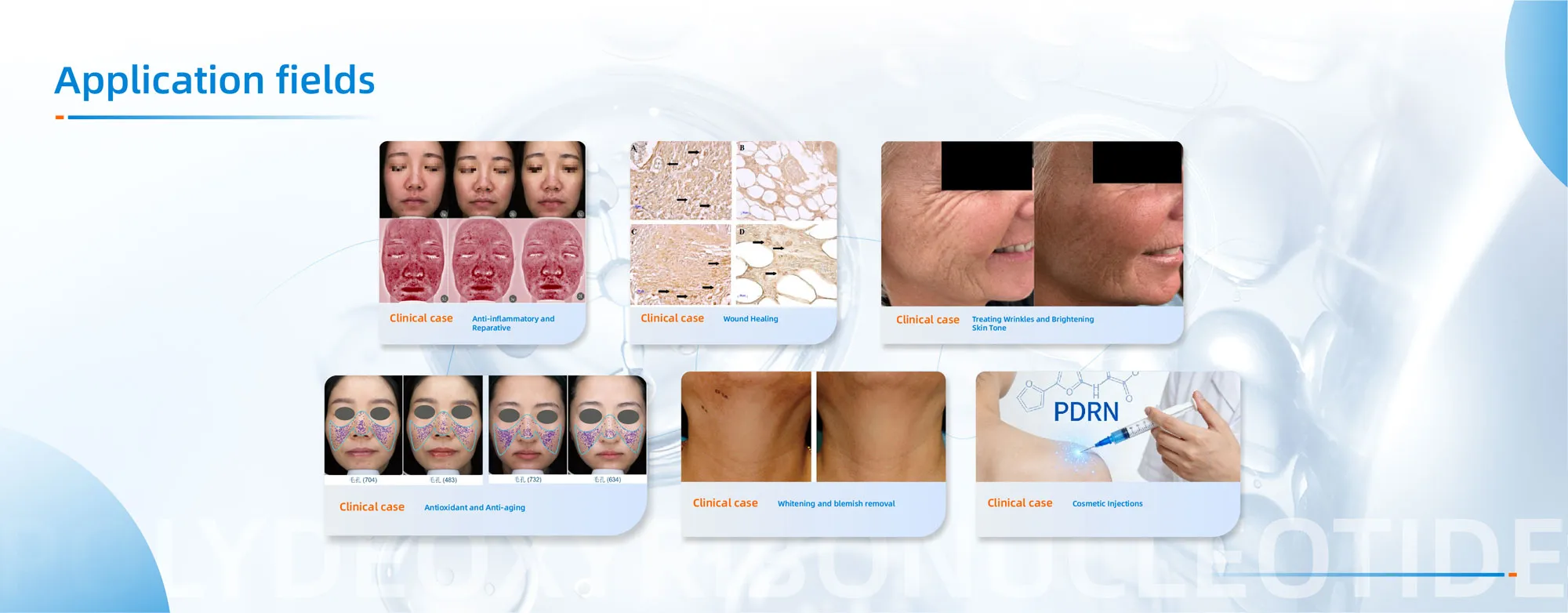
In the field of dermatology, PDRN has clear data supporting its effectiveness in improving barrier damage and inflammatory skin problems. Clinical studies show that preparations containing PDRN can significantly improve redness symptoms in erythematotelangiectatic rosacea, with an average reduction of 32.7% in erythema area after 4 weeks of use; for post-cosmetic procedure wounds, it can shorten epidermal healing time by 20% to 30%, and alleviate post-operative redness, swelling, heat, and pain.
Furthermore, in topical application trials for atopic dermatitis, PDRN reduced skin itching scores and increased stratum corneum hydration. This is not marketing jargon, but a direct manifestation of its anti-inflammatory and repair mechanisms.
2.Whitening and Anti-aging: Proven to Work at the Root Cause
In vitro cell experiments have confirmed that PDRN can inhibit tyrosinase activity (inhibition rate of approximately 28%), downregulate the expression of melanin-regulating proteins such as MITF, and reduce melanin production; at the same time, it can enhance fibroblast mitochondrial activity, inhibit matrix metalloproteinase MMP-1, and promote collagen synthesis.
3.Photodamage Protection: Targeted DNA-level Repair
After UV irradiation, skin cells experience DNA damage. PDRN can quickly activate the p53 protein pathway to initiate DNA repair mechanisms, reduce UV-induced gene mutations, and lower the risk of photoaging and photodamage. This effect has been verified in photodamaged cell model experiments and is one of its core advantages that distinguishes it from ordinary antioxidant ingredients.
Application areas: from essential medical needs to expanded applications in skincare.
The application of PDRN did not begin with skincare marketing; its value was first recognized in the medical field, and only later gradually expanded to medical aesthetics and functional skincare. The efficacy in different scenarios has clear boundaries.
1.Medical Field:
As early as 2008, the Italian company Mastelli launched the first PDRN medicinal injection, Placentex, used for the repair of chronic wounds (diabetic foot ulcers, burn wounds), corneal damage, and bone damage. Clinical data shows that its effective rate in healing difficult-to-heal wounds can reach 76.5%, making it a clinically recognized auxiliary component for tissue repair.
2.Medical Aesthetics Field:
In the medical aesthetics field, PDRN is commonly known as “salmon DNA” due to its source material and is widely used in mesotherapy and post-microneedling repair. The Korean Food and Drug Administration (KFDA) included it as a compliant ingredient for tissue transplantation and wound treatment in 2008, accelerating the healing of minimally invasive wounds in medical aesthetics, improving redness in sensitive skin and rough skin texture. Its effects have been verified by clinical feedback from medical aesthetics institutions.
3.Functional Skincare Field:
With technological advancements, PDRN has been successfully incorporated into topical skincare products. For skin problems caused by excessive cleansing, chemical peels, or post-laser treatments, such as weakened skin barrier, redness, and dryness, topical PDRN provides superior repair signals compared to ordinary moisturizing ingredients. It doesn’t directly “treat” the problem, but rather creates a better microenvironment for skin self-repair by reducing inflammation and promoting the healthy differentiation of keratinocytes.
Many high-end repair creams, serums, or ampoules use it as a core ingredient, emphasizing its “strengthening and repairing” and “anti-aging and stabilizing” effects. It is often combined with barrier-repairing ingredients such as ceramides and centella asiatica extract to enhance its efficacy, and also paired with antioxidants (such as SOD) to protect against oxidative damage while repairing the skin.
Conclusion
PDRN is not a marketing gimmick; its anti-inflammatory and reparative effects, along with its DNA-level protection, are supported by solid biological mechanisms and clinical data. Its core value is demonstrated in applications ranging from medical wound healing to post-cosmetic procedure care. However, in the functional skincare market, some brands engage in misleading marketing practices, such as exaggerating concentrations and efficacy claims.
Consumers should understand that: medical-grade PDRN (injected/microneedled) offers significant reparative effects and is suitable for post-cosmetic procedures or severely damaged skin barriers; topical PDRN skincare products are suitable for daily repair and maintenance of sensitive skin, as well as for anti-aging and whitening purposes in skincare. A rational understanding of ingredient value is crucial to avoid marketing traps.





Please leave us a message.