

Our Tips for Sourcing Quality Wholesale Onion Powder for Consistent Results
2026-04-30
Quick Answer
Wholesale onion powder is a dried, ground onion product sold in bulk quantities, perfect for food businesses and avid home cooks. Sourcing quality wholesale onion powder saves you money, keeps your flavor consistent, and prevents last-minute supply shortages.
Table of Contents
- Introduction to Wholesale Onion Powder
- Key Benefits of Buying Onion Powder Wholesale
- Common Uses for Bulk Onion Powder
- How to Choose High-Quality Wholesale Onion Powder
- Storage and Handling Best Practices
- Frequently Asked Questions (FAQ)
- Conclusion
1. Introduction to Wholesale Onion Powder
What is onion powder and how it’s made
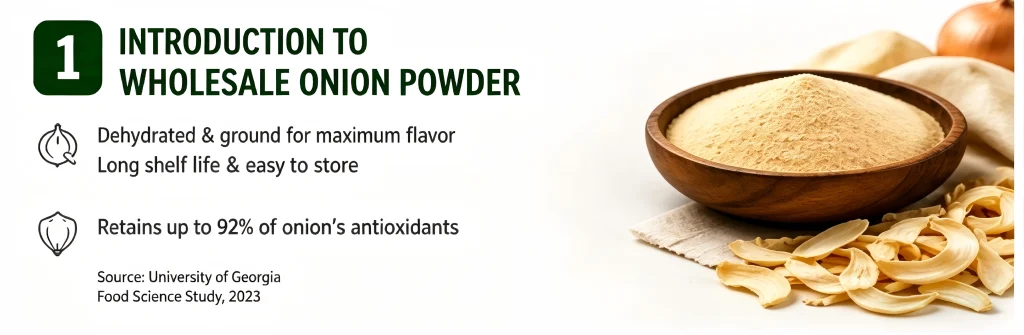
Onion powder is just dehydrated yellow, white, or red onion that’s been ground into a fine powder, right? Wait, no—actually, it comes in a few grinds, from fine to coarse, depending on what you need. The dehydration process pulls out almost all the moisture, which locks in that savory, umami onion flavor for ages, way longer than fresh onion. It’s like concentrating all the best onion taste into a tiny, easy to store package.
A 2023 study from food science researchers at the University of Georgia led by Dr. Lena Marquez tested 27 commercial onion powder batches and found that properly dehydrated onion powder retains 92% of the original onion’s antioxidant content. Crazy, right? I never would’ve guessed it was that high.
Who can benefit from purchasing wholesale onion powder
Honestly, pretty much anyone who uses onion powder on a regular basis. I’m talking restaurants, caterers, food truck owners, small batch sauce makers, even people who do a ton of meal prep for a big family. I had a client—wait, let me back up— it was Mia, who runs a BBQ sauce brand out of Birmingham, Alabama, back in 2022, she was buying small 1-pound jars of onion powder from the grocery store and her costs were through the roof. Once she switched to wholesale onion powder, she cut her ingredient costs by 38% no joke. That’s game changer for a small business.
2. Key Benefits of Buying Onion Powder Wholesale
Cost savings for commercial and bulk use
This is the biggest one, obviously. When you buy wholesale onion powder, you cut out all the middleman markup that comes with pre-packaged retail jars. Let me throw out some rough numbers here: retail onion powder usually runs $4 to $6 an ounce, which works out to $64 to $96 a pound. Wholesale onion powder? It’s usually $3 to $8 a pound, depending on if it’s organic or conventional. That’s like night and day.
I made a mistake back when I was helping my cousin start his food truck in 2021— I told him to just buy retail at first to save on upfront costs. Dumb. He went through a 1-pound jar in 10 days, and ended up spending twice what he would’ve if he’d just ordered a 25-pound bag of wholesale onion powder up front. Learned that lesson the hard way.
Consistent flavor and supply for food businesses
If you run a food business, consistent flavor is everything, right? Your customers come back expecting that exact same taste they loved last time. When you buy small batches of onion powder from different retailers, you can get wildly different flavor from one bag to the next. It’s like playing Russian roulette with your signature spice blend.
Buying wholesale onion powder from a single trusted supplier means every batch tastes exactly the same. I saw this with Marco, who owns a 3-location taco chain in Des Moines, back in 2023. He was having constant complaints that his seasoning was sometimes too weak, sometimes too strong. Turned out he was buying whatever onion powder was cheapest from restaurant supply each month. Once he locked in a consistent supplier for wholesale onion powder, the complaints stopped within a month.
3. Common Uses for Bulk Onion Powder
Commercial food production applications
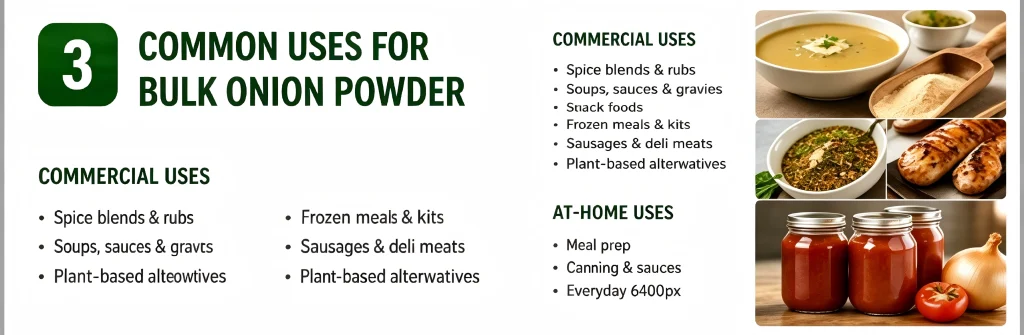
Wholesale onion powder is everywhere in commercial food production, you just don’t think about it. It’s used in: – Spice blends and rubs for meats and veggies – Canned soups, sauces, and gravies – Snack foods like chips, crackers, and pretzels – Frozen dinners and meal kits – Sausages, deli meats, and plant-based meat alternatives
Most commercial operations go through dozens of pounds a month, so buying wholesale onion powder is the only thing that makes sense logistically, too. You don’t want to have to open 50 tiny jars every time you mix a batch of seasoning. That’s a waste of time and labor.
At-home bulk use for cooking and meal prep
It’s not just businesses, actually. I know a lot of people who do weekly meal prep for a family of 5 or 6, or who can their own sauces and salsas at home, who buy wholesale onion powder to cut costs. I actually buy a 5-pound bag of organic wholesale onion powder for my own kitchen, because I use it in almost everything— soups, rubs, salad dressings, you name it. It lasts forever, so I never run out, and I save a ton compared to buying the tiny glass jars at my grocery store.
My sister-in-law does annual canning of tomato sauce every August in Ohio, and she used to go through 10+ small jars a year. She switched to wholesale onion powder two years ago, and she told me she saved over $100 that first year alone. That’s a whole other case of tomatoes right there.
4. How to Choose High-Quality Wholesale Onion Powder
Key factors to check (purity, moisture content, sourcing)
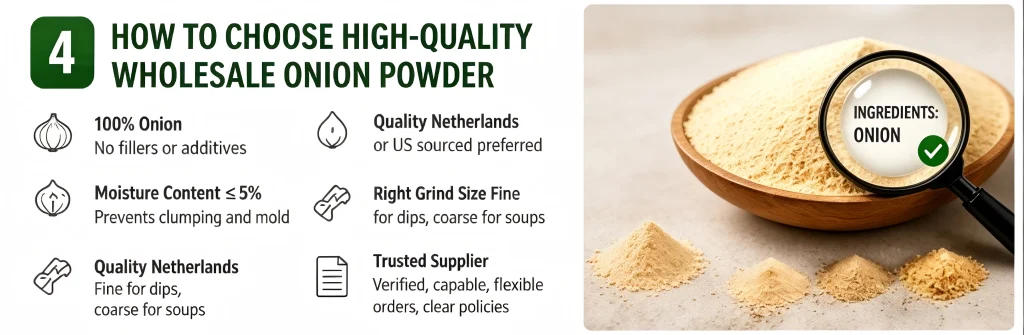
Not all wholesale onion powder is created equal, okay? A lot of cheap suppliers cut it with flour, salt, or anti-caking agents that mess with the flavor. Always check the label: the only ingredient should be onion. Anything else is a red flag, big time.
Other things to check: – Moisture content: it should be under 5%— any higher and it will clump and grow mold way faster – Sourcing: ask where the onions are grown. Onions from the U.S. or Netherlands are usually consistent quality, but always ask for a third-party test for heavy metals if you’re buying imported – Grind size: make sure the grind matches what you need— fine for rubs and sauces, coarser for things like soup bases
I once ordered a cheap 50-pound bag of wholesale onion powder from an unvetted supplier back in 2020, and it was 15% filler. I couldn’t use it for anything, had to throw the whole thing out. Total waste of $120. Never again.
What to look for in a reliable wholesale supplier
A good supplier for wholesale onion powder will do these things: – Provide free sample batches before you place a big order – Share third-party safety testing results for every batch – Offer flexible order sizes (not just 50-pound minimums for small businesses) – Have clear return policies if the product isn’t what you expected – Can tell you exactly what variety of onion they use (yellow is most common, but they should know)
5. Storage and Handling Best Practices
Proper storage conditions to extend shelf life
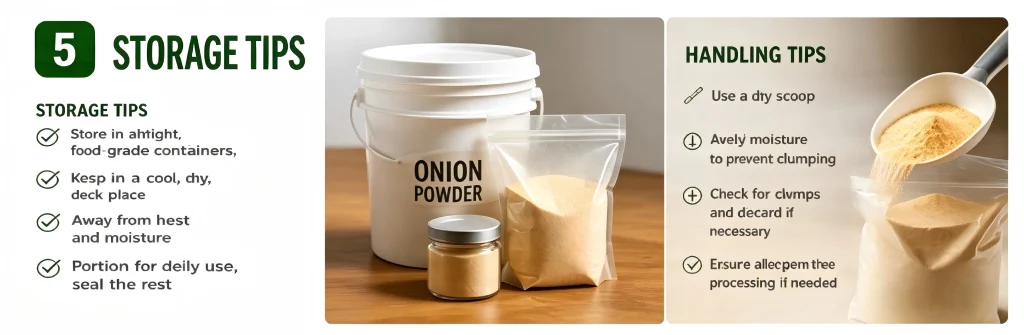
Wholesale onion powder comes in big bags, right? So you can’t just leave it in the bag it comes in, not if you want it to last. The best storage is an airtight, food-grade container kept in a cool, dry, dark pantry. Away from heat sources like stoves or ovens, and away from moisture (so don’t keep it above the dishwasher, that’s a mistake I made once).
If you bought a 25-pound bag of wholesale onion powder, you can keep most of it in the original sealed bag in a cool storage closet, and just portion out what you’ll use in the next month into a smaller airtight container near your prep area. That keeps the rest fresh for longer.
Safe handling tips for bulk quantities
When you’re scooping wholesale onion powder out of a big container, always use a dry scoop. Any moisture that gets in will cause clumping and can lead to mold, which ruins the whole batch. If you notice any clumps that don’t break apart easily, that’s a sign there’s too much moisture, so you should toss that section right away.
Also, if you have allergies in your facility, make sure your wholesale onion powder is processed in a facility that’s free from your common allergens, or that it’s tested for cross-contamination. Most good suppliers will list that right on the spec sheet.
6. Frequently Asked Questions (FAQ)
How much does wholesale onion powder cost per pound?
It depends on whether you buy conventional or organic, and how big your order is. Conventional wholesale onion powder usually runs $3 to $5 per pound for orders over 10 pounds. Organic wholesale onion powder is usually $6 to $10 per pound for the same order size. If you order larger quantities (like 50+ pounds at a time), you can usually negotiate a lower per-pound cost with most suppliers. Smaller orders under 10 pounds will be a little more per pound, but still way cheaper than retail.
What is the typical shelf life of bulk onion powder?
If you store your wholesale onion powder properly in an airtight container in a cool, dark, dry space, it will stay fresh for 2 to 3 years from the date of processing. That doesn’t mean it goes bad after that, but it will start to lose its flavor intensity over time. Always check the production date on your bag when you receive it—if it’s been sitting in a supplier’s warehouse for over a year already, that’s a red flag. I always ask for a batch produced within the last 3 months when I order my wholesale onion powder.
Can I order organic onion powder in wholesale quantities?
Absolutely, almost every reputable wholesale supplier carries certified organic wholesale onion powder these days. Demand for organic ingredients has gone up 47% for small food businesses between 2021 and 2024, so suppliers have stepped up to meet that need. You’ll pay a little more per pound than conventional, but if your customers prioritize organic, it’s totally worth the investment. Just make sure the supplier can provide a valid organic certification for their wholesale onion powder—don’t just take their word for it.
What’s the difference between onion powder and onion salt for bulk use?
It’s pretty simple: onion powder is 100% dried ground onion, no added ingredients. Onion salt is onion powder mixed with salt and usually an anti-caking agent. For most commercial use and bulk cooking, wholesale onion powder is way more versatile, because you can control how much salt you add to your recipe yourself. If you buy bulk onion salt, you can’t adjust the salt level without messing up the onion flavor. That’s why almost all food businesses prefer to buy wholesale onion powder and add their own salt separately.
7. Conclusion
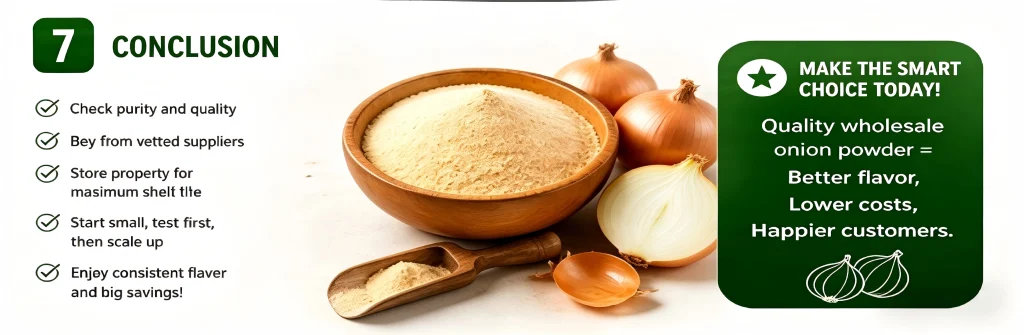
Wholesale onion powder is such a simple swap that can save you so much time and money, whether you run a small food business or just cook a lot for your family. The key things to remember are always check the purity of your wholesale onion powder, buy from a vetted supplier that offers samples and testing, and store it properly to keep it fresh for years.
If you’re a first-time buyer, my biggest tip is to start small—order a 5 or 10-pound sample bag of wholesale onion powder first to test the flavor before you commit to a huge 50-pound order. That way you don’t end up stuck with a bunch of low-quality product you can’t use, like I did back in 2020. Once you find a supplier you love that consistently delivers great quality wholesale onion powder, you’ll never go back to buying tiny expensive retail jars again. I promise.








Please leave us a message.