

Hydroxyapatite Particle Morphology: How Shape Affects Material Performance
2026-06-15
Hydroxyapatite is widely used in oral care, dental materials, bone repair materials, implant coatings and biomedical composites. When buyers evaluate hydroxyapatite powder, they often focus on particle size, purity and Ca/P ratio. However, another important technical parameter is often overlooked: hydroxyapatite particle morphology.
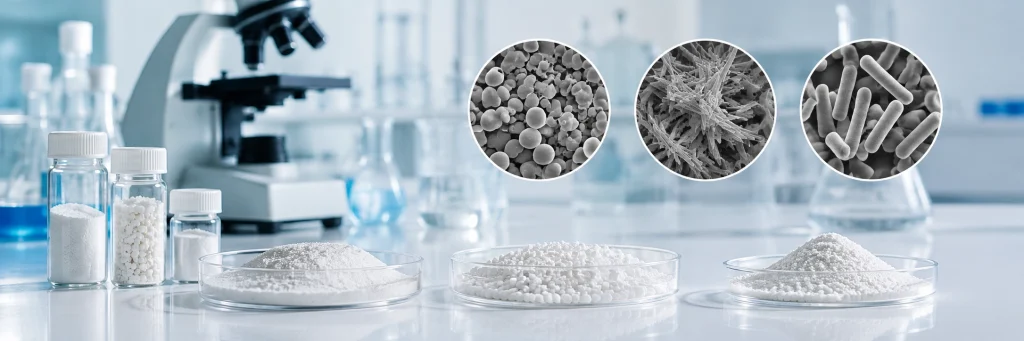
Particle morphology refers to the shape, surface structure and physical appearance of hydroxyapatite particles. Depending on the production method and process conditions, hydroxyapatite may appear as spherical particles, needle-like crystals, rod-shaped particles, plate-like structures, porous granules or irregular aggregates.
For dental, oral care and bone repair applications, particle morphology can affect dispersion, stability, flow behavior, surface interaction, composite reinforcement and processing performance. This is why manufacturers should not choose hydroxyapatite powder based only on particle size. The shape of the particle matters too.
What Is Hydroxyapatite Particle Morphology?
Hydroxyapatite particle morphology describes the physical shape and structural form of hydroxyapatite particles. Under microscopic observation, hydroxyapatite powder may show different appearances, such as:
- Spherical particles
- Rod-shaped particles
- Needle-like crystals
- Plate-like particles
- Porous granules
- Irregular agglomerates
- Nano-scale clusters
- Micro-scale particles
These shapes are closely related to synthesis method, pH, reaction temperature, calcium source, phosphate source, aging time, drying method and post-treatment process.
For example, wet precipitation may produce fine particles with different degrees of aggregation. Hydrothermal synthesis may help create more controlled crystal shapes such as rods, needles or plates. High-temperature treatment may change crystallinity, particle growth and aggregation behavior.
In practical applications, two hydroxyapatite powders with similar particle size may perform differently if their morphology is different. This is especially important for formulators, dental material manufacturers and biomaterial developers.
Why Particle Morphology Matters
Hydroxyapatite particle morphology affects how the powder behaves during formulation, processing and application. For B2B buyers, morphology is not just a laboratory detail. It can influence the final product.
1. Dispersion Behavior
Dispersion is one of the most important concerns for hydroxyapatite powder used in toothpaste, mouthwash, oral care suspensions, coatings and composite materials.
Spherical or near-spherical particles may disperse more easily in certain systems because they have fewer sharp edges and may show better flow behavior. Needle-like or rod-shaped particles may interact more strongly with each other, which can increase viscosity or cause aggregation if the formulation is not properly designed.
For nano hydroxyapatite, morphology becomes even more important. Nano particles have high surface energy and may agglomerate easily. If particle morphology is not controlled, the powder may be difficult to disperse evenly in water-based or polymer-based systems.
2. Flowability and Processing
Powder flowability affects weighing, mixing, filling, packaging and large-scale manufacturing.
Spherical particles often show better flowability than highly irregular or needle-like particles. Irregular particles may interlock with each other, increasing friction and reducing flow. This can create challenges during production, especially when hydroxyapatite powder is used in bulk quantities.
For manufacturers producing dental materials, bone repair granules or composite powders, flowability can affect batch consistency and processing efficiency.
3. Rheological Properties
Rheology describes how a material flows or deforms. In suspensions, gels, pastes and composite systems, hydroxyapatite morphology can influence viscosity, spreadability and stability.
For example, needle-like or rod-shaped particles may increase internal friction in a formulation. This can result in higher viscosity or different thixotropic behavior. In some cases, this may be useful. In other cases, it may make the product harder to process.
For toothpaste, injectable pastes, bone repair putties or coating slurries, rheology is a key performance factor. Choosing the right hydroxyapatite morphology can help manufacturers control texture, extrusion behavior and application feel.
4. Surface Interaction
Particle morphology also influences surface area and contact behavior. Particles with rough, porous or elongated structures may provide more surface interaction than smooth spherical particles.
In dental applications, surface interaction may influence how hydroxyapatite particles interact with enamel, dentin or dental material matrices. In bone repair applications, surface features may affect how the material interacts with biological fluids, proteins and surrounding tissue.
However, more surface interaction is not always better. A highly reactive or irregular morphology may also affect stability, aggregation or formulation compatibility. The best morphology depends on the target application.
5. Mechanical Performance in Composites
Hydroxyapatite is often combined with polymers, collagen, β-TCP, bioglass or other materials to form composite biomaterials. In these systems, particle morphology can influence mechanical strength, toughness, interfacial bonding and degradation behavior.
Rod-shaped or needle-like hydroxyapatite may provide reinforcement effects in some polymer matrices. Porous or irregular particles may improve interlocking but may also affect processing and uniformity. Spherical particles may improve dispersion and flow but may provide different reinforcement behavior.
For bone tissue engineering, 3D printing and scaffold design, morphology should be selected based on the final material structure, mechanical requirements and biological performance goals.
Common Hydroxyapatite Particle Shapes
Spherical Hydroxyapatite
Spherical hydroxyapatite particles are often preferred when flowability, smooth dispersion and uniform mixing are important.
Potential advantages include:
- Better powder flow
- Easier mixing in some systems
- Reduced interlocking between particles
- More uniform distribution in composites
- Suitable for certain coatings, suspensions and oral care systems
Spherical hydroxyapatite may be useful for manufacturers who need stable processing behavior and predictable batch-to-batch performance.
Needle-Like Hydroxyapatite
Needle-like hydroxyapatite has an elongated crystal structure. This morphology can provide high surface interaction and may influence mechanical reinforcement in composite materials.
Potential advantages include:
- High aspect ratio
- Strong interaction with surrounding matrices
- Possible reinforcement effect in composites
- Similarity to some natural mineral structures
However, needle-like particles may also create challenges. They may agglomerate more easily, increase viscosity and reduce powder flowability. For some applications, careful dispersion and formulation design are required.
Rod-Shaped Hydroxyapatite
Rod-shaped hydroxyapatite is commonly discussed in biomedical and materials research. It may offer a balance between surface interaction and processability depending on particle length, diameter and aggregation state.
Potential uses include:
- Dental materials
- Polymer composites
- Coating systems
- Bone repair materials
- Biomaterial scaffolds
Rod-shaped hydroxyapatite may be suitable when manufacturers want controlled morphology and functional surface interaction.
Plate-Like Hydroxyapatite
Plate-like hydroxyapatite particles may be relevant to biomimetic material design because the mineral phase in natural hard tissues can show plate-like or layered characteristics.
Potential advantages include:
- Biomimetic structural features
- Strong surface contact
- Potential use in advanced dental or bone-related materials
However, plate-like particles may also affect dispersion and viscosity. They require careful formulation evaluation.
Porous Hydroxyapatite
Porous hydroxyapatite is widely used in bone repair concepts because porosity can support fluid penetration, surface area and tissue interaction.
Potential applications include:
- Bone graft substitutes
- Bone void fillers
- Scaffold materials
- Composite bone repair systems
- Orthopedic and dental biomaterials
Porous morphology is especially important when the goal is tissue integration or osteoconductive support. However, porosity may also reduce mechanical strength if not properly designed.
Irregular Hydroxyapatite Particles
Irregular hydroxyapatite particles are common in many powder production processes. They may be cost-effective and suitable for general applications, but they can create challenges in flowability, dispersion and uniformity.
For high-end dental or biomedical applications, buyers should ask whether the morphology is controlled and whether SEM images or morphology descriptions are available.
Hydroxyapatite Morphology in Oral Care Applications
In oral care formulations, hydroxyapatite is often used in toothpaste, mouthwash, gels and desensitizing products. For these products, morphology affects dispersion, stability, mouthfeel and interaction with tooth surfaces.
A well-controlled hydroxyapatite powder should be easy to disperse in the formula and should not create a gritty texture. Fine spherical or well-dispersed nano hydroxyapatite may be useful in smooth toothpaste systems. However, particle size distribution and aggregation state are just as important as the individual particle shape.
For mouthwash or liquid oral care products, dispersion stability is even more important. If particles agglomerate or settle too quickly, the product may require stronger suspension technology.
Formulators should evaluate:
- Particle shape
- Particle size distribution
- Dispersion behavior
- Sedimentation tendency
- Compatibility with thickeners and surfactants
- Mouthfeel
- Batch stability
Hydroxyapatite Morphology in Dental Materials
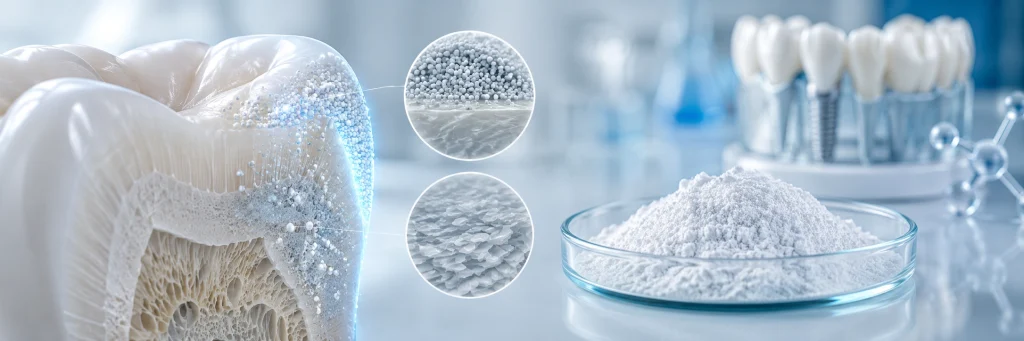
Dental materials may require more precise control of hydroxyapatite morphology than consumer oral care products. Hydroxyapatite can be used in dental composites, polishing materials, dentin desensitizing products, implant coatings and enamel-supporting formulations.
In dental composites, hydroxyapatite morphology may affect filler dispersion, mechanical strength and bonding with the resin matrix. In implant coating materials, morphology and particle structure can influence coating behavior, surface roughness and biological interaction.
For dental material manufacturers, morphology should be evaluated together with:
- Ca/P ratio
- Phase purity
- Crystallinity
- Particle size
- Specific surface area
- Surface chemistry
- Processing method
- Final product requirements
Choosing the wrong morphology may lead to poor dispersion, unstable viscosity or inconsistent product performance.
Hydroxyapatite Morphology in Bone Repair Materials
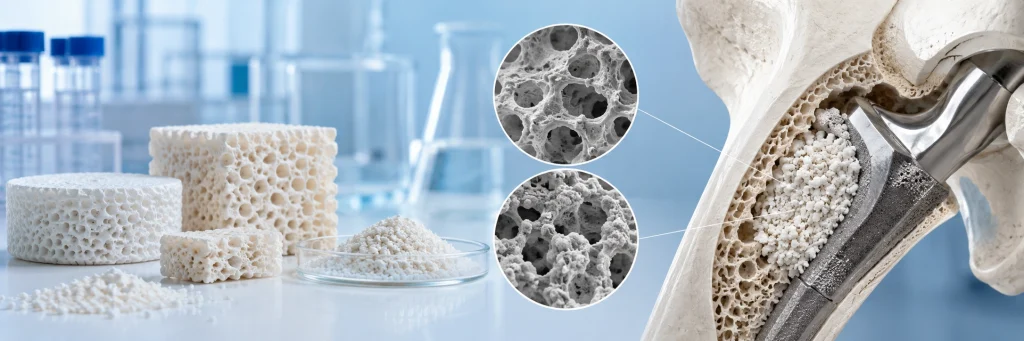
Bone repair materials often require hydroxyapatite with specific structural features. In this field, morphology is directly related to material function.
For example, porous hydroxyapatite granules or scaffolds may be selected when the goal is bone ingrowth and tissue integration. Nano hydroxyapatite may be used in composite scaffolds to improve biological similarity and surface activity. Rod-like or needle-like hydroxyapatite may be used in polymer composites for reinforcement and biomimetic design.
Common bone repair applications include:
- Bone graft substitute materials
- Bone void fillers
- Porous bioceramic scaffolds
- Hydroxyapatite-polymer composites
- Hydroxyapatite-collagen composites
- Hydroxyapatite/β-TCP systems
- Implant coating materials
In these applications, morphology should be selected according to the final material design. A powder suitable for toothpaste may not be suitable for a bone scaffold. A porous granule suitable for bone repair may not be suitable for a smooth oral care suspension.
How Synthesis Method Affects Hydroxyapatite Morphology
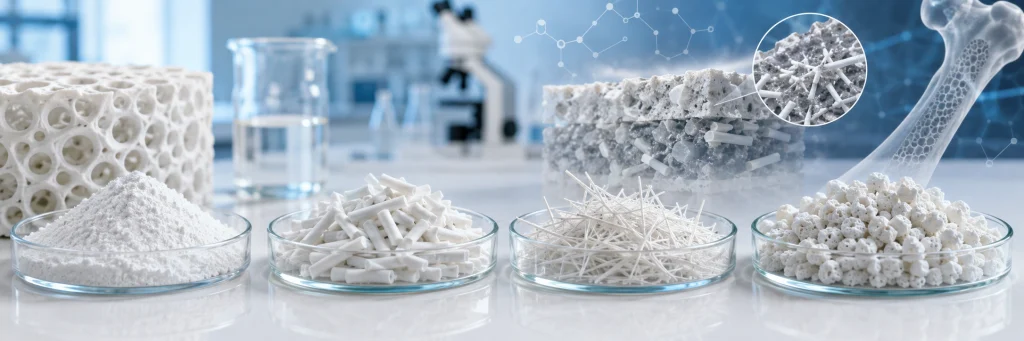
Hydroxyapatite morphology is strongly influenced by production method. Common synthesis approaches include wet precipitation, hydrothermal synthesis, sol-gel methods and solid-state reactions.
Wet Precipitation
Wet precipitation is widely used for hydroxyapatite powder production. It can produce fine particles and nano-scale hydroxyapatite, but the final morphology depends on reaction pH, temperature, concentration, stirring speed and aging time.
This method is often suitable for producing powders used in oral care, dental materials and general biomaterial development.
Hydrothermal Synthesis
Hydrothermal synthesis can help control crystal growth and morphology. It is often used when manufacturers need rod-shaped, needle-like or plate-like hydroxyapatite particles.
This method may produce higher crystallinity and more defined crystal structures, depending on the process.
Sol-Gel Method
Sol-gel synthesis can create fine and homogeneous hydroxyapatite particles. It may be useful when high purity and uniform distribution are required.
However, process control is important to avoid unwanted agglomeration or incomplete conversion.
High-Temperature Processing
High-temperature treatment may improve crystallinity and phase stability, but it may also increase particle growth and aggregation. For some applications, high crystallinity is useful. For others, excessive particle growth may reduce dispersibility.

How to Evaluate Hydroxyapatite Particle Morphology
Professional buyers should not rely only on product descriptions such as “nano hydroxyapatite” or “high purity hydroxyapatite.” Morphology should be verified with proper testing.
Common evaluation methods include:
SEM Analysis
Scanning electron microscopy is one of the most useful methods for observing hydroxyapatite morphology. SEM images can show whether particles are spherical, rod-like, needle-like, porous or aggregated.
TEM Analysis
Transmission electron microscopy is useful for nano hydroxyapatite because it can show particle shape and structure at a smaller scale.
Particle Size Distribution
Particle size data helps buyers understand whether the powder is nano, micro or broadly distributed. However, particle size alone cannot fully describe morphology.
Specific Surface Area
Surface area data can help indicate the degree of fineness, porosity and surface activity. A higher surface area may improve interaction but may also affect dispersion and stability.
XRD and FTIR
XRD and FTIR do not directly show particle shape, but they help confirm phase composition and chemical structure. These tests should be used together with morphology analysis.
How to Choose the Right Hydroxyapatite Morphology
The best morphology depends on application. Buyers should first define the final product type and performance goals.
For Toothpaste and Oral Care
Choose hydroxyapatite with:
- Fine particle size
- Good dispersibility
- Low grittiness
- Stable suspension behavior
- Suitable morphology for smooth texture
- Consistent batch quality
For Mouthwash and Liquid Systems
Choose hydroxyapatite with:
- Good dispersion stability
- Low sedimentation tendency
- Controlled particle size
- Surface properties compatible with liquid systems
- Minimal aggregation
For Dental Materials
Choose hydroxyapatite with:
- Controlled morphology
- Reliable phase purity
- Suitable particle size distribution
- Good matrix compatibility
- Stable processing behavior
- Technical documentation
For Bone Repair Materials
Choose hydroxyapatite with:
- Application-matched morphology
- Porous or scaffold-friendly structure when needed
- Suitable crystallinity
- Controlled Ca/P ratio
- Reliable biocompatibility-related data
- Appropriate purity and heavy metal limits
For Composite Materials
Choose hydroxyapatite with:
- Good dispersion in the matrix
- Suitable surface area
- Morphology that supports mechanical goals
- Stable particle-matrix interaction
- Consistent batch-to-batch quality
Common Buyer Mistakes
Mistake 1: Only Comparing Particle Size
Particle size is important, but it does not fully describe hydroxyapatite performance. Two powders may both be 60 nm, but one may be spherical and well-dispersed while another may be needle-like and highly aggregated.
Mistake 2: Assuming Nano Is Always Better
Nano hydroxyapatite can be useful in many applications, but smaller is not always better. Nano powders may be harder to disperse and may require stronger formulation control.
Mistake 3: Ignoring Aggregation
Many hydroxyapatite powders form aggregates. The primary particle size may be small, but the actual dispersed particle size in a formulation may be much larger. Buyers should evaluate both powder morphology and dispersion behavior.
Mistake 4: Using One Grade for All Applications
A hydroxyapatite grade designed for toothpaste may not be suitable for implant coatings or bone repair scaffolds. Application-matched selection is essential.
Mistake 5: Not Asking for SEM Images
For technical applications, SEM images are highly useful. They help buyers visually confirm particle morphology and aggregation state.
What Specifications Should Buyers Request?
When sourcing hydroxyapatite powder, buyers should request a complete technical package, including:
- Certificate of Analysis
- Technical Data Sheet
- Safety Data Sheet
- SEM or morphology images
- Particle size distribution
- Ca/P ratio
- Phase purity
- Crystallinity
- Specific surface area
- Heavy metal limits
- Microbial limits, if applicable
- Recommended application and storage conditions
For advanced dental and biomedical materials, buyers may also need additional testing based on the final product and regulatory requirements.
Why Work with a Professional Hydroxyapatite Supplier?
Hydroxyapatite morphology is not just a visual feature. It is part of raw material design and quality control.
A professional hydroxyapatite supplier can help customers select the right grade based on:
- Target application
- Particle morphology
- Particle size
- Ca/P ratio
- Purity level
- Dispersion requirements
- Processing method
- Documentation needs
- Sample testing and scale-up plan
This support is especially important for companies developing oral care products, dental materials, bone repair materials, implant coatings or biomaterial composites.
Conclusion
Hydroxyapatite particle morphology plays an important role in material performance. Shape can affect dispersion, flowability, rheology, surface interaction, mechanical behavior and formulation stability.
For oral care products, morphology influences texture and dispersion. For dental materials, it affects matrix compatibility and processing. For bone repair materials, it can influence scaffold structure, porosity and biological interaction. For composites, morphology may affect reinforcement and material uniformity.
When selecting hydroxyapatite powder, buyers should not only check particle size and purity. They should also evaluate morphology, aggregation, phase composition, Ca/P ratio and supplier documentation.
The right hydroxyapatite morphology can help manufacturers build better products with more stable performance, stronger technical positioning and more reliable quality control.
FAQ
What is hydroxyapatite particle morphology?
Hydroxyapatite particle morphology refers to the shape and surface structure of hydroxyapatite particles, such as spherical, rod-like, needle-like, plate-like, porous or irregular forms.
Why does hydroxyapatite morphology matter?
Morphology affects dispersion, flowability, rheology, surface interaction, composite performance and processing behavior.
Is spherical hydroxyapatite better than needle-like hydroxyapatite?
Not always. Spherical particles may offer better flow and dispersion, while needle-like or rod-shaped particles may provide stronger surface interaction or reinforcement in some composites. The best choice depends on the application.
What morphology is suitable for toothpaste?
For toothpaste, hydroxyapatite should have good dispersibility, low grittiness and stable formulation behavior. Fine and well-dispersed particles are usually preferred.
What morphology is suitable for bone repair materials?
For bone repair materials, porous structures, granules, scaffolds or morphology designed for tissue interaction may be useful, depending on the final product design.
How can buyers check hydroxyapatite morphology?
Buyers can request SEM images, TEM data, particle size distribution, specific surface area and technical documentation from the supplier.
Is particle size the same as morphology?
No. Particle size describes how large the particles are, while morphology describes their shape and structure. Both should be evaluated together.







Please leave us a message.