

SOD Raw Material COA: What Cosmetic Brands Should Check Before Purchasing
2026-06-26
Introduction: Why SOD Raw Material COA Matters
For cosmetic brands, formulators, and ingredient distributors, choosing a reliable SOD raw material supplier is not only about price. Quality documentation is just as important. One of the most important documents buyers should request before purchasing Superoxide Dismutase is the SOD raw material COA, also known as the Certificate of Analysis.
A COA helps buyers understand whether a specific batch of SOD raw material meets the agreed quality specifications. It usually includes key information such as product name, batch number, test items, test results, testing methods, manufacturing date, expiry date, and storage conditions.
For cosmetic applications, SOD is often used in antioxidant-focused skincare formulas, including serums, creams, masks, lotions, and scalp care products. Because SOD is an enzyme-based active ingredient, its activity, stability, and storage condition are especially important. A clear and complete COA can help brands reduce quality risks and make better purchasing decisions.
What Is SOD Raw Material?
SOD stands for Superoxide Dismutase. It is an antioxidant enzyme that helps convert superoxide radicals into less reactive molecules. In cosmetic formulations, SOD is commonly positioned as a premium antioxidant ingredient for skincare, personal care, and scalp care products.
Depending on the production process and supplier, SOD raw material may be available in different forms, such as:
- SOD powder
- Cosmetic grade SOD
- Recombinant Superoxide Dismutase
- SOD solution
- SOD ingredient blends
- SOD encapsulated or stabilized forms
For B2B buyers, it is important to confirm the exact grade, source, activity, carrier system, and recommended application before placing a bulk order.
What Is an SOD Raw Material COA?
An SOD raw material COA is a batch-specific quality document provided by the manufacturer or supplier. It shows the test results of a particular batch of SOD raw material and compares those results with the product specifications.
A professional SOD Certificate of Analysis should not be a simple product description. It should provide measurable quality information. For example, instead of only saying “high activity,” the COA should list the actual enzyme activity value and testing method.
A complete COA helps buyers answer several key questions:
- Is this batch consistent with the supplier’s specification?
- What is the SOD activity level?
- Is the product suitable for cosmetic formulation?
- Are microbial limits controlled?
- Are heavy metals within acceptable limits?
- Is the batch traceable?
- What are the recommended storage conditions?
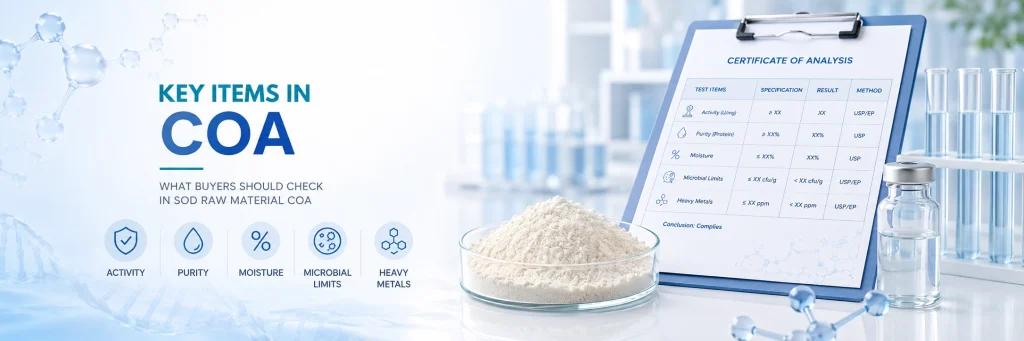
Key Items to Check in an SOD Raw Material COA
When reviewing an SOD raw material COA, buyers should pay attention to the following sections.
1. Product Name and Grade
The COA should clearly state the product name, such as Superoxide Dismutase, SOD Powder, or Cosmetic Grade SOD. If the product is intended for cosmetic use, the grade should be clearly identified.
Buyers should make sure the COA matches the product they are purchasing. If the supplier offers different grades, such as cosmetic grade, food grade, or research grade, the document should not be mixed or unclear.
2. Batch Number and Traceability
A reliable SOD raw material COA should include a batch number or lot number. This is important for traceability. If there is a quality issue later, the batch number helps both the buyer and supplier identify the production record, test data, and shipping information.
For brands that manufacture finished cosmetic products, batch traceability is also important for internal quality control.
3. Appearance
Appearance is usually a basic test item. SOD raw material may appear as a powder or solution, depending on the product type. For powder products, the COA may describe the appearance as white, off-white, or light-colored powder.
Although appearance alone cannot prove quality, it helps buyers check whether the material has obvious abnormalities, such as discoloration, caking, contamination, or moisture-related changes.
4. SOD Activity
SOD activity is one of the most important parameters in an SOD raw material COA. Since SOD is an enzyme, activity is directly related to its functional value in formulation.
A professional COA should list:
- Activity result
- Unit of measurement
- Testing method
- Specification range
For example, a COA may show SOD activity in U/g or another applicable unit. Buyers should compare the activity result with the supplier’s claimed specification and with their own formulation requirements.
If a supplier only provides vague descriptions such as “high activity” without test data, buyers should request more detailed documentation.
5. Purity or Protein Content
Depending on the production process, the COA may include purity, protein content, or assay information. This helps buyers understand the concentration and consistency of the active material.
For cosmetic brands, stable quality between batches is often more important than choosing the highest number on paper. A good supplier should be able to provide consistent SOD raw material quality over repeated orders.
6. Moisture Content
Moisture is especially important for powder ingredients. High moisture content may affect storage stability, flowability, and shelf life. It can also increase the risk of caking or microbial growth.
When reviewing the COA, buyers should check whether the moisture result is within the specified range. For enzyme-based raw materials, proper moisture control is part of quality stability.
7. pH Value
If the SOD raw material is supplied as a solution or if the powder is tested in solution, pH may be listed on the COA. pH is important because enzyme activity and formulation compatibility can be affected by pH conditions.
Formulators should check whether the SOD raw material is suitable for the target formula system, especially for serums, creams, lotions, and scalp care products.
8. Microbial Limits
For cosmetic raw materials, microbial control is essential. A professional SOD raw material COA may include microbial test items such as:
- Total plate count
- Yeast and mold
- Escherichia coli
- Staphylococcus aureus
- Pseudomonas aeruginosa
- Salmonella, if applicable
The exact microbial test items may vary depending on the supplier, market, and product grade. Buyers should confirm whether the microbial limits meet their internal quality requirements and target market standards.
9. Heavy Metals
Heavy metal testing is another important part of raw material quality control. A COA may include items such as lead, arsenic, mercury, and cadmium.
For cosmetic ingredient buyers, heavy metal control is important for product safety, brand compliance, and customer trust. If heavy metal data is not listed on the COA, buyers can ask the supplier whether third-party testing is available.
10. Storage Conditions and Shelf Life
SOD is an enzyme-based ingredient, so storage conditions are very important. The COA or product specification should clearly state recommended storage conditions, such as temperature, light protection, moisture protection, and sealed packaging.
Buyers should also check:
- Manufacturing date
- Retest date
- Expiry date
- Shelf life
- Storage temperature
- Packaging condition
If SOD raw material is not stored properly, its activity may decrease over time. For this reason, brands should follow the supplier’s storage instructions after receiving the goods.
How to Read an SOD Certificate of Analysis Before Buying
Before purchasing SOD raw material in bulk, buyers should not only check whether a COA exists. They should also check whether the document is complete, clear, and batch-specific.
Here is a simple checklist:
- Does the COA show the exact product name?
- Does it include a batch number?
- Are the test results clearly listed?
- Is SOD activity included?
- Are microbial limits included?
- Are heavy metals tested?
- Are the testing methods shown?
- Is the document signed or approved by quality control?
- Does the COA match the sample or batch being shipped?
- Can the supplier provide MSDS and TDS together with the COA?
A reliable SOD raw material supplier should be able to provide not only COA, but also supporting documents such as MSDS, TDS, specification sheet, allergen statement, non-GMO statement, or other documents based on buyer requirements.
Why COA Is Important for Cosmetic Formulators
For cosmetic formulators, the COA is not just a purchasing document. It supports the whole product development process.
A detailed SOD raw material COA can help formulators:
- Confirm ingredient identity
- Compare different suppliers
- Check batch consistency
- Evaluate formulation suitability
- Support internal quality review
- Reduce raw material risks
- Prepare product documentation
When developing antioxidant skincare products, SOD may be used together with other ingredients such as peptides, hyaluronic acid, niacinamide, plant extracts, ceramides, or other antioxidant systems. In these formulas, ingredient quality and stability are important for final product performance.
Formulation Tips for SOD Raw Material
Because SOD is an active enzyme ingredient, formulators should pay attention to processing conditions. The recommended use level, pH range, temperature, and addition stage should be confirmed with the supplier before production.
General formulation considerations include:
- Avoid high processing temperature unless the supplier confirms heat stability
- Add SOD during the cooling phase when needed
- Avoid extreme pH conditions
- Protect from long-term light and moisture exposure
- Confirm compatibility with preservatives, surfactants, and active ingredients
- Conduct stability testing in the final formula
The exact formulation method depends on the type of SOD raw material and the final cosmetic product format.
How to Choose a Reliable SOD Raw Material Supplier
A good SOD raw material supplier should provide stable product quality, clear documentation, and technical support. When comparing suppliers, buyers should not only ask for the lowest price. They should also evaluate quality control capability and communication efficiency.
Important supplier factors include:
- Batch-specific COA available
- SOD activity clearly tested
- MSDS and TDS support
- Stable production capacity
- Custom packaging options
- Sample support
- Export experience
- Fast response for documentation
- Clear storage and transportation guidance
- Ability to support cosmetic formulation needs
For international buyers, communication and documentation quality are especially important. A supplier that can quickly provide COA, MSDS, TDS, and product specifications will help reduce purchasing delays.
Common Questions About SOD Raw Material COA
What does COA mean for SOD raw material?
COA means Certificate of Analysis. For SOD raw material, it is a quality document showing the test results of a specific batch, including activity, appearance, microbial limits, heavy metals, and other quality parameters.
Why is SOD activity important in the COA?
SOD is an enzyme-based ingredient, so activity is one of the most important quality indicators. The activity value helps buyers understand the functional strength and batch consistency of the raw material.
Should every batch have its own COA?
Yes. For B2B purchasing, each batch should have its own COA. A general specification sheet is helpful, but it cannot replace a batch-specific Certificate of Analysis.
What documents should I request besides COA?
Besides COA, buyers can request MSDS, TDS, product specification, ingredient source information, storage guidance, and other compliance documents depending on the market and application.
Is SOD raw material suitable for cosmetic formulations?
SOD is commonly used in antioxidant-positioned cosmetic formulations. However, the final suitability depends on product grade, activity, stability, formula system, and supplier recommendations.
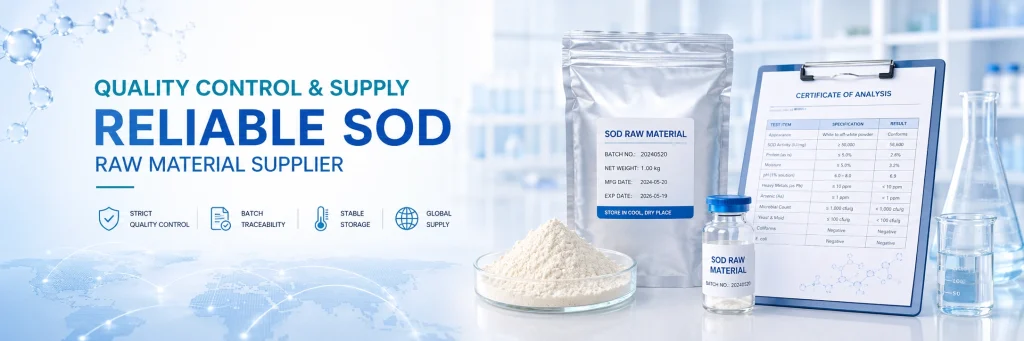
Conclusion: COA Is the First Step in SOD Raw Material Quality Control
When purchasing SOD raw material, the COA is one of the most important documents to review. A complete SOD raw material COA helps buyers verify batch quality, confirm enzyme activity, check microbial and heavy metal limits, and evaluate whether the material is suitable for cosmetic formulation.
For cosmetic brands, formulators, and distributors, choosing a reliable SOD raw material supplier means choosing both product quality and documentation support. Before placing a bulk order, always request a batch-specific COA, compare the test results with your quality requirements, and confirm storage and formulation guidance with the supplier.
If you are looking for cosmetic grade SOD raw material with COA, MSDS, TDS, sample support, and customized packaging, contact our team to request product specifications and batch documentation.





Please leave us a message.