

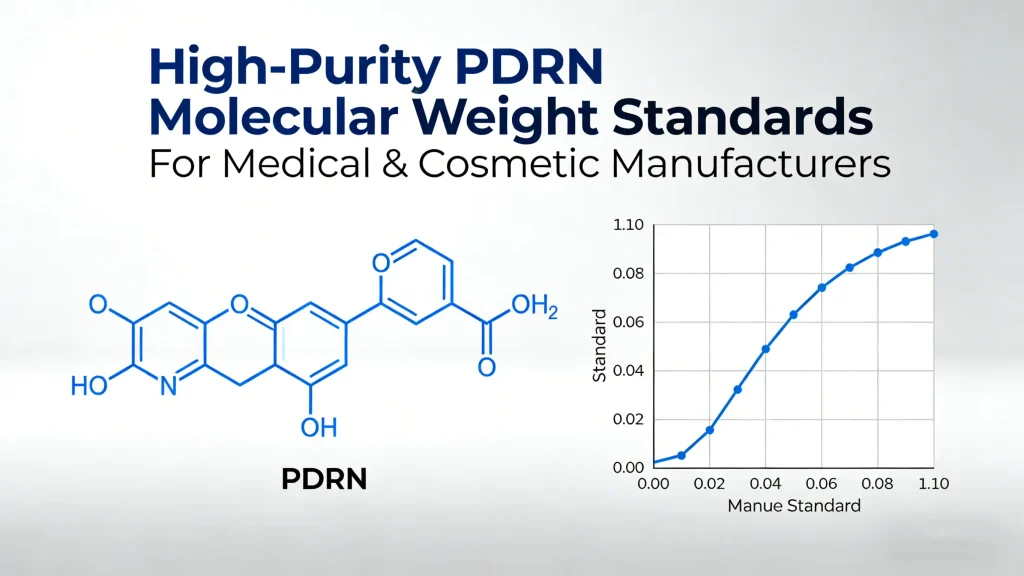
High-Purity PDRN Molecular Weight Standards for Medical & Cosmetic Manufacturers
2026-02-27
Introduction
Polydeoxyribonucleotide (PDRN) is a functional polymer of short DNA fragments increasingly used as an active raw material in wound-repair therapies, injectables and premium skincare formulas. For manufacturers and procurement teams, the single most important technical attribute of PDRN is molecular-weight distribution — the precise sizes and proportions of DNA fragments in a lot directly affect tissue interaction, product stability and regulatory fit. This article presents a supplier-oriented guide to accepted molecular-weight bands for different applications, practical laboratory methods for verification, essential quality controls, and the exact procurement questions procurement and R&D teams should ask before placing a bulk order.
What is PDRN and how fragment size affects performance
PDRN is a purified preparation of short, linear deoxyribonucleotide fragments. Rather than a single molecule, PDRN is a mixture whose bioactivity arises from the relative abundance of different fragment sizes. Fragment length determines how a molecule diffuses through tissue, how long it persists, and which cellular mechanisms it engages — therefore, not all PDRN powders are interchangeable. A supplier that controls fragment distribution and documents it clearly reduces formulation risk for manufacturers.
Recommended molecular-weight ranges by application
The ranges below are practical specifications manufacturers commonly request. Use them as starting points when negotiating product specs or asking for certified samples.
| Application Type | Typical MW Range (kDa) | Why this range |
|---|---|---|
| Injectable / Medical | 200 – 1500 kDa | Sustained activity under tissue; controlled degradation profile |
| Topical / Cosmetic | 60 – 200 kDa | Better skin penetration and low irritation risk |
| Research / Reference Standard | 50 – 1500 kDa (full profile) | Full-spectrum for in-lab comparison and assay calibration |
Note: these bands are target ranges. Buyers should request the actual distribution curve (e.g., histogram or chromatogram) rather than a single “average” value.
How manufacturers verify molecular-weight distribution
Reliable vendors supply orthogonal test data. Common and accepted methods include:
-
Size-exclusion chromatography (SEC / GPC) — primary method to obtain a molecular-weight distribution curve and calculate Mn/Mw and polydispersity (PDI).
-
HPLC with UV detection — used to confirm chemical purity and quantify nucleic acid content.
-
Mass spectrometry (e.g., MALDI-TOF) — useful for resolving peak patterns of smaller oligomers and confirming mass ranges.
-
UV spectrophotometry (A260/A280 ratio) — quick check for nucleic acid purity and protein contamination.
-
Endotoxin (LAL) and sterility testing — critical for injectable grades.
What to request from suppliers: raw chromatograms (GPC traces), Mw and Mn values, PDI, test methods and instrument models, and full batch COA.
Essential quality control & regulatory parameters for medical-grade PDRN
When your product will be used in manufacturing medical or injectable products, insist on these documented controls:
-
COA with MW distribution (GPC chromatogram attached)
-
DNA purity percentage (HPLC result)
-
Endotoxin limit (EU/mg) and LAL test report
-
Sterility test result (for sterile formats)
-
Heavy metals (ICP-MS report for Pb, Hg, As, Cd)
-
Microbial limits (bioburden)
-
Stability data (accelerated and real-time)
-
Production standards (cGMP certificate, facility audit evidence)
-
Traceability (raw material origin, lot numbers and chain of custody)
Suppliers who include method SOPs and instrument calibration records demonstrate higher audit readiness.
Procurement checklist — questions to ask every PDRN supplier
-
What is the exact molecular-weight distribution for the batch (provide GPC chromatogram)?
-
Which analytical methods and instruments were used to measure MW and purity?
-
Can you provide COA, endotoxin report, heavy metals, and stability data for the lot?
-
Is production performed under GMP and is there third-party certification?
-
What is the formulation format (sterile powder, sterile solution) and recommended storage?
-
Do you offer technical support, formulation guidance, and sample testing before purchase?
-
What are your minimum order quantities, lead times, and shipping conditions for bulk lots?
Keep these questions as a script when vetting suppliers — demand documents first, then samples.
Practical tips for manufacturers integrating PDRN
-
Start with a certified sample and run your in-house SEC/HPLC to confirm supplier data.
-
Document acceptance criteria (e.g., acceptable PDI, endotoxin limit) in purchasing contracts.
-
Ask about lot-to-lot variability and request a history of past batch COAs.
-
Consider formulation compatibility (pH, excipients) — fragment stability can be sensitive to formulation conditions.
Call to Action (conversion-focused)
If you need certified, bulk PDRN with complete molecular-weight documentation, request a technical packet and sample today. Our packets include GPC chromatograms, HPLC purity reports, endotoxin and heavy-metal analyses, and GMP certification for injectable grades.
Request sample & COA → [Get a quote / Request sample] (suggested anchor: Request a PDRN sample & COA)
Technical inquiry → [Contact our technical team] (suggested anchor: Speak to a PDRN specialist)
Suggested internal links & anchor texts (for SEO & navigation)
-
Product page: “PDRN product specifications” → anchor text: PDRN product page
-
Quality / Compliance page: “GMP & COA details” → anchor text: GMP & COA
-
Formulation support page: “Formulation and stability guidance” → anchor text: Formulation support
-
Case studies: “Clinical & cosmetic use cases” → anchor text: PDRN case studies
Add these internal links near relevant paragraphs (e.g., after the QC paragraph link to GMP & COA).
FAQ (for page body & JSON-LD FAQ Schema)
Q1: What fragment sizes are best for topical PDRN?
A1: Topical formulations commonly use mid-range fragments (roughly 60–200 kDa) to balance skin penetration and stability.
Q2: How should I verify a supplier’s molecular-weight claim?
A2: Request the GPC/SEC chromatogram and COA; confirm with an independent in-house or contract lab if needed.
Q3: What tests are non-negotiable for injectable PDRN?
A3: Endotoxin (LAL), sterility, heavy metals, and documented GMP production are mandatory for injectable use.
Q4: Can I request custom molecular-weight fractions?
A4: Many manufacturers can fractionate or supply narrower MW bands on request; discuss MOQ and lead time.






Please leave us a message.